
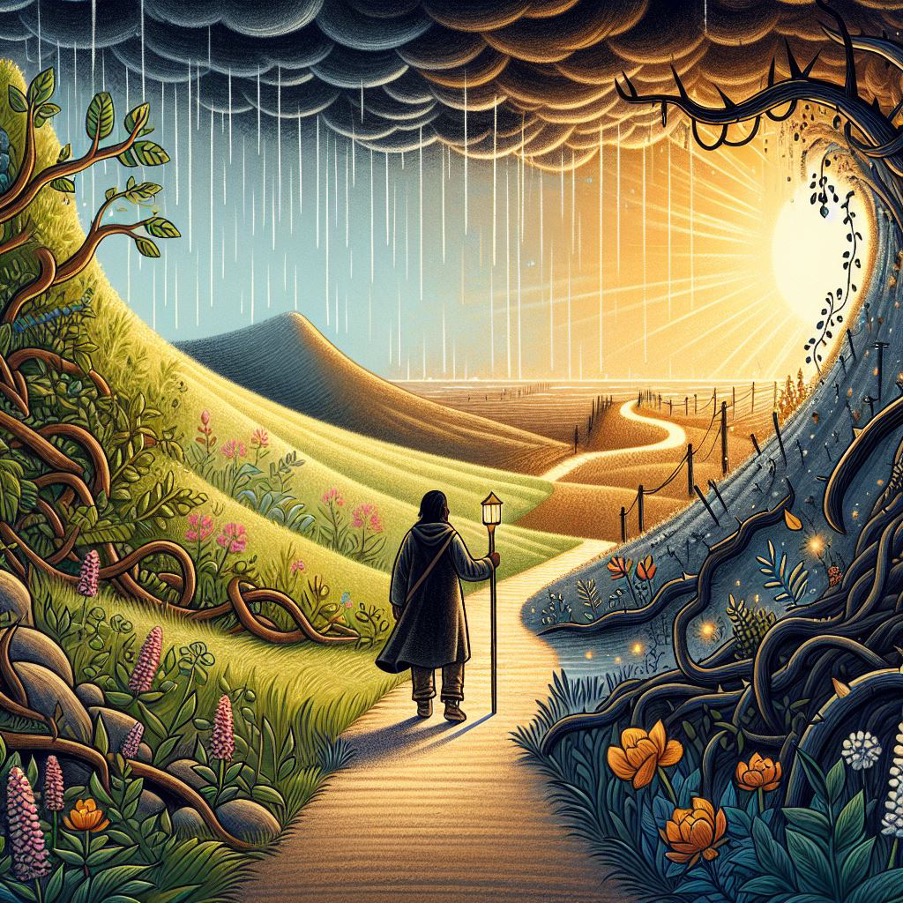
I managed to get an old laptop I had many years ago working recently and I found on it a story by one of my children. The story was entitled ‘Harry the Hare’. It was the beginning of the story, about a hare, who was the odd one out, he was in a school full of lions and tigers, and he felt he had become ‘lunch’ to all the other animals at that school, and his dad had served him up on a plate by moving him to this school. However, the story stopped there, it was only the beginning of his story and when he wrote the beginning of this story, he didn’t know the end or the journey.
This felt to me like the start of an unusual story, a story with challenge, a starting point of the story that you wouldn’t choose, and potentially some overwhelming fear about how it would turn out. At the start of the story, it is hard to think how Harry could have seen life differently. However, my favourite kind of story does exactly that. I love unusual stories, and I have spent many years studying illness master plots. This term refers to recognisable plots of stories that relate to an illness experience. At the onset of the illness, there can be challenge, loss, disruption and what is faced in life can be very overwhelming. Just like Harry the Hare the start of the story could be filled with fear of the unknown. This can be combined with a recognition of loss. Illness stories can focus on the past, remembering what life used to be like. This focus can represent how good life used to be and that the only thing to hope for is having that back again. Whilst some illness plots look back, other master plots can look forward in interesting ways.
My favourite illness narrative plot was shared with me in 2019 by a lady who had a stroke. She told an adventure illness narrative master plot. I have pasted an extract of this plot in her own words to provide a sense of the story. She stated:
“if you think of young children… I remember my children when they were trying to walk they just persisted and persisted. And they didn’t mind falling over because, I suppose, we all said, “Oh, well done,” …[and] I don’t mind [falling over]… it’s kind of an adventure to me…. Well, I have had the advantage of falling over – this is four years before my stroke. I fell over and I smashed my face. I tripped on a paving stone. And I lost my sight totally in the eye….And from that time on it gave me the advantage of looking at life as learning new things….I have had lots of things that I call adventures. Meeting people unexpectedly in the street and being taken for coffee and finding out about them has been really fascinating actually…So it programmed me for when I came out of hospital [after the stroke] I looked at everything as excitement and people are curious about you when you can’t, when you’re fuddling around really.”
It seems to me that this story and the adventure plot she had found previously was one she could draw on and tell again when facing a stroke and it is a story that is highly valued by people who hear it. The start of my most recent story was joining the GSSPP, and at the start of my story, the most frequent expression I told to colleagues, was a feeling of being lost, I didn’t even have the start of plot in my mind, and I wasn’t sure how it would turn out. The feeling of being lost meant that I couldn’t find the direction for my research, but also, I believe it meant I had lost the joy I have always had with my work. I had deliberately changed my story; I didn’t want to look back at what I had done before but couldn’t quite work out how to look forward. The journey with the GSSPP is the start of my story, not the end and now, following this start I have taken a couple of steps towards a new direction I can start to think of it as an adventure.
My reflection on all of this is that when life changes, when you face a challenge, when you begin something new, or start a new story in the present chapter of your life, what may have once seemed or felt the hardest start, could end up as an adventure. Whatever the start has been to your story, it is not necessarily the end. Persistence and courage could help you decide the next chapter of your story. Importantly, if you are feeling lost or overwhelmed by change or challenge a good starting point is to seek out unusual stories and that may provide you with an adventure and the opportunity to find moments of joy.
? Reference: MDPI Review on Nature-Based Interventions – https://www.magonlinelibrary.com/doi/abs/10.12968/ijtr.2021.0131
#MentalHealth #Storytelling #Resilience #IllnessNarratives #AdventurePlot #LinkedInBlog #HopeInStories
? I’d love to hear your story. Have you ever found hope in an unexpected chapter of life? Share your reflections below!
A.A.Soundy@bham.ac.uk