
I am currently on the second day of a small angle neutron scattering experiment at the neutron source at the Helmholtz Zentrum Berlin, using the High Magnetic Field Facility for Neutron Scattering, on the instrument EXED. EXED (EXtreme Environment Diffractometer) is a time-of-flight instrument adapted to the restrictions imposed by the magnet, which can provide a continuous field up to 26 T. It is most commonly used for diffraction experiments, and while my experiment is a diffraction experiment, it is in the ‘small angle’ regime, which means using a slightly different setup to the usual.
I am looking at the diffraction signal from the vortex lattice in a superconductor. Some superconductors are ‘dogmatic’, and expel all magnetic field whenever they are in the superconducting state (Type I), and others are ‘pragmatic’, and allow some magnetic flux to penetrate the material, as flux, or vortex, lines (Type II). These vortex lines are packed in as a function of magnetic field, and typically form a triangular lattice. The spacing between the vortices depends on the magnetic field, but for the magnetic fields that this instrument specialises in, it will be of the order of 100 Å. The neutron beam passing through the sample contains a range of wavelengths from 2.5 to 9.3 Å (somewhat tuneable) and so you can calculate the expected angle using Bragg’s law – hence the use of the term ‘small angle neutron scattering’.
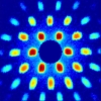
Above is an example of a diffraction pattern from niobium, showing that the vortex lattice is triangular. The spots droop a little, due to the effects of gravity on the neutrons as they travel to the detector.