
In a rare event of sunny and warm British summer, “Ethics & Expertise” project has brought together project team and Advisory Board to review the work done over the last year and set the direction for the next one. Over two days, we presented our emergent findings and ran a workshop with members of Ethox Centre, University of Oxford to explore future research directions on ethics advisory systems across different institutional settings.
Challenging Assumptions
One of the key themes throughout the two days was to challenge conventional assumptions about ethics and advisory systems, particularly about what good ethics advice looks like, who provides it, and how it is embedded in policymaking. The group discussed at length if fragmentation of advisory system is necessarily undesirable. A provocation was raised: perhaps a fragmented ethics advisory ecosystem can exhibit characteristics of pluralism, flexibility, and responsiveness, which may be beneficial in crisis contexts?
After presenting typologies of ethics-policy advisory ecosystems that we developed while analysing the data, a discussion ensued about perfect typology types. Australia’s ethics infrastructure, for instance, can be described as dispersed rather than implicitly embedded, a descriptor that can work better for the UK context. It was evident that the typology of ethics advisory systems needs more empirical nuance, a greater context sensitivity, and a recognition of national differences.
The team also presented institutional maps of ethics advisory systems across the three national contexts. Questions were raised about how institutions were selected, and which actors or bodies might be missing from the current data. We are excited to share the evolving work on these maps more widely in our future publications. We provided some early research insights on our case studies of One Health/Planetary Health and results of a digital data sprint from our case on AI ethics in healthcare. The latter case has already become a significant matter of debate since the UK government’s recent publication of the NHS 10 year plan, which as this article in the BMJ points out, is heavily reliant on digital solutions.
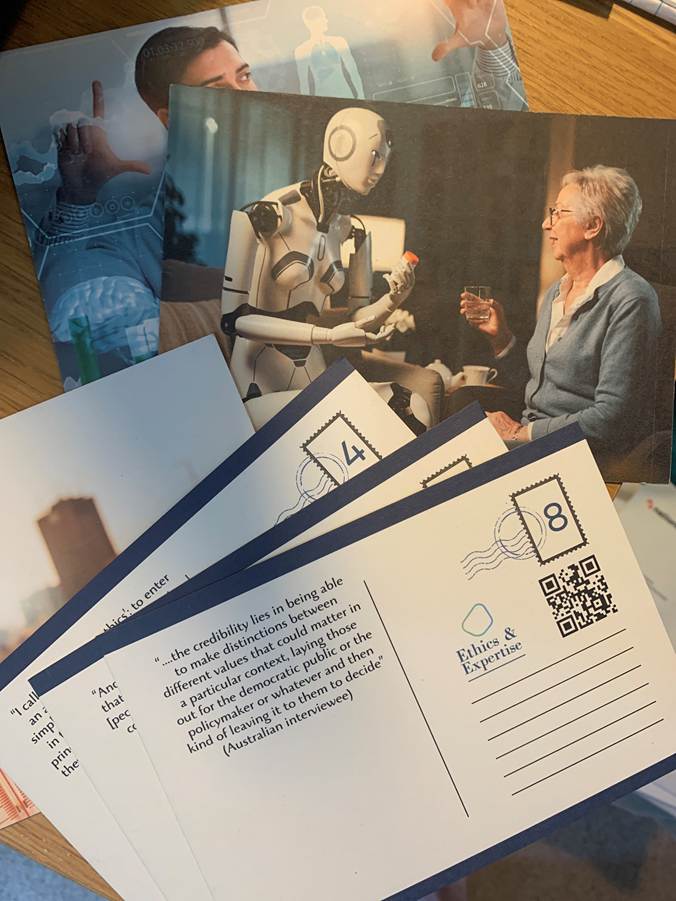
Multiple Faces of Ethics
Several board members highlighted the risk of collapsing ethics into narrow discussions of harm or injustice – important though those are – without recognising the broader role of ethics knowledge and skills in policymaking. There is a risk of treating ethics as a technical box-ticking exercise without challenging pre-conceived assumptions, clarifying values, and creating space for reflection and deliberation.
This complexity of ethics was further echoed in the discussion on the evolving function of ethics advisory bodies. While it is difficult to identify impact of ethics advice (what counts as good ethics advice), its purpose is more complex than making providing a clear-cut decision: ethics advice can detangle complexity, create visibility of diverse perspectives, and encourage institutional reflexivity. In other words, ethics advice can enrich decision-making in the civil service rather than replace it.
Success Criteria: what a good ethics advisory system looks like?
The team presented evolving evaluative framework of ethics advisory ecosystems. Some members of the advisory board were concerned that framing ethics advice as a preventive tool against unethical policy was too narrow. Instead, it should aim to prevent unreflected policy through making room for normative, and plural deliberation. There were concerns about ethics washing and symbolic advisory practices – especially when ethics bodies are tasked with “managing” controversial issues without actual avenues for impact or influence.
From Ideal Types to Adaptive Systems
Day two expanded the conversation through seminar presentations from scholars and practitioners including Prof John Coggon, Prof Jimoh Amzat, Prof Patricia Kingori, Danielle Hamm, and Dr Federica Lucivero. We were reminded that advisory systems are often emergent rather than designed. Prof Coggon’s metaphor of “fitting a cloud into a balloon” captured the challenge of forcing diverse, context-specific advisory practices into a tidy idealised model.
Instead of aiming for universal design, several speakers raised the issue that developing universal models can ignore the specific and diverse policy context across countries in the Global South. There seems to be a need for advisory systems and models that can accommodate temporary closures and foster openness. Ethics, particularly in the context of AI, planetary health, and global health emergencies, must be responsive to plural and shifting values. The foundations of these values need to be transparent and open to challenge whilst also providing a basis for judgment and application.
A Way Forward
The research done by the E&E project sits in a complex terrain between aspiration to have effective advisory systems and institutional reality. Our annual meeting affirmed the need to deepen our understanding of how ethics operates in practice – as tools, processes, and relationships.
As one participant put it, successful ethics advice might not always be about having visible impact but about reshaping how problems are framed in the first place. That is harder to measure, but arguably more meaningful.
The path ahead involves refining our evaluative tools and analytical frameworks, and building capacity for reflexivity across the public sector.