

Global communications past and present
This event invites you to present a short flash paper or research poster introducing any text, image, object or quote related to global communications over the past 200 years. We’d like to hear how your selection reflects global or local networks and how you might use this example in your own research or teaching. All interested participants are warmly invited to this workshop, from any department or career stage. Lunch and refreshments will be provided.
When and Where
- 1pm-3pm, Monday 14th April 2025
- Hybrid: Alan Walters G11, Zoom
Workshop format and topics
We aim to share insights across disciplines and learn from others’ approaches to global communications in an informal and low-preparation way. Talks can be 5-15 minutes long, and we’ll have time for group discussion of emerging themes, questions and connections. There is no limit to topics: examples might include historical moments or objects, quotes from literature, theory, or criticism, or responses in different forms of creative media.
This is part of a project to build an online research gallery showcasing cross-disciplinary and transhistorical approaches to global communications in the College of Arts and Law and beyond.
How to join
If you’re interested in speaking and/or attending, please email Dorothy Butchard (d.butchard@bham.ac.uk) and Chris Mourant (c.mourant@bham.ac.uk) to register interest.
If you can’t make this date but would like to present at the next ‘Around the World’ workshop, please email to let us know your availability in w/c 9th June 2025.
For example…
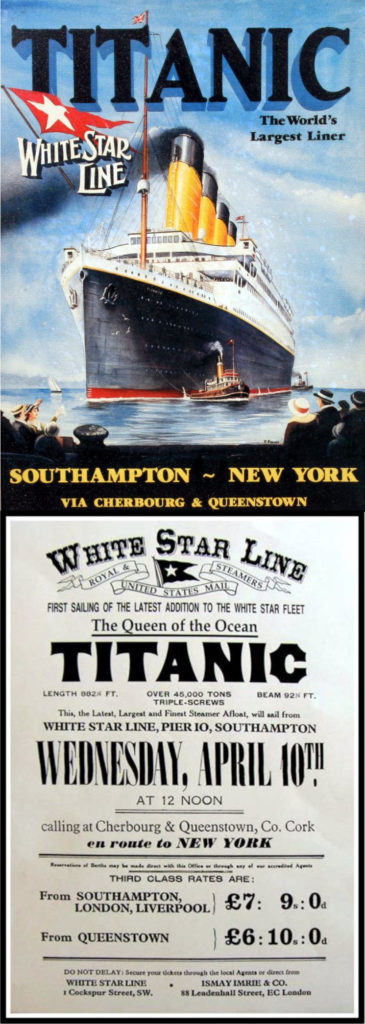
On this day, 1912
We will meet on the afternoon of 14 April, the same day the Titanic hit a fateful iceberg in 1912. Marketed as “the latest, largest, and finest steamer afloat,” the Titanic is both a case study in commercial ambitions for more effective and luxurious modes of long-distance transportation, and a reminder of the unpredictability of untested innovations. It is also a story of cutting-edge communications technologies: the recently developed Marconi wireless telegraph, first proven for transatlantic contact just over a decade earlier in 1901, enabled the ship to call for rescue and has been credited with the survival of over 700 people.
The aftermath of the Titanic draws attention to the promises and hazards of long-distance travel and communications—and the powerful impact of their representation in academic discussion, media, arts, and pop culture.