
James Hall and Sue Jowett provide an update on their ongoing work to adapt health economic methods to support local authorities in understanding the impacts of environmental policymaking. Their research focuses on integrating economic evaluation into decision-making processes, ensuring that environmental policies are also assessed for their broader health and economic implications.


Air pollution and climate – Two of the biggest environmental risks to human health
The impact of environmental factors on public health is an increasingly urgent area of research, particularly in relation to air pollution and climate change. Poor air quality is generally considered the biggest environmental risk to human health in the UK, being linked to numerous health conditions, including respiratory diseases, cardiovascular problems, cognitive impairment, and even adverse birth outcomes. At the same time, climate change contributes to extreme weather events, rising temperatures, and shifting disease patterns, exacerbating existing health inequalities.
Understanding the economic costs associated with these environmental health risks is essential for effective policymaking. By applying health economics methods, we can better quantify the financial burden of air pollution and climate-related illnesses, as well as the costs and benefits of policies to mitigate these harms. This in turn can help local authorities develop policies that improve both environmental and public health outcomes.
Our research
The introduction of health economic methods into environmental health assessment has been pioneered across a range of different projects, often collaborating closely with colleagues in the School of Geography, Earth and Environmental Sciences, as well as key partners in local authorities, national government, industry and the third sector.
Our partnerships began with the West Midlands Air Quality Improvement Programme (WM-Air), a multi-partner initiative to support the improvement of air quality and health across the West Midlands, funded by the NERC RISE programme. Colleagues in GEES developed new capacity to predict air quality, with our team building the Air Quality Lifecourse Assessment Tool (AQ-LAT) to utilise the environmental predictive capacity to subsequently estimate health and economic impacts of potential policy measures. The work has helped shift the air pollution health focus on to the problem of particulate matter pollution, as is evident in the 2023 WMCA Air Quality Framework.
We use our research to inform policymaking in the region, to educate policymakers and about the harms of air quality, as well as the inequities in the health-related burden. We have produced a series of briefing notes and reports for local policy makers, such as the Health Impacts of air Pollution briefing note for Birmingham, and have developed geographic information systems approaches to displaying our findings, such as our map of attributable mortality in the WMCA
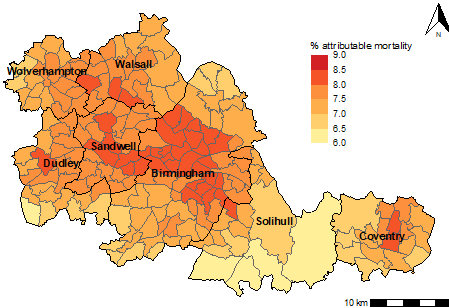
Percentage of early deaths attributable to air pollution at ward level in the WMCA (2019)
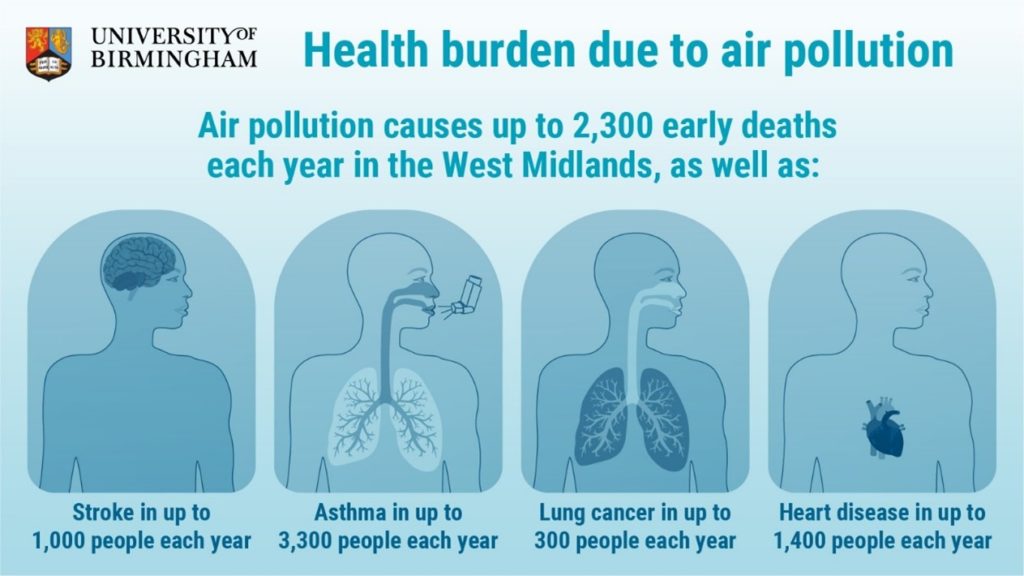
We also try to use our research to educate the public about the potential harms of poor air quality, see an example of our public infographics below,
What’s next?
Building on WM-Air, we are currently working on adapting the AQ-LAT for broader environmental exposures than simply air pollution, such as physical activity and noise pollution. Working collaboratively with 14 regional and national partners, the WM-Net Zero project, funded by the Wellcome Trust, will produce the CLIMATE-LAT toolkit. This will estimate the health and economic impacts of Net Zero policies to help improve policy design, to maximize co-benefits on air quality and health and minimize potential unintended consequences.
Funding has also been secured from NERC to adapt the CLIMATE-LAT to include pluvial flooding and the urban heat island effect as environmental risk factors. Recognising that climate change has already arrived and our social and economic systems are nowhere near adapted for it, the West Midlands Adapt (WM Adapt) project seeks to drive a step change in local adaptation delivery. Working in close collaboration with partners at the WMCA, the CLIMATE-LAT ADAPT will provide policymakers with improved understanding of overheating and flooding risks, as well as health and economic impacts and future costs and benefits associated with various adaptation pathways.
Finally, the UKRI/NIHR funded INHABIT research hub will conduct research into the impact of transition to Net Zero housing on indoor environments and will also create practical, scalable solutions. The AQ-LAT will be adapted to estimate health and economic impacts of changes in indoor air quality. The five-year project brings together local, regional, and national authorities, housing associations, businesses, and research organisations.