
Over the summer two University of Birmingham Students undertook a College-funded Collaborative Research Internship with current MBS Director Dr Sarah Kenny. They explored the archives of the YMCA which are housed at the Cadbury Research Library. Here LLM Law, Data and Technology student Nana Ama G. Kutin shares her reflections on what these archives offer historians.
THE YMCA THROUGH HISTORIC ARCHIVES
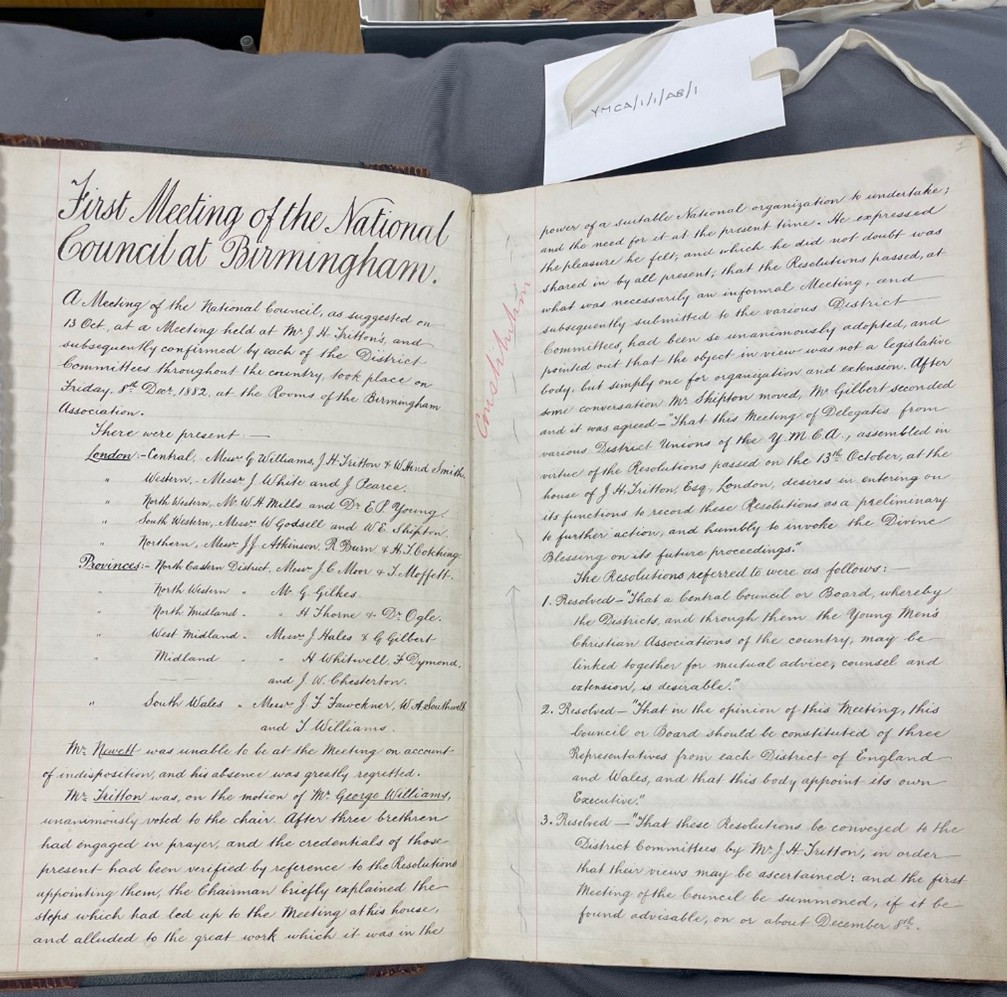
Did you know the first meeting of the National Council of the YMCA was held in Birmingham? Archived minutes for the YMCA, held in the Cadbury Research Library, note that the first official meeting of the newly formed National Council took place in Birmingham on 8 December 1882, and that is when deliberations on the council’s membership took place. It was in this period that the YMCA decided to have a centralised organisation of its operations, to give a better structure to its work across England and Wales and beyond. It is great to point out this Birmingham connection, at a time when the University of Birmingham is celebrating its 125th anniversary, through historic archives.
Throughout the historic archival material available within the Cadbury Library YMCA catalogue, an amazing story can be seen before and after the meeting in Birmingham, resulting in significant impact in youth work that remains relevant even today. Today the core work the YMCA is known for includes housing, family and youth work, health, training and education as well as mentoring young people. The YMCA however started as the Young Men’s Christian Association engrossed in prayer, bible study and evangelising – indeed, in 1879 the organisation, through the operation of its Christian Commercial Travellers’ Association noted “that the unalterable basis of this Association be the acceptance of the Holy Scriptures as the authoritative and sufficient communication of the will of GOD to man, and ample faith in Christ as the ground of salvation.”
It had been agreed on, and passed as a resolution, at a previous meeting in London on 13 October 1882 that the YMCA establishes “a central council [by which its] Districts, and through them the young men’s Christian associations of the country, may be linked together for mutual advice, council and extension […]”. As part of the extension of the work of the YMCA, the organisation in the twentieth century identified a problem of unemployment among youth and this triggered training programmes to help the young girls and boys within the community. For instance, as part of preparing young people for adult life, vocational preparation training was suggested for young people who left school with no qualifications for whatever reason, up until they tuned eighteen. It can be said that it is in identifying needs of the societies in which the YMCA operated, that the work of the organisation expanded and increasingly impacted the wider society.
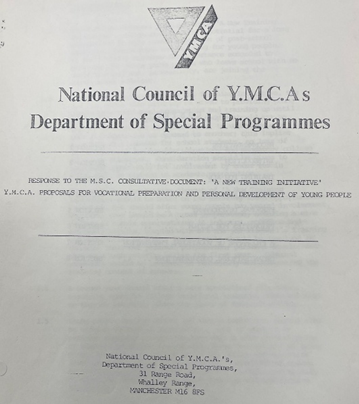
It is fascinating how the archives reveal how a Christian association, established in the nineteenth century, has today grown and contributed to the training of young people in a variety of different social, economic, and political contexts.
Nana Ama G. Kutin is a Masters of Law (Law, Data and Technology) student who participated in the interdisciplinary Collaborative Research Institute of the College of Arts and Law and her interest was in the humanitarian, voluntary and youth work of the YMCA
You can find out more about the YMCA collections here.