
The briefing paper Safety for Ukrainians and the Risks of Return has been produced by the University of Birmingham’s “Support for Displaced Ukrainians” team for use in the campaign advocating for safety for Ukrainians displaced to the UK by Russia’s full-scale invasion. The evidence presented here is drawn from our major survey of displaced Ukrainians in the UK, which was launched in September 2025 and gathered almost 3000 responses. The policy report based on this survey, Displaced Ukrainians in the UK – Experiences and Future Intentions – Support for Displaced Ukrainians, demonstrated that only 5% of displaced Ukrainians in the UK say they would return to Ukraine when the war ends. The evidence presented here is intended to inform discussions about the need for a clear route to permanent residency for Ukrainians in the UK, ensuring they can make genuine choices about if and when they return, and how both the UK and Ukrainian governments can support these decisions.
It highlights the key safety concerns expressed by displaced Ukrainians regarding the prospect of returning to Ukraine once the war ends. We have separated those concerns into six sections: 1) no trust in peace deal; 2) fear of violence; 3) challenges of reintegration; 4) reintegration of children and young people; 5) polarised societies; 6) mental health and wellbeing.
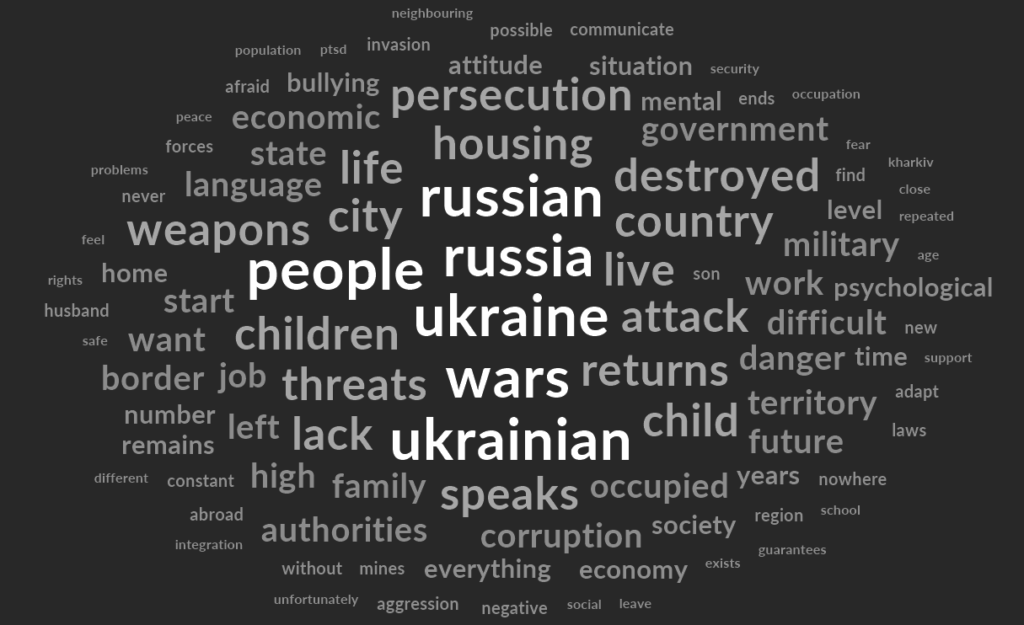
The image below shows the most commonly used words in the survey responses:
The full report shows the range of safety concerns and how they are connected: the quotations below from our research survey give a glimpse into the challenges displaced Ukrainians anticipate facing:
No trust in the peace deal: “If the ‘peace deal’ is signed on the terms that the Russian Federation has drawn up, then most likely the Russian Federation will attack again after a certain period of time.”
Fear of violence: “Even in the western regions that are not on the front lines, returning to Ukraine is fraught with danger. Widespread lawlessness, a large number of weapons among the population, and psychological trauma in the military after the front lead to unpredictable aggression and cases of violence”.
Challenges of Reintegration: “I won’t receive a pension because I was on leave to care for 3 children and didn’t work for a long time; I won’t be able to pay utilities and therefore there will be a risk of dying from the cold or hunger.”
“We have been forced to move several times since 2014 and the occupation of our hometown. We no longer have the strength to change our place of residence and start all over again “.
Reintegration of children and young people: “My child integrated here, it was a very difficult path for her, she passed her GCSEs perfectly and sees her future already here. Returning is simply breaking her to the roots.”
Polarised Societies: “I feel condemned that I left. And it is difficult for me to communicate psychologically with my colleagues in Ukraine, because over the years we have gone through different experiences.”
Mental Health and Well-Being: “Emotional stress. I was in Ukraine twice after the start of the full-scale invasion, went to my mother. Each time I returned with panic attacks and a depressive state. Everything there reminds me of my brother and husband who were killed by russia.”
Download the paper in full (PDF, 465KB): Safety for Ukrainians and the Risks of Return
Download the paper in full (DOCX, 361KB): Safety for Ukrainians and the Risks of Return