
In the heart of Nizhny Novgorod, young Mily Balakirev cherished a quiet corner adorned with sacred icons, gifts that nourished his early spiritual life. Alongside his family, Balakirev regularly attended church, embedding a deep sense of tradition from a young age. However, his years at the all-male gymnasium revealed another side to him—known for his pranks and sharp wit among peers.
Balakirev’s musical inclinations emerged early, particularly with the piano. His mother, recognising his absolute pitch and prodigious musical memory, initially guided his lessons. Her son’s rapid advancement soon led her to seek further instruction under Alexander Dubuque in Moscow, where Balakirev swiftly mastered foundational piano techniques [1]. Despite his skill, he never aspired to the virtuoso’s life, aware of the aristocracy’s disdain for professional musicians, whom they viewed as mere jesters.

The sudden death of his mother profoundly impacted the adolescent. He renounced God but continued his musical studies under Karl Eisrich, where he came to the attention of the music connoisseur and biographer of Mozart, Alexander Ulybyshev [2]. This affluent nobleman took the promising young Balakirev under his wing. He allowed Balakirev to study scores in his extensive library, ordered a fine instrument from abroad, and allowed him to perform as a pianist at musical evenings attended by Nizhny Novgorod’s elite. At the age of 15, Balakirev made his conducting debut, boldly leading a serf orchestra in a successful rendition of Beethoven’s Eighth Symphony.
Balakirev’s father grew concerned about his son’s close relationship with Ulybyshev prompting him to send Balakirev to Kazan University to study mathematics. This academic endeavor was short-lived, lasting only one year. Upon his return to Nizhny Novgorod, Balakirev took pride in supporting himself through piano teaching, claiming his income exceeded that of a typical government official [3].
Balakirev returned to Ulybyshev, and together they traveled to St. Petersburg. There, the young 19-year-old musician was introduced to Anton Rubinstein, Alexander Dargomyzhsky, and most importantly, Mikhail Glinka. On February 12, 1856, Balakirev made his public debut in the St. Petersburg University hall, brilliantly performing his own composition, Concert Allegro in F-sharp minor with the orchestra. This piece, however, was considered unfinished by the composer throughout his life, hidden away and never performed again.
It is unclear how close Glinka and Balakirev became, but their interaction marked a turning point in Balakirev’s life. He composed a fantasy on themes from Glinka’s opera A Life for the Tsar. After Glinka’s death, through Balakirev’s efforts, a memorial plaque was installed on the house in Berlin where the composer had died. Following Glinka’s mysterious death, Balakirev consciously chose to avoid personal relationships and remained close friends with Lyudmila Shestakova until his sister’s death.
During this challenging period, Balakirev met Apollon Gussakovsky, a chemistry student with musical aspirations. Balakirev saw potential in Gussakovsky and mentored him, sharing musical ideas in the styles of Liszt and Schumann, with the hope that Gussakovsky would further develop these into full compositions. Engrossed in his mentorship, Balakirev was unaware that Gussakovsky completed his studies and moved abroad, leading to the natural conclusion of their relationship. They did not have the opportunity to reconnect after this [4].
In the late 1850s, Balakirev organised The Mighty Five, a group radically opposed to official music institutions like the Conservatory and the Imperial Russian Musical Society [3]. He introduced Tchaikovsky, who warmly accepted Balakirev’s suggestion to write the overture Romeo and Juliet and later, at his friend’s insistence, composed the ‘Manfred’ Symphony.
By the late 1860s, all members of The Mighty Five had fallen out with each other. Balakirev struggled with his dismissal as the head of the Russian Musical Society. The betrayal of his closest friends brought him particular anguish, with only Tchaikovsky defending him and calling for his reinstatement. In his symphonic works, he drew inspiration from Liszt and Berlioz, yet his lack of formal education limited his use of their innovations. Invited to conduct concerts for the Russian Musical Society for two seasons, he scandalously refused. In Nizhny Novgorod, Balakirev gave a concert to an almost empty hall. He remained alone.
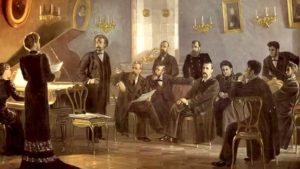
By the age of 33, Mily Alexeyevich Balakirev was considered past his prime as a musician by his contemporaries. During a profound mental crisis, he retreated from the public eye, adopting a lifestyle marked by seclusion. Balakirev made significant personal changes during this time: he quit smoking, became a vegetarian, and restricted his diet to bland fish. His compassion extended beyond his personal health as he established a shelter for cats and dogs, and took a humble position at a goods station on the Warsaw Railway [4].
This period of withdrawal did not last indefinitely. In 1885, Balakirev made a significant return to the musical scene in St. Petersburg, where he assumed the prestigious role of director of the court singing chapel [3]. However, his comeback was overshadowed by controversy. Balakirev expressed strong opinions against the inclusion of the Jewish community in musical education institutions, accusations that were rooted in historical and religious arguments. These views were not well-received and led to widespread criticism and disapproval from his peers, isolating him further within the musical community.
Amidst these professional challenges, Balakirev’s personal life was equally tumultuous. He frequented a fortune-teller on Nikolaevskaya Street, seeking insights into his floundering career and the fortunes of his former colleagues [4]. Despite his efforts to keep these visits secret, the fortune-teller became enamored with him, adding yet another layer of complexity to his already strained existence.
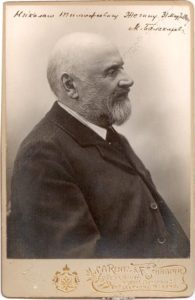
Balakirev’s later years continued to be marked by conflict as he vocally condemned the Russian Revolution of 1905, alienating him from many in his social circle. Contrary to the peaceful and merciful connotations of his name, his actions and attitudes during these years reflected a man in turmoil [1]. His musical career, however, found a final note of completion, albeit posthumously. His last major composition, the Concerto in E-flat major for piano and orchestra, was ultimately completed by his disciple, Sergei Lyapunov, ensuring that Balakirev’s musical legacy would endure beyond his personal controversies [5].
[1] Garden, Edward. 1967. Balakirev: A Critical Study of His Life and Music. London: Faber & Faber.
[2] Norris, Jeremy. 1994. The Russian Piano Concerto Volume I: The Nineteenth Century. Bloomington: Indiana University Press.
[3] Britannica, T. Editors of Encyclopaedia. ‘Mily Balakirev’. Encyclopedia Britannica, January 1, 2025. https://www.britannica.com/biography/Mily-Balakirev.
[4] Lyapunova and E. Yazvitskaya. 1967. Mily Alekseevich Balakirev: Chronicle of Life and Work. Leningrad: Muzyka.
[5] Breheda, Vera. 1984. The Original Solo Piano Works of Mily Balakirev. D.M.A. thesis. Washington: University of Washington.
