
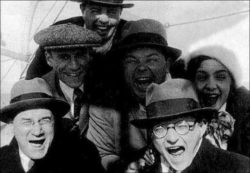
Although football is once again capturing the world’s attention during the latest World Cup, it is easy to forget that some of the sport’s most devoted fans came from a wide variety of professions. One of them was the composer Dmitri Shostakovich. Today, Shostakovich is remembered as one of the greatest composers of the 20th … Continue reading “Why was one of the world’s greatest composers so passionate about football?”
Category: Classical Composers
Mikhail Glinka’s Unrealised Italy
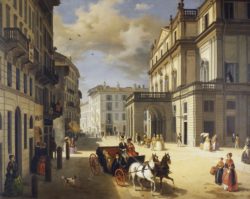
Glinka spent three years in Italy from 1830 to 1833. He arrived in Italy as an accomplished musician. Glinka would always remember the musical evenings held in the salon of the Russian envoy, Vorontsov-Dashkov. Here, the composer met the renowned musical family of the Counts Bellgioioso. His main residence was Milan, the capital of opera … Continue reading “Mikhail Glinka’s Unrealised Italy”
Ballet in Motion: Darius Milhaud’s Le Bœuf sur le Toit and the Cinematic Influence on Modern Dance

For those who regard classical ballet as untouchable and ideal, French composer Darius Milhaud (1892–1974) challenges convention with his bold and eccentric one-act pantomime ballet, Le Bœuf sur le Toit (The Bull on the Roof) [1]. Inspired by his time in Brazil, Milhaud composed this vibrant work in 1919, embracing a playful mix of farce, … Continue reading “Ballet in Motion: Darius Milhaud’s Le Bœuf sur le Toit and the Cinematic Influence on Modern Dance”
Princess Zinaida Volkonskaya’s Romanesque estate: a cultural paradise in 19th-century Europe
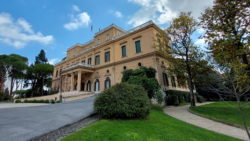
Princess Zinaida Alexandrovna Volkonskaya (1789–1862) is a prominent figure in early 19th-century Russian cultural history, known not only for her talent as a singer and composer but also for her role as a salon hostess and patron of the arts. After many years of active cultural activity in Russia and Europe, Volkonskaya finally settled in … Continue reading “Princess Zinaida Volkonskaya’s Romanesque estate: a cultural paradise in 19th-century Europe”
Rossini in Love: Passion, Voice, and the Art of Bel Canto
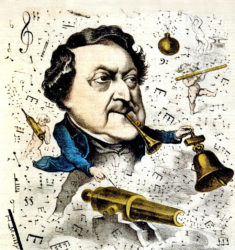
In September 1815, Italy’s most influential impresario, Domenico Barbaja, summoned the young Gioachino Rossini to Naples with a mission: This audience needs to be stunned! There are no subtleties—only No tenderness— only boiling passion. No nuances—sing at full power. And with that command, Barbaja offered a final suggestion: “I recommend Isabella Colbran to you.” There … Continue reading “Rossini in Love: Passion, Voice, and the Art of Bel Canto”
Intimate Space in Classical Music
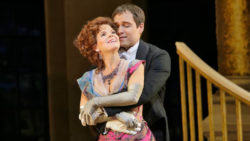
What does it mean for music to be intimate? Is it a matter of small form, quiet volume, or introspective content? Or is it something more elusive — an atmosphere, a feeling of being allowed into someone’s emotional world? Romanticism ushered in a new focus on subjectivity and introspection. Unlike literature, where intimacy could be … Continue reading “Intimate Space in Classical Music”
Bold, bleak, and unforgettable: Semele at the Royal Opera House

Oliver Mears’s staging of Handel’s dramma per musica offers a strikingly dark and provocative reinterpretation of Semele, now running at Covent Garden through July 18. Mears places the tale in a glitzy yet soulless the 1960s luxury hotel, where ambition and betrayal play out against sleek Art Deco backdrops and an ever-present furnace motif. This … Continue reading “Bold, bleak, and unforgettable: Semele at the Royal Opera House”
Music from a time capsule: Respighi’s ‘Antique Arias and Dances’

Imagine that you have found an old, dusty music book with melodies written hundreds of years ago for a lute or harpsichord. They are beautiful, but their sounds seem distant and fragile. Now imagine that a genius artist took these melodies and coloured them with the richest and velvety tones of a modern string orchestra, … Continue reading “Music from a time capsule: Respighi’s ‘Antique Arias and Dances’”
William Lawes: A Seventeenth-Century Court Musician Reflected in English History
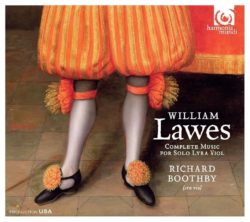
Among the paintings in the Oxford University collection, a ceremonial portrait of a young man by an unknown artist stands out. This portrait, known through several copies and the source of numerous unanswered questions, conveys the aristocratic image of an English cavalier. He is depicted full-length, leaning on a cane—a symbol of courtly etiquette—and … Continue reading “William Lawes: A Seventeenth-Century Court Musician Reflected in English History”
Tchaikovsky’s Italian Holidays
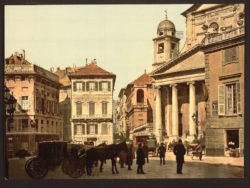
A glance over the vast creative legacy of Pyotr Tchaikovsky reveals a recurring fascination with Italy—evident in the titles, motifs, and moods of many of his works. From Romeo and Juliet and Francesca da Rimini to the Neapolitan Song from the Children’s Album, Italian references abound. Among these is the lesser-known chamber work Souvenir de … Continue reading “Tchaikovsky’s Italian Holidays”