
‘The boy is gifted, the girl is a genius’. That’s what the music teachers of young Felix and Fanny Mendelssohn told their parents. Expectations for brilliance ran high—their grandfather, Moses Mendelssohn, was a leading philosopher of the Enlightenment. But the family’s musical talent came from another branch of the tree: their mother, Lea Mendelssohn, an accomplished pianist, was their first music teacher. At fifteen, Fanny, and her younger brother Felix, then eleven, enrolled at the Berlin Sing-Akademie under Carl Friedrich Zelter [3]. Fanny was admitted mostly to accompany her brother—but soon, it was her genius that turned heads.
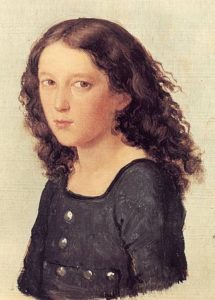
To the casual listener, both children seemed equally talented. They performed and composed side by side. Yet seasoned musicians noted something extraordinary in Fanny’s work. ‘She’s astonishing’, they said. ‘Fanny is something else entirely’. Visitors to the Mendelssohn home, where music salons were held regularly, often left in awe of her.
Still, while Felix was encouraged to pursue composition professionally, Fanny was expected to use her musical charm to attract a husband. ‘Enough with music’, her father told her at fifteen [2]. ‘It’s time to think about becoming a wife and mother’. That decree was devastating. Deprived of formal ambitions, Fanny devoted herself to nurturing her brother’s growing career. She lived and breathed Felix’s music, and he, at thirteen, was already publishing his first piano quartet [2].
When Zelter took Felix to meet Goethe in 1821, Felix wrote detailed letters to Fanny about his impressions [3]. She read and reread them, immersing herself in her brother’s experiences. She even sent Goethe some of her songs, set to his poetry. He was impressed and sent more verses in response. Yet, her modesty and self-doubt held her back.
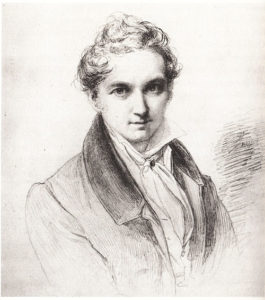
At seventeen, Fanny fell in love with the painter Wilhelm Hensel, who first heard her music at a concert and was instantly captivated [1]. For seven years he petitioned her parents for permission to marry her—despite being eleven years her senior, financially unstable, and from a different background. Eventually, when he secured a court appointment, the Mendelssohns relented [1].
Their marriage marked a turning point. Wilhelm rejected the prevailing belief that a woman’s place was solely in the home. He helped Fanny establish a music salon that became a hub for Berlin’s cultural elite [3]. Though she often preferred listening to others, Fanny never stopped composing. She wrote passionately and frequently—her home filled with manuscript pages. Yet the idea that it was ‘unseemly’ for a woman to be a genius haunted her [2].
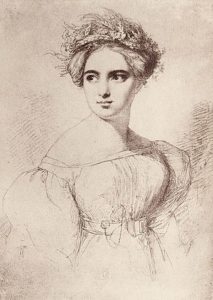
Wilhelm, ever supportive, would set up a writing desk for her, and after she finished composing, he’d decorate the final drafts with his illustrations—always asking her first about the music’s meaning, since he couldn’t read scores. Even after their son, Sebastian Ludwig Felix (named in honor of Bach, Beethoven, and Felix), was born, Fanny continued to compose with undiminished fervor. The scores, enriched with Wilhelm’s art, became tangible expressions of their shared love and creativity.
Fanny’s works circulated widely—even gracing major concert halls. But the name attached to them was often her brother’s. Felix was comfortable publishing her music under his name, telling their parents, ‘Composing is a profession for me. For Fanny, it’s just a pastime’ [3]. With their encouragement, he convinced Fanny not to publish under her own name.
And so, her works became part of his legacy. Many of Felix’s celebrated publications contain Fanny’s music—up to a third, in some cases. At her father’s insistence, she nearly stopped composing entirely. It was Wilhelm who pushed back and helped publish a collection of her music in 1842—without consulting Felix. The two had effectively ended a decades-long deception [1].
In 1839–40, the Hensels traveled to Italy, where Wilhelm arranged concerts for Fanny. [2] Her performances featured works by Bach, Mozart, Beethoven, Felix—and herself. One of her most beloved compositions, the Year cycle (Das Jahr), consists of twelve piano miniatures, each representing a month. She gifted the work to Wilhelm for Christmas, though today it is recognised as a pioneering work that prefigured Tchaikovsky’s The Seasons.
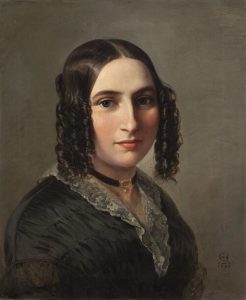
Despite her talent, Fanny remained convinced she lacked real ability. Even as late as the 1840s, she continued handing over compositions to Felix [2]. He included them in his own publications, often without hesitation or acknowledgement. Scholars now believe she authored the overture to Shakespeare’s A Midsummer Night’s Dream, including the famous Wedding March—a satirical take on pomp and ceremony that later became a global wedding staple after it was used at a British royal wedding in 1858 [1].
When Queen Victoria once sang a Mendelssohn song to Felix at Buckingham Palace, he had to confess, embarrassed, that it had been written by his sister. But moments like this were rare [3].
Was this plagiarism? Fraternal love? Or a compromise in the face of social limitations?
Fanny Hensel (née Mendelssohn) left behind around 500 musical works—what could be identified, recovered, and preserved. Her legacy includes dramatic scenes, chamber music, oratorios, lyrical piano pieces, organ preludes, cantatas, and works we still have yet to rediscover. Thanks to Wilhelm’s efforts, much of what was published during her life came to light. Their son would not follow in their artistic footsteps—he became a distinguished mathematician.
Eventually, Fanny did get to perform a concert of her own. She was understandably anxious. During rehearsal for one of Felix’s cantatas (Walpurgisnacht), she suffered a stroke at the piano and died shortly after, aged 42. Felix was inconsolable and died six months later, also of a stroke, at age 38. He left behind a Requiem for Fanny.
Felix Mendelssohn is rightly remembered as one of Germany’s great composers. But we now recognise that his sister’s voice—subdued, doubted, and sidelined—was equally deserving of acclaim. Later, her letters, diaries, and compositions would inspire books, films, and scholarship. Her grandson Kurt, though not musically inclined, became a renowned mathematician.
And finally, Fanny’s brilliance emerged from behind the curtain of silence.
Bibliography:
[1] Hensel, Sebastian, ed. 1884. The Mendelssohn Family (1729–1847) From Letters and Journals. 2 vols. Translated by Carl Klingemann. London: Sampson Low and Co.
[2] Kimber, Marian Wilson. 2004. Felix and Fanny: Gender, Biography and History”. In The Cambridge Companion to Mendelssohn, edited by Peter Mercer-Taylor, 42–52. Cambridge, England: Cambridge University Press.
[3] Todd, R. Larry. 2010. Fanny Hensel: The Other Mendelssohn. Oxford: Oxford University Press.
