
A glance over the vast creative legacy of Pyotr Tchaikovsky reveals a recurring fascination with Italy—evident in the titles, motifs, and moods of many of his works. From Romeo and Juliet and Francesca da Rimini to the Neapolitan Song from the Children’s Album, Italian references abound. Among these is the lesser-known chamber work Souvenir de Florence, a tribute to a city the composer regarded as both a source of inspiration and a second home.
Tchaikovsky absorbed the essence of Italy during his travels: he listened intently to folk tunes performed by street musicians, attended carnivals, visited ancient ruins, and explored Italy’s artistic treasures. The result of these vivid impressions was Capriccio Italien, a symphonic fantasy based on Italian folk themes. Writing from Geneva to his patron Nadezhda von Meck, he admitted, ‘I shall stay here until I receive from you the means to go to Italy, which attracts me strongly’ [Letter 622]. Indeed, Italy’s warm climate, natural beauty, and cultural riches proved profoundly nurturing for his creative spirit.

One of his most celebrated operas, The Queen of Spades, was composed at the Hotel Washington on Via Vespucci No. 8 in Florence, now home to a popular tourist bar. The Italian public always welcomed him warmly. A commemorative plaque on his Florentine villa reads: ‘In this villa in 1878 lived and worked Pyotr Ilyich Tchaikovsky, who, arriving at the gentle Tuscan hills from the vast Russian plains, transformed the eternal harmonies of both lands’. Locals even referred to The Queen of Spades as ‘the Florentine opera’, since it was born on the banks of the Arno.
Another homage to Florence is the chamber work Souvenir de Florence—a sextet for two violins, two violas, and two cellos, commissioned by the St. Petersburg Chamber Music Society. Legend has it that its representatives intercepted Tchaikovsky at the station just before his departure for Italy, pleading for a new work. Though pressed for time and focused on opera composition, he agreed. Initially, the process proved difficult: ‘I’m writing with incredible effort’, he confessed, ‘it isn’t the lack of thoughts that’s hindering me, but the novelty of the form. It requires six independent and, moreover, homogenous voices. It’s incredibly difficult’ [Letter 4149]. Yet the spirit of Florence must have stirred him; the piece was completed. The first two movements evoke Italy’s melodic lyricism, while the latter movements unmistakably turn toward Russia. Though some critics have dismissed the sextet as minor, many would disagree—it is, arguably, a true masterpiece.
Tchaikovsky’s time in Florence was just one of many Italian sojourns that left their mark. Rome inspired Capriccio Italienin 1880, a vivid composition teeming with street life, festival sounds, and folk songs. The opening brass fanfare imitates military bugles Tchaikovsky heard daily from nearby barracks. He found the folk melodies enchanting and worked on the piece with great enthusiasm, capturing the joy, color, and carnival atmosphere of the Italian streets.
Throughout his life, Tchaikovsky drew creative strength from Italy. In 1871–72, during visits to Nice, Genoa, and Venice, he composed Nocturne and Humoresque for piano. His Neapolitan Song, later adapted for Swan Lake, was inspired by the tunes of southern Italy. In 1878, recovering emotionally from a short and tumultuous marriage, he completed Eugene Onegin and the Fourth Symphony while staying in San Remo.
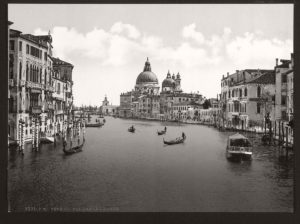
Tchaikovsky first visited Venice in 1872 en route from Nice to Vienna. He returned in 1874, writing to his brother Modest on April 24th from St. Mark’s Square: ‘Look at the vignette and be furious, burst with envy. I walked around this square all day today’ [Letter 347]. Though initially he found Venice cold and gloomy, he was captivated by the Palazzo Ducale, which he described as ‘the height of beauty and interest, with the romantic aroma of the Council of Ten, the inquisition, torture, oubliettes, and other such delights’ [Letter 347].
In 1877, after his failed marriage, Tchaikovsky again returned to Venice for emotional healing. With his brother Anatoly and his servant Aleksei Sofronov, he worked on orchestrating Act II of Eugene Onegin and continued writing his Fourth Symphony. From his suite at the luxurious Hotel Londra Beau Rivage, he described his routine in detail: composing in the morning, strolling through the city in the afternoon, and writing again in the evening. Yet he admitted in a letter, ‘I find Venice utterly repulsive… there’s something vile and nasty here to which I will never grow accustomed’ [Letter 672]. Despite these misgivings, in 1881 he returned yet again and finally reconciled with the city. Writing to Anatoly, he confessed: ‘Venice this time delights me… The air is soft and caressing. I feel cheerful and well’ [Letter 1895]. He delayed his departure to Florence just to enjoy one more day.
Tchaikovsky also held deep respect for the Italian operatic tradition, particularly the works of Verdi. This admiration influenced his own operas, in which he attempted to fuse Russian musical drama with Italian lyricism and expressiveness. Italy, in this way, shaped not only his compositions but also his personal life—offering refuge, healing, and boundless creative energy.
In sum, Italy became for Tchaikovsky a place where the beauty of nature, art, and music intertwined. The works he composed under its influence continue to enchant listeners around the world, proving that the language of music knows no borders—and that, sometimes, an artist must travel far from home to find the truest voice within.
