
Oliver Mears’s staging of Handel’s dramma per musica offers a strikingly dark and provocative reinterpretation of Semele, now running at Covent Garden through July 18.
Mears places the tale in a glitzy yet soulless the 1960s luxury hotel, where ambition and betrayal play out against sleek Art Deco backdrops and an ever-present furnace motif. This modern palace—so immaculately designed by Annemarie Woods—sharpens the story’s themes of desire, vanity, and the destructive consequences of hubris . The production’s visual impact alternates between glamourous and ominous, with stygian shadows and flare-ups of flame foreshadowing Semele’s fate . The chorus and orchestral playing under Christian Curnyn are strong, though occasionally risk overwhelming the finer vocal lines when handling lighter voices . Curnyn brings an authoritative Handel approach, even if the ROB’s full modern orchestra sometimes drowns the subtleties .
Pretty Yende’s Semele is a dichotomy: initially cautious, she blossoms into emotional intensity by the second half. Critics note her melodic lines in ‘Myself I shall adore’ and her vivid lament in Act III as highlights, though early intonation wobbles pulled some reactions . Ben Bliss delivers a smooth, lyrical Jupiter; his “Where’er you walk” scored notable praise for its blend of sweetness and sardonic charm . Alice Coote’s vengeful Juno steals scenes with fiery intensity and stage presence. Supporting singers—including Carlo Vistoli (Athamas), Niamh O’Sullivan (Ino), Marianna Hovanisyan (Iris), and Brindley Sherratt (Somnus/Cadmus)—are uniformly strong, contributing to an ensemble cast that sustains dramatic momentum throughout.
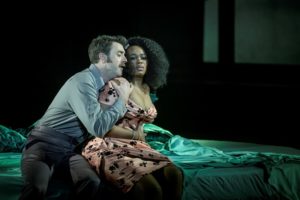
Critics are divided on whether Mears’s dark reinterpretation sacrifices Handel’s bawdy charm. The Times and FT emphasised the production’s uncompromising moral tone and provocative final image, calling it bold, but left some viewers questioning whether essential joy was lost . Others, like The Spectator, note the staging is ‘contradictory’, yet concede the music’s brilliance still overwhelms with ‘splendour’ Overall, Semele at the ROH is a daring, displacement of Handel into 20th-century cynical drama. The vocal performances, particularly ofe from Yende, Bliss, and Coote, are compelling. The production’s bracing darkness may not delight everyone, but it leaves a lasting impression—an opera both stripped of sentiment and enriched by its vivid, emotional core. Don’t miss out!
