
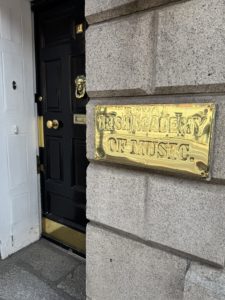
Between 25–28 August 2025, Dublin became the stage for one of the most important gatherings in current musicological research: The Expansive Canvas: Large-Scale Form in the Music of 19th-Century Women Composers. Co-hosted by Trinity College Dublin and the Royal Irish Academy of Music, the conference brought together scholars, performers, educators, and industry leaders to examine how women composers navigated, redefined, and sometimes resisted the monumental forms of the long nineteenth century.
From the outset, the conference set out to challenge prevailing narratives. Large-scale works—symphonies, sonatas, concertos, and operas—have traditionally been framed as the preserve of male genius, with women confined to the ‘salon’ or ‘miniature’ genres. By placing women at the centre of discussions on large-scale form, The Expansive Canvas demanded a rethinking not just of musical history, but of cultural memory itself.
The opening session, led by Nicole Grimes (TCD) and Denise Neary (RIAM), framed the event as both scholarly and collaborative. This dual mission was evident throughout the four days: the programme wove together formal papers, roundtable discussions, and performances, all staged across Trinity College, RIAM, and the evocative St Bartholomew’s Church.
Roundtables provided the backbone of the event. The first, Why the Expansive Canvas?, asked how our understanding of musical form and ambition might shift when women’s symphonies, operas, and concertos are placed at the centre. Later discussions examined performance perspectives, pedagogical inclusion from childhood to doctoral study, and the position of women’s large-scale creativity across the arts. Each provocation was dialogic in nature, inviting delegates to become co-participants in shaping the conference’s intellectual energy.
Equally striking was the integration of live performance into the academic fabric. Recitals at RIAM and St Bartholomew’s showcased works rarely heard in modern concert life: chamber sonatas, fantasies, and richly scored vocal pieces by composers such as Emilie Mayer, Louise Farrenc, and Cécile Chaminade. These events were more than musical interludes—they became arguments in themselves, demonstrating the expressive ambition and technical brilliance of composers too long excluded from mainstream programming.
For many delegates, the lunchtime recital featuring soprano Aisling Kenny and violinist Levon Chilingirian was a highlight, not least for its compelling demonstration of how large-scale female-authored works can sit naturally within today’s repertoire.
The paper sessions revealed the sheer diversity of approaches. Panels ranged from close analytical studies of Fanny Hensel’s sonata forms to explorations of Alma Mahler’s re-orchestrations, Ethel Smyth’s operatic representations of female power, and Cécile Chaminade’s symphonic ambitions. The breadth of methodology—from formalist analysis to feminist historiography—underscored the richness of the field.
My own contribution, The Creative Legacy of Zinaida Volkonskaya: Destiny and Challenges of Its Exploration, sought to position Volkonskaya within the expanding canon of women who engaged directly with opera and large-scale vocal forms. Long remembered primarily as a salonnière, Volkonskaya’s work reveals her as a mediator between Italian traditions and Russian cultural aspirations, and thus central to understanding transnational networks of creativity in the early 19th century. Presenting this research in dialogue with other papers on Russian and European women composers reinforced how much remains to be uncovered.
It was also encouraging to see future Birmingham scholarship represented: Matthew Madeley, who is about to begin his PhD at the University of Birmingham, delivered a fascinating paper on Susan Spain-Dunk and Alice Verne-Bredt, exploring how the Phantasy genre offered these composers a condensed yet ambitious approach to large-scale form. His work promises to contribute significantly to ongoing conversations about genre, innovation, and women’s creative strategies.
One of the most compelling aspects of the conference was its engagement with industry leaders and educators. Sabine Kemna from Furore Editions offered a candid account of the challenges and triumphs of publishing works by women composers, while Katherine Cooper of Presto Classical traced the surge in recorded projects devoted to female-authored symphonies and operas. Their contributions highlighted how scholarship, performance, and industry are mutually reinforcing: new editions make performances possible, recordings generate visibility, and research provides the critical framework to ensure these works are taken seriously.
Equally thought-provoking was the Music Education Summit, which asked how the works of 19th-century women composers might be embedded into syllabi from grade exams through to doctoral curricula. The discussion made clear that inclusion requires more than token gestures—it demands a restructuring of pedagogical canons and the creation of resources that equip teachers and students alike.
The final roundtable expanded the conversation beyond music, exploring parallels in literature, visual art, and cultural history. Speakers including Fionnuala Dillane and Harry White argued persuasively that women’s large-scale creativity in the 19th century was consistently underestimated across disciplines. Situating music within this wider cultural matrix underscored the transformative potential of the “expansive canvas” as a conceptual frame.
Reflecting on the conference as a whole, what emerges most strongly is its collaborative ethos. By combining scholarly research with performance, by engaging both established academics and early-career researchers, and by connecting universities, conservatoires, and industry, The Expansive Canvas embodied the very expansiveness it sought to champion.
For musicology, the implications are profound. The narratives of the 19th century are being rewritten not through isolated acts of recovery but through collective effort: networks of scholars, performers, publishers, and educators working together to reshape the canon. The conference did not simply ask us to hear Mayer’s symphonies or Hensel’s sonatas differently; it invited us to reconsider what counts as the centre of musical history.
As the conference closed, it was clear that this was not an endpoint but a beginning. Projects sparked in Dublin will undoubtedly resonate into future scholarship, performance, and pedagogy. For those of us privileged to take part, the experience was both intellectually invigorating and emotionally resonant—a reminder of why conferences matter as spaces of connection, inspiration, and shared purpose.
The Expansive Canvas was more than a conference; it was a reimagining of music history’s possibilities. By affirming the centrality of women’s large-scale works, it challenged the hierarchies that have long shaped our discipline and offered a vision of a more inclusive, dynamic, and truthful musical past.
