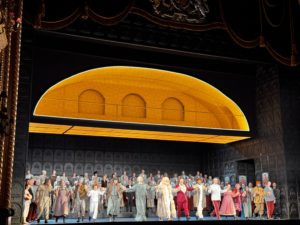
Attending Boris Godunov at the Royal Opera House in February 2026 felt less like witnessing a revived production and more like undergoing a prolonged psychological examination. This staging presented Mussorgsky’s original 1869 version, performed without an interval or the later additions that softened or expanded the opera’s architecture. The result was an uncompromising, concentrated experience — one that many online critics described as ruthless, but which I would characterise as a quiet shock.
The decision to use the 1869 version was central to the production’s impact on the audience. Without the Polish Act and later revisions, the opera unfolds as a tightly compressed study of power and guilt, with Boris almost continuously at its centre from the beginning. Several reviewers noted that this version leaves little room for distraction or narrative relief, and this was strongly felt in the theatre. The drama developed with an unsettling sense of inevitability, as though Boris’s collapse had begun before the first note sounded.
Much of the critical attention — and quite rightly — is focused on Bryn Terfel in the title role. This marked his third major portrayal of Boris in this production, and the maturity of his interpretation was evident. Rather than emphasising brute authority, Terfel presented Boris as a ruler who was already losing control. The voice carried weight and darkness when required, but there were also moments of pronounced fragility, where the sound seemed deliberately unstable, even hollow. The Guardian described his performance as “majestic and deeply inward”, awarding the production ★★★★☆, while The Times praised the “psychological sharpness” of his portrayal, granting four stars. Across reviews, there was a clear consensus that this Boris was less dominant than disintegrating — a man gradually consumed by what he knows, or fears, he has done.
Under the direction of Mark Wigglesworth, the Royal Opera House orchestra delivered a Mussorgsky score that many critics have described as austere, disciplined, and unsentimental. Wigglesworth resisted the temptation to romanticise the music, allowing its angularity and raw textures to speak for themselves. The Guardian highlighted the orchestra’s “granite weight”, while The Arts Desk noted the conductor’s ability to sustain tension across extended harmonic suspensions, awarding the performance ★★★★☆. From the audience, the effect felt hypnotic rather than consoling: long pedal points, heavy brass writing, and sparse textures created a sense of suspended time, intensifying the opera’s emotional and claustrophobia.
The chorus played an unusually significant role in shaping the atmosphere of the evening. Mussorgsky’s people are never passive observers, and here they appeared as a collective presence that felt weary, hungry, and dangerously malleable. The famous plea for bread — one of the most frequently cited moments in online reviews — was described by Opera Today as “harrowing in its restraint,” with the production receiving 4.5 stars. Rather than overwhelming the listener with volume, the chorus conveys desperation through repetition and persistence, giving the scene an unsettlingly modern resonance.
Among the secondary roles, Adam Palka received widespread praise for his portrayal of Pimen, lending vocal solidity and narrative authority to a role that anchors the opera’s historical memories. Opera Magazine singled out his performance as “quietly commanding”, noting the clarity of his diction and the seriousness with which he approached the chronicler’s role in the film. James McCorkle, as Grigory (the Pretender), created a strong dramatic contrast with Boris, his brighter vocal colour cutting sharply through the darker sound world. Several reviews highlighted this contrast as one of the production’s strengths, reinforcing the opera’s political tension, both musically and dramatically.
Visually, Richard Jones’s staging continued to divide opinions, though it rarely left audiences indifferent. The production’s stark design — with its rigid spatial divisions and restrained palette — was described by The Financial Times as “brutally effective”, earning ★★★★☆ rating. Some online commentators found the minimalism bleak, even alienating, while others praised it for refusing to distract from the opera’s psychological core. Personally, I found the restraint to be effective. The absence of decorative excess allowed Mussorgsky’s moral and emotional tensions to remain central, and the recurring visual motifs — particularly those associated with memory and childhood — took on an almost obsessive quality.
One figure repeatedly mentioned in reviews was the Holy Fool, whose brief appearance had a disproportionate emotional impact. His fragmented and vulnerable presence cuts through the opera’s political machinery with painful clarity. Bachtrack described this moment as “the ethical heart of the evening,” awarding the overall production ★★★★☆. In performance, the Holy Fool appeared less as a character than as a rupture — a reminder that in this opera, truth arrives from outside systems of power.
Audience responses reflected the inherent difficulty of the opera. While many praised the performances and the seriousness of the approach, others found the experience demanding, citing the lack of melodic release and the emotional weight of the evening as reasons. Even critical reactions tended to frame this as a feature rather than a flaw. Boris Godunov does not seek to console, and this production made no apology for that.
Leaving the theatre, I felt the kind of silence that follows prolonged concentration rather than entertainment. This was not an evening that sent the audience home humming melodies but one that required them to sit with discomfort, ambiguity, and unresolved tension. The February 2026 revival reaffirmed the unique place Boris Godunov occupies in the operatic canon. In its original form, and in this particular London production, it remains an opera that speaks unflinchingly ofpower, responsibility, and the human cost of ambition.
For contemporary London audiences, the production offered something rare: an opera that trusted its material, performers, and audience to engage deeply. It may not have been an easy night at the opera, but it was an honest and necessary one, and it will remain with me for a long time.