
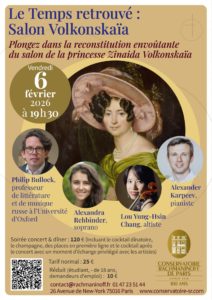
On 6 February 2026, in the elegant surroundings of the Conservatoire Rachmaninoff in Paris, the past felt startlingly close. Le Temps retrouvé: Salon Volkonskaïa was not simply a concert, but a carefully crafted reanimation of an early nineteenth-century world: the salon of Princess Zinaida Volkonskaya — writer, composer, singer, intellectual and one of the most fascinating cultural mediators of her time. For me, as a final-year PhD candidate in Musicology at the University of Birmingham, the evening represented something deeply personal and professionally significant. It was a moment where years of archival research, theoretical reflection, and writing about women’s agency in music moved beyond the page and into lived, shared experience.
The event, hosted by the Conservatoire Rachmaninoff de Paris, brought together an extraordinary group of artists and scholars. Professor Philip Bullock offered literary and historical insight; soprano Alexandra Rehbinder and violist Lou Yung-Hsin Chang embodied the intimate expressive world of salon performance; and pianist Alexander Karpeev brought to life the piano repertoire that would have resonated in such spaces two centuries ago. Yet what made the evening distinctive was not simply the calibre of those involved. It was the deliberate centring of Volkonskaya herself — not as a decorative hostess orbiting ‘great men’, but as a creative and intellectual force in her own right.
In my article, The Musical Legacy of Princess Zinaida Volkonskaya: Investigating Her Compositions and Influence in the Early 19th Century, I argue that Volkonskaya’s salon functioned as a dynamic site of artistic negotiation between Russia and Western Europe. She was not merely providing tea and polite conversation; she was shaping taste, enabling performance, fostering debate, and facilitating encounters between writers, composers, political thinkers and aristocrats. Her salon was a space in which identities — national, artistic, gendered — were negotiated and performed. Too often, however, such spaces have been relegated to the margins of music history, treated as charming backdrops rather than as engines of cultural production.
The Paris concert challenged that marginalisation in the most tangible way possible. Sitting in the audience, hearing repertoire contextualised within Volkonskaya’s world, I was struck by how different the narrative feels when the woman at the centre of the room is recognised as an agent. The music does not change; what changes is our understanding of how and why it sounded. In a salon, performance was not an abstract aesthetic event but part of a web of social ritual: arrival, greeting, discussion, flirtation, rivalry, intellectual exchange. Music was woven into conversation, and conversation was often shaped by the presence of powerful, articulate women.
My doctoral research focuses primarily on the Irish composer John Field and the development of the nocturne in Russia. Field’s career in Moscow and St Petersburg unfolded precisely within this salon culture. It has become increasingly clear to me that understanding figures like Volkonskaya is essential to understanding the evolution of the nocturne itself. Genres do not develop in isolation. They emerge within specific social ecologies. The salon — intimate, semi-public, intellectually vibrant — provided the ideal environment for a genre defined by introspection and nuance. By foregrounding Volkonskaya, the Paris event illuminated the infrastructure that enabled such music to flourish.
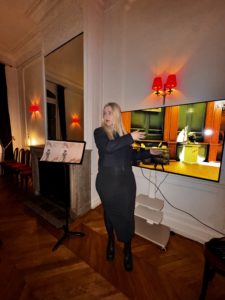
This concert also connected to my broader creative-research project, Time Regained: Volkonskaya’s Salon, an immersive 3D reconstruction developed in collaboration with Alessia Jarvis at Goldsmiths. As described in the project outline , the experience invites visitors into an early nineteenth-century evening: footsteps on parquet floors, murmured greetings, women adjusting dresses by candlelight, fragments of artistic gossip, a declamation that dissolves back into layered conversation, the clink of tableware, distant fireworks, and finally the solemn striking of midnight. The aim is not nostalgia, but immersion — an attempt to think spatially and sonically about how cultural exchange actually felt.
Seeing elements of this conceptual approach resonate within the Paris concert was profoundly affirming. It demonstrated that musicology can extend beyond traditional formats without sacrificing rigour. For academic audiences, the event reinforced the argument that salons were critical sites of transnational exchange, shaping aesthetic developments in ways that demand serious scholarly attention. For non-specialist audiences, it offered an accessible, emotionally engaging way to encounter a complex historical argument. Rather than presenting a lecture about women’s roles in music, it allowed those roles to be experienced.
One of the most significant impacts of the evening lies in how it reframes the question of women in music. The narrative we often encounter is one of absence: why were there so few recognised women composers? Why are their works underperformed? These are important questions, but they can inadvertently reinforce a sense of marginality. The Paris concert suggested a different angle. Instead of asking where women were missing, it asked where they were central. In Volkonskaya’s salon, women were curators of taste, orchestrators of conversation, performers, patrons, and intellectual interlocutors. They shaped the very conditions under which canonical male composers were heard and discussed.
This reframing has broader implications for how we teach and write music history. It encourages us to look beyond the printed score and to consider the social architectures that sustain artistic life. It also invites a more nuanced understanding of power. The salon was not a formal institution; it did not grant official titles or academic posts. Yet it exercised influence through hospitality, charisma, education, and cultural capital. Recognising that influence complicates simplistic hierarchies between ‘public’ and ‘private’, between ‘serious’ composition and ‘domestic’ sociability.
The location of the concert in Paris added another layer of resonance. Volkonskaya herself was a figure of mobility, navigating Russian and Western European contexts with fluency. Hosting an event dedicated to her in a city so central to Russian émigré culture underscored her role as a bridge between worlds. In an era when questions of identity, exile, and cultural dialogue remain pressing, revisiting her salon feels unexpectedly contemporary. It reminds us that cross-cultural negotiation is not a new phenomenon; it has long been embedded in artistic practice.
For the University of Birmingham, my involvement in this project reflects the potential of doctoral research to operate internationally and publicly. Academic work can, and perhaps should, move between archives, classrooms, concert halls, and digital environments. The Paris concert exemplified that movement. It drew on archival study, engaged with literary scholarship, collaborated with professional performers, and reached an audience beyond the academy. It demonstrated that research on nineteenth-century salon culture is not an esoteric niche, but a lens through which to reconsider enduring questions about gender, creativity, and cultural exchange.
Personally, the evening was also a reminder of why I began this line of inquiry. There is something profoundly moving about hearing music in a context that restores its social dimensions. The salon was a space of listening, but also of speaking — of voices overlapping, challenging, supporting, persuading. In recovering Volkonskaya’s presence within that space, we recover a more dialogic vision of musical history. It becomes less a sequence of solitary geniuses and more a network of relationships.
As I continue to complete my PhD, projects like this reinforce my conviction that scholarship and creativity need not be separated. Writing about Volkonskaya’s influence is one form of recovery. Curating, reconstructing, and collaborating to bring her world to life is another. Both contribute to expanding knowledge of women in music — not by adding a token name to an existing canon, but by questioning how that canon was formed in the first place.
Le Temps retrouvé allowed us, however briefly, to step into a room where a woman stood at the centre of artistic life and to recognise that her influence was neither incidental nor ornamental. In doing so, it did more than recreate a historical evening. It shifted the frame through which we understand the past. And if we can shift that frame in the concert hall, perhaps we can shift it in our histories as well.
