
There are rare moments in classical music where you can quite literally witness a career begin. Sitting in the hall this spring, listening to the finalists of the Siemens–Hallé International Conductors Competition 2026, it felt very much like one of those moments.
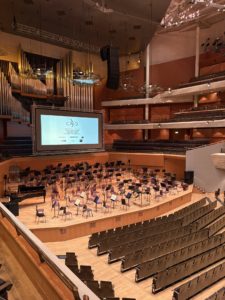
Held at the iconic The Bridgewater Hall, the competition has quickly established itself as a major platform for emerging conductors, offering not just recognition, but something far more substantial: a structured pathway into the profession.
At the heart of the competition lies a remarkable prize. The winner becomes Assistant Conductor of the Hallé Orchestra for three years, working alongside its Principal Conductor and Artistic Advisor, Kahchun Wong. It is, quite literally, a life-changing opportunity—one that allows an emerging conductor to develop within a professional orchestral environment while building an international profile.
What distinguishes this competition from many others is its emphasis on long-term artistic development. The Assistant Conductor is not a ceremonial title, but a deeply embedded role: conducting concerts, directing the Hallé Youth Orchestra, observing rehearsals, and participating in artistic planning.
Over several days, candidates move from rehearsal settings into the intensity of a public final concert with the Hallé itself. In 2026, the final—presented by BBC Radio 3’s Tom McKinney—placed both jury and audience in direct contact with the conductors’ musical personalities.
What stayed with me most vividly, however, was the experience of hearing the same piece conducted multiple times. It is something we rarely encounter in concert life, and it proved unexpectedly revealing.
Each interpretation seemed to open up a different version of the work. Subtle changes in tempo, phrasing, and gesture altered not just the surface, but the entire sense of musical direction. In one reading, a passage unfolded with a kind of spacious lyricism; in another, it gained urgency and tension. Even the orchestra’s response appeared to shift, as if each conductor elicited a slightly different sound-world from the same players.
From the audience, this created a real sense of suspense. I found myself listening differently—less passively, more analytically—constantly reassessing what felt convincing, coherent, or emotionally compelling. It also made the jury’s task seem almost impossibly complex. When performances differ not in quality but in perspective, evaluation becomes a question of artistic vision rather than correctness.
In that moment, the role of the conductor became unusually clear: not simply to reproduce the score, but to shape and articulate it—to make an argument through sound. Hearing these contrasting interpretations side by side felt, in a way, like witnessing musical analysis in real time.
The scale of the competition is equally striking. In 2026, more than 270 applicants from across the world entered, with only a select few reaching the final stages. This global reach reflects not only the prestige of the Hallé, but also the broader partnership behind the competition.
The collaboration with Siemens AG represents a long-standing alliance between music and innovation. Over the past two decades, Siemens and the Hallé have worked together not only to support artistic excellence, but also to deliver education and outreach initiatives across the North of England, reinforcing Manchester’s position as a vibrant musical centre.
The 2026 competition was won by Finnish-American conductor Aku Sorensen, whose performances combined clarity, control, and a natural communicative presence.
What stood out was not only technical assurance, but a sense of ease in shaping the orchestra’s sound—something that is difficult to define, but immediately perceptible. His interaction with the players suggested both authority and attentiveness, qualities essential for a role that is as collaborative as it is directive.
From September 2026, he will take up the position of Assistant Conductor, working closely with Kahchun Wong and becoming Music Director of the Hallé Youth Orchestra. It is an environment that offers both responsibility and mentorship—a rare combination for an emerging conductor.
The Siemens–Hallé International Conductors Competition is, ultimately, more than a contest. It is a carefully designed framework for nurturing musical leadership.
Previous winners, including Delyana Lazarova and Euan Shields, have already demonstrated how transformative this opportunity can be. As Hallé Chief Executive David Butcher has noted, the competition brings ‘the very best and brightest musical talent to Manchester’—but perhaps more importantly, it allows that talent to develop over time, within a supportive artistic community.
Competitions can sometimes feel like endpoints. Here, however, it feels more accurate to think of this as a beginning.
For the audience, it offers a rare glimpse into the process of artistic formation. For the conductors, it provides something far more significant: time, space, and guidance.
And for those of us listening, it is a reminder of something fundamental—that even the most familiar music can be transformed entirely, depending on who stands on the podium.
