
In his critical essay Mozart and His Significance for Our Time, Edvard Grieg wrote:
Many contemporary composers have attempted to modernise Mozart in order to rekindle public interest in his music, especially among audiences whose tastes have been dulled by excessive seasoning. A difficult task! I, too, have attempted to give some of Mozart’s piano sonatas a sound more familiar to the modern ear by adding a second piano. In my defense, I must emphasise that I have not altered a single note of Mozart’s original, thus paying him the respect he deserves [1].
Grieg believed that one of the reasons Mozartian traditions had been forgotten and distorted was the tendency of contemporary conductors to misinterpret and reshape the composer’s works [1]. Yet, despite the passage of time and changing musical aesthetics, the Norwegian composer successfully created a version of Mozart’s sonatas that, while keeping the original text intact, resonated with 19th-century audiences in a way that felt more immediate and relevant.

Between 1876 and 1879, Grieg worked on his two-piano arrangements of Mozart’s sonatas in F major (K.533/494), G major (K.283), C major (K.545), and C minor (K.475). His approach was deeply rooted in the transformation of listening experiences that took place in the 19th century [5]. As chamber music, originally composed for intimate salon settings, began to be performed in large concert halls, the clarity and balance of these works were often acoustically diminished. What once seemed rich and expressive in an aristocratic salon could sound sparse and insufficient in a grand auditorium [3].
Grieg’s primary aim was to enhance the sonority of Mozart’s works without compromising their structural integrity. By sensitively following the original text and utilising the expanded capabilities of the modern piano, he introduced dynamic nuances and harmonic embellishments that made Mozart’s sonatas more resonant for his contemporaries. In this sense, Grieg acted as a sound engineer of his time, striving to recreate the auditory experience that 18th-century audiences would have enjoyed when hearing Mozart’s music in its intended setting [3]. Rather than distorting or overwriting the original, he used the second piano as a means of amplification—illuminating Mozart’s ideas through the lens of 19th-century musical language [2].
Grieg’s approach was not an isolated experiment but rather part of a broader tradition of commentary transcription—a practice in which composers retained an original work unchanged while adding a newly composed secondary voice [5]. Throughout his arrangements, Grieg’s second piano part serves as both a commentary and interpretation of Mozart’s text, creating a dialogue between the two composers. The distribution of roles is clear: the first piano presents Mozart’s original material, while the second piano represents Grieg’s voice—a 19th-century reflection on the classical masterpiece [2].
This technique had notable precedents. Grieg’s own piano teacher at the Leipzig Conservatory, Ignaz Moscheles, had employed a similar method in his Melodic-Contrapuntal Studies (1863), in which he composed additional parts for J.S. Bach’s preludes—one for cello and another for a second piano. Moscheles himself may have been inspired by Felix Mendelssohn and Robert Schumann, both of whom had added piano accompaniments to Bach’s solo violin and cello suites—interpretative layers that Grieg was undoubtedly familiar with.
The late 19th century saw an increase in such arrangements, which aimed to make historical repertoire more accessible and resonant for modern audiences. Adolf von Henselt, for instance, added a second piano part to 50 études by Johann Baptist Cramer and 48 études by Henri Bertini (1874), as well as to Muzio Clementi’s Sonatina in G major. Similarly, orchestrations of Chopin’s piano concertos, carried out by various composers, sought to enrich their orchestral textures without altering the solo piano lines.
Grieg’s engagement with Mozart’s original works was deeply connected to texture. While he preserved the essential structural and thematic ideas of Mozart’s sonatas, he sought to expand their sonic space, drawing inspiration from two of Mozart’s own models: his four-hand piano sonatas and the keyboard versions of his piano concertos [2].
In Mozart’s four-hand piano sonatas, the second piano does not merely double the first; it competes with it, amplifies the overall sound, and expands the register. Many of these works (K.521, K.381, K.497) open with densely packed textures achieved through the doubling of the first pianist’s part by the second. A striking example is the D major sonata, where even the lyrical Andante features an orchestral effect—its melody in the Primo part is doubled in the Secondo two octaves below, evoking the sound of a bassoon or cello. In his later sonatas (B-flat major, F major), Mozart takes this interplay even further, creating a true dialogue between the two pianists, merging the intimacy of chamber music with the dynamism of a concerto. However, despite these elements of grandeur, the four-hand sonatas remain firmly within the stylistic framework of the galant era.
To achieve greater dynamic intensity, Grieg turned not only to Mozart’s four-hand works but also to his piano concertos, whose textures provided an ideal model for enriching the sonatas. By drawing on the keyboard reductions of Mozart’s concertos, Grieg mirrored similar textural functions in the second piano part while also incorporating his own creative additions [5].
One of Grieg’s most distinctive techniques was the use of sustained tones in the second piano, often presented in a figurated manner, which function as orchestral pedals. This effect broadens the harmonic field and enhances the orchestral character of the music, as seen in the opening of the C minor Fantasy, the development section, and the coda of the F major sonata’s third movement. Grieg also employed tutti effects by thickening the musical fabric through added voices and doublings. This can be observed in the final section of the G major sonata’s third movement, where increased density in the texture creates a powerful, full-bodied sound reminiscent of an orchestral climax.
A hallmark of the classical concerto is the alternation of material between soloist and orchestra. Grieg incorporated this principle by selectively doubling only part of a theme in the second piano or by continuing a passage where Mozart’s line had been suspended on a long note. This technique creates the effect of the theme being handed over to an imaginary orchestra, while also accelerating harmonic rhythm—a crucial element in increasing dramatic tension. Grieg applied this approach to nearly all the slow movements of the sonatas, with the exception of the G major Sonata, as well as to the second, lyrical section of the C minor Fantasy.
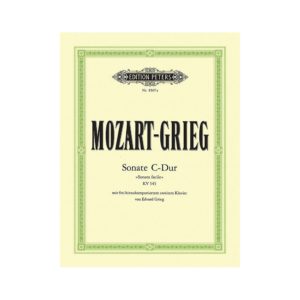
A particularly striking example occurs in the finale of the ‘Easy’ C major Sonata where Grieg inserts a scherzando-style passage labeled Cadenza into a rest in Mozart’s original. This addition intensifies the sense of playfulness, reinforces the concerto-like quality of the arrangement, and thickens the sonority [5].
While maintaining the integrity of Mozart’s original first piano part, Grieg transformed the texture by enhancing its polyphonic dimension. One of his most effective techniques was the introduction of counterpoint, often chromaticised, as seen in the main and transition sections of the F major Sonata’s first movement, as well as in episodes of its third movement.
Grieg also employed imitative techniques embedded within Mozart’s own writing. For example, in the first movement of the F major sonata, the second phrase of the main theme in Mozart’s original is repeated an octave lower, resembling an orchestral call-and-response. Recognising the potential of this idea, Grieg takes it a step further by presenting his added material an octave higher, effectively shifting the register to an imaginary instrument. The octave leap in imitation serves as a bridge, allowing the material to be transferred seamlessly into a different tonal space, evoking an expanded instrumental palette. Occasionally, Grieg employs even wider imitative intervals, further heightening the orchestral illusion [3].
In Grieg’s reworking of Mozart’s G major Sonata, the development section contains sevenths and sixths that emerge through the gradual contraction of an octave—a subtle yet distinctive transformation of harmonic space. One particularly intriguing technique he employs is pre-imitation, where the second piano anticipates melodic figures from the first piano, making it seem as though Mozart is imitating Grieg rather than the other way around. This inventive interplay, which introduces a sense of musical role reversal, is something Grieg applies exclusively in his arrangement of the C minor Fantasy, a genre already less bound by classical conventions.
Beyond these textural innovations, Grieg composes independent accompanying voices—melodic phrases with a broader, more expansive contour, introduced precisely at moments when Mozart’s part features scalar or chord-based passagework [5]. It is as if Grieg seeks to enrich Mozart’s material by overlaying it with new, more expressive melodic lines. A clear example of this can be found in the first movement of the C major sonata, where Mozart’s arpeggiated figuration is overlaid with a lyrical counterpoint, doubled at the octave and marked espressivo by Grieg.
Grieg’s pursuit of a more contemporary 19th-century sound for Mozart’s sonatas also influences his choice of figuration. In climactic sections, he introduces dense rhythmic textures (such as in the development of the second movement of the G major sonata and the third movement of the F major sonata) [2]. Meanwhile, the classical Alberti bass is transformed—its regular pattern expanded by Romantic-style nocturne-like harmonic figurations, creating a stereo effect in the two-piano version.
Grieg’s harmonic additions remain structurally faithful to Mozart’s original by adhering to the inherent counterpoint and voice-leading principles of the Classical period. His use of passing tones and suspensions in the second piano results in brief moments of dissonance, enriching the harmonic verticality while maintaining the clarity of Mozart’s textures [3].
Some harmonic modifications stem from the increased instrumentation—with a second piano at his disposal, Grieg reinforces harmonic foundations. For example, in the bass line of the second piano, quartal and quintal leaps transform Mozart’s chord inversions into root-position triads and seventh chords, thereby reinforcing their functional weight. This technique is particularly evident in the final section of the G major sonata’s last movement, where Grieg expands Mozart’s elliptical harmonic progressions (short sequences of two or three chords) into longer five- or six-chord structures, incorporating altered harmonies for greater coloristic effect [2].
One striking example of this occurs in the finale of the G major sonata, where Grieg embellishes an elliptical cadence with an altered dominant (D4u) featuring a lowered fifth. Additionally, he replaces Mozart’s simple dominant and subdominant triads with seventh chords—for instance, where Mozart originally wrote a IV chord, Grieg often substitutes a second-inversion ii7 chord, adding harmonic complexity. In the slow movement of the C major sonata, Grieg even places a subdominant seventh chord over a dominant pedal, subtly shifting Mozart’s harmonic balance toward a more Romantic, expressive language. Another hallmark of Romantic harmony in Grieg’s approach is his use of the major-minor system. In major-key sections, he frequently introduces minor-mode versions of the subdominant, a technique that enhances chromaticism and deepens expressivity [2].
Grieg’s two-piano textures reveal an interplay between Mozart’s chamber music aesthetic and a more symphonic treatment of the piano, characteristic of Romantic virtuosity. His treatment of the second piano part shows strong parallels to Mozart’s four-hand sonatas and concerto reductions, yet infuses them with orchestral qualities [5].
Key methods of orchestration-like expansion in Grieg’s arrangements include:
• Arpeggiated textures, which appear prominently in the second movement of the G major sonata and the C minor Fantasy (marked literature Q in the score), lending a Romantic sweep to the music.
• Virtuosic scalar and arpeggiated passages, spanning a wider register, which he employs as a means of variation in the recapitulation of the second movement of the F major sonata.
These effects rely heavily on pedaling, a vital expressive tool of Romantic pianism. In many ways, Grieg’s compositional choices align with performance practices recommended by 19th-century editors of Mozart’s sonatas, who advocated for harmonic pedaling in places like the end of the exposition of the F major sonata’s first movement. Grieg’s modifications reinforce and amplify these editorial traditions, and at times, he even suggests pedal use in rapid scale passages (where the second piano doubles Mozart’s melody in thirds).
Another Romanticising feature of Grieg’s arrangements is his dramatic expansion of dynamics.
• The upper dynamic threshold is heightened to ff and fff, often with additional markings such as marcato or pesante to emphasise weight and intensity.
• Conversely, the lower dynamic range extends to ppp, with gradual fading effects (calando, sostenuto, ritenuto).
These dynamic fluctuations are often mirrored by tempo modifications:
• Increased volume is frequently accompanied by Grieg’s indications such as animato, agitato, or stringendo.
• Conversely, moments of dynamic decline correspond to markings like calando, sostenuto, ritenuto, or a tempo.
At the heart of Grieg’s approach is a fundamental question: How can Mozart’s chamber music be adapted for the listening expectations of 19th-century audiences? His answer was to reinterpret the second piano part as both an amplifier and an interpreter of the original, effectively simulating a virtual symphonic orchestra accompanying Mozart’s solo piano line.
However, Grieg’s concept of ‘commentary’ goes beyond mere juxtaposition. The term itself, derived from the Latin commentarium, implies interpretation, explanation, and expansion of an existing text [2]. In Grieg’s hands, this means actively exploring possibilities suggested but not explicitly realised in Mozart’s originals. Many ideas that Mozart might have developed further in a more orchestral setting find natural realisation in Grieg’s arrangements[5].
This approach to compositional commentary was later embraced by other composers, notably:
• Sergei Prokofiev, who applied a similar principle in his two-piano arrangements of Schubert’s waltzes (1925).
• Edison Denisov, who followed this tradition in his transcription of Bach’s Partita in D minor for solo violin (1981).
Bibliography:
[1] Grieg, Edvard. 1897. Mozart. The Century Illustrated Monthly Magazine 33: 140-146.
[2] Goebel, Albrecht. 1987. Die Mozart-Bearbeitungen von Edvard Grieg. Zeitschrift für Musikpädagogik, 12 (42): 8-14.
[3] Horton, John. 1974. Grieg. part of The Master Musicians Series. London: J. M. Dent.
[4] Irving, John. 1999. Mozart’s Piano Sonatas: Contexts, Sources, Style, Cambridge: Cambridge University Press.
[5] Jost, Peter. 2002. Eine Norwegisierung Mozarts?’ Zu Edvard Griegs Bearbeitungen Mozartscher Klaviersonaten. In: Im Dienst der Quellen zur Musik: Festschrift Gertraut Haberkamp zum 65. Geburtstag, edited by Paul Mai. Tutzing: Hans Schneider: 595-607.
