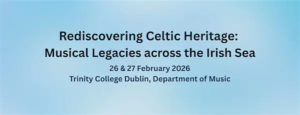
On 26–27 February 2026, I had the pleasure of participating in the international symposium Rediscovering Celtic Heritage: Musical Legacies across the Irish Sea, hosted at Trinity College Dublin . Set within the inspiring surroundings of the Trinity Long Room Hub Arts & Humanities Research Institute, the event brought together scholars, performers, and postgraduate researchers for two days of intellectually rich and genuinely generous exchange. From the outset, the atmosphere was open, collegial, and deeply engaged. This was not a conference where papers simply unfolded one after another; rather, conversations developed organically — continuing through coffee breaks, lunch discussions, and the evening concert. The sense of shared curiosity was palpable.
One of the most striking aspects of the symposium was its treatment of Celtic heritage not as a fixed or nostalgic category, but as something mobile and negotiated. Papers explored eighteenth-century music publishing networks, the politics of Celticism in the early twentieth century, convent education, repertoire reconstruction, and even contemporary folk metal .
Session 2, Celticism, Irishness, and Cultural Politics, opened up important discussions about internal colonialism and centre–periphery dynamics, prompting us to reconsider how composers from England, Ireland, Wales, and Scotland differently engaged with “Celtic” identity . These were thoughtful, theoretically nuanced presentations that challenged easy binaries.
Session 4, Transnational Exchange and Networks, resonated especially strongly with my own research interests . The papers in this session demonstrated how musical identities are shaped through friendship, mobility, patronage, and pedagogy — through lived relationships rather than abstract labels. It was a reminder that the Irish Sea has historically functioned less as a border and more as a conduit.
I presented my paper, Irish–Russian Musical Exchanges in the Long Nineteenth Century: John Field as Cultural Mediator, in Session 4. The paper reassesses John Field not simply as the inventor of the nocturne, but as a cultural mediator whose Irish musical identity was reframed and negotiated within Russian salon culture.
What made the experience particularly meaningful was the warmth and engagement of the audience. The questions that followed were thoughtful and genuinely constructive, opening up new angles on diaspora, reception history, and the language of national attribution. Rather than feeling interrogative, the discussion felt collaborative — the kind of scholarly exchange that moves research forward.
Several conversations afterwards — including with scholars working on Irish print culture and women’s networks — sparked ideas about comparative methodologies and archival parallels that I am already beginning to incorporate into the next stage of my project. It was one of those rare conference moments where you leave not simply affirmed, but intellectually sharpened.
The symposium also maintained a strong connection between research and performance. The opening workshop and the evening concert, featuring Quartet Draig and Welsh pop artist Ani Glass, powerfully reinforced the theme of living heritage . Hearing repertoire shaped by Welsh traditions alongside contemporary reinterpretations underscored that Celtic musical legacies are not museum pieces — they are continually reimagined in sound.
There was a particularly welcome emphasis throughout the programme on overlooked repertoires and voices, including women’s musical networks and amateur traditions. The blend of archival recovery, institutional history, and performer-led research made the event feel expansive rather than narrowly thematic.
The closing panel encouraged critical reflection on the category of “Celtic” itself . How do we use it responsibly? When does heritage become projection? And how might transnational frameworks help us move beyond reductive national narratives?
For me, the symposium was both affirming and energising. It reinforced the importance of approaching nineteenth-century music not within isolated national silos, but through networks of exchange, migration, and reinterpretation. It also demonstrated how vibrant and collaborative this field of scholarship continues to be.
I left Dublin feeling grateful — for the conversations, for the generosity of fellow researchers, and for the reminder that rediscovering heritage is ultimately about dialogue.