
Written by John Munro
In this rich commentary John Munro, co-director of the Centre for the Study of North America and new associate member of the Centre for Urban Wellbeing tells us about their “New Routes” conversation series. Researchers from Tunisia, US, UK and Germany met to discuss Elsa Devienne’s award winning book focussed on Los Angeles, Sand Rush. John picks up on a lively debate on the book’s relevance to understanding power, space and environments in the urban landscape. So too he weaves important connections made by the discussants between the historical emergence of surfing and skating as leisure pursuits and the unfolding and racialised politics of recourse extraction and recreation. We look forward to more events in this series as we urgently seek new ways of knowing urban modernity, understanding its cultural dynamics and addressing its enduring divides. The next New Routes conversation will be on 23 June, to discuss The Internal Colony: Race and the American Politics of Global Decolonization. by Sam Klug. Register here. It could not be more timely, see you there!
With spring almost in sight, we took to the beach.
On 27 February 2025, a discussion of Northumbria University historian Elsa Devienne’s remarkable book Sand Rush: The Revival of the Beach in Twentieth-Century Los Angeles marked the beginning of a new conversation series and a new collaboration. Hosted by myself and literature and media scholar Yosra Amraoui of the University of Carthage, this readers-meet-author session also launched “New Routes in Transnational American Studies: A Conversation Series from the Tunisian Association for American Cultural Studies and the University of Birmingham’s Centre for the Study of North America“.
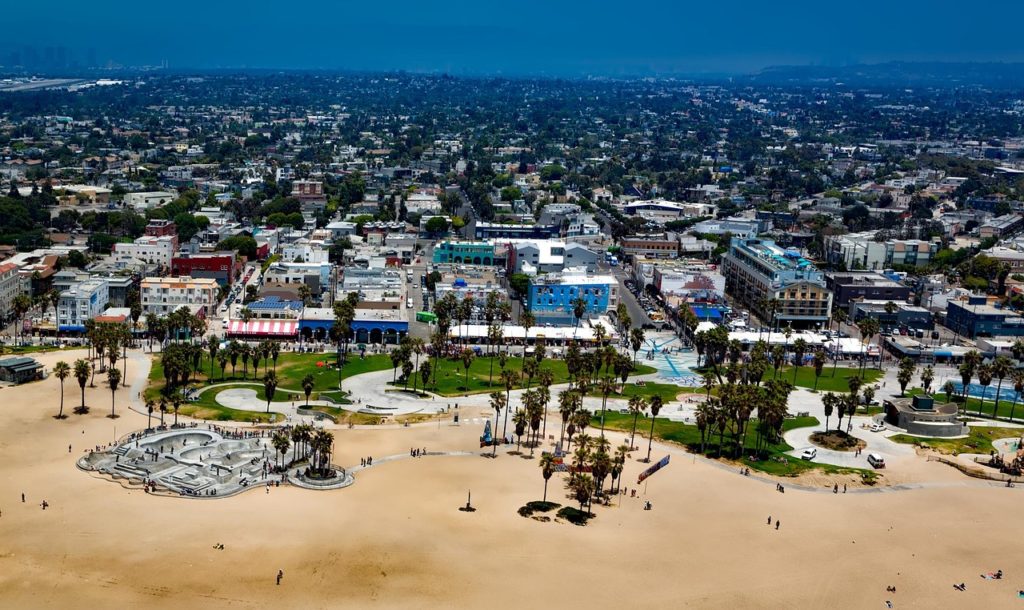
Originally published in French but now appearing in significantly revised form in English from Oxford University Press, Sand Rush makes a big contribution to the lively historiography of an extremely significant world city, but its bifocal urban and environmental lens also offers a novel view to anyone interested in the relationship between power and public space in twentieth and twenty-first century urban landscapes. No surprise then, that Devienne’s study has already nabbed the Organization of American Historians’ prestigious Willi Paul Adams Award and been long-listed for the French Association of Anglophone studies book prize. It was also unsurprising that the readers in this first “New Routes” conversation had no shortage of praise for what this work has accomplished.
But we didn’t meet to fawn over the book. Rather, we gathered to elaborate on its themes, ask questions, make transnational connections, and consider how Sand Rush resonates in the far-flung locations in which the session’s readers read it. The University of Mannheim’s Katharina Motyl started things off by doing all of the above. Perhaps most notable in her insightful remarks was her comparison between sand and snow, underscoring how the climate crisis that Devienne writes about is shaping access along axes of race, class, gender, and sexuality to both swimming and skiing. Next up was Michell Chresfield, of Cornell University, who placed the politics of leisure within an analytical frame sufficiently capacious to capture those dynamics in which racial capitalism and settler colonialism unsuccessfully wager that Black and Indigenous presence might, like a face drawn in sand at the edge of the sea, be erased.
For his part, the University of Sousse’s Oussema Othmeni offered a clarifying array of observations and questions pertaining to how the LA fires that recently caught the world’s attention can be better understood by attending to the relationship between the beaches of Los Angeles – and beyond – and ideologies of capitalist modernization. Last but not least, resource extractivism came into focus by way of Myka Tucker-Abramson (University of Warwick)’s generative comments on the ways oil acted as precondition for both public recreation along the waterfront and private transport within LA’s system of automobility. Elsa Devienne then responded to these and other issues readers had raised before the audience posed further questions about the writing process, privatization, gentrification, subcultures, the state of the field of American studies and, of course, Baywatch!
Dr. Devienne had her work cut out for her in trying to address the sheer range of issues and ideas this conversation spoke to. But just as on the pages of Sand Rush itself, she created a vivid image of the racial, urban, and environmental past and present by connecting a great many dots. The discussion also had a productively unfinished quality to it, creating a space from which panel and audience might go away with further thoughts. So let me add one of my own, prompted in particular by Michell Chresfield’s remarks. While reading Sand Rush and listening to this conversation, my mind returned repeatedly to images of how the Indigenous Hawaiian practice of surfing on water came ashore, as it were, in southern California when skateboarding adapted the activity on wheels and in swimming pools – emptied often enough by drought – and from there spread around the world, including as an Olympic sport in the author’s hometown just last year. I sometimes share instances of Indigenous skateboarding in places like Bolivia or Canada or Palestine with my students to exemplify Indigenous modernity. But Sand Rush and the conversations it is prompting has helped me to more clearly see how skateboarding has been a mode of mobility influenced by Indigeneity all along.
Read this book, listen to this conversation, and chances are you’ll be similarly presented with new insights, new ways to connect issues, and new routes along which to learn from and about transnational American studies.
The next book we’ll meet to discuss in the “New Routes” series is The Internal Colony: Race and the American Politics of Global Decolonization. This session will bring together readers Wassel Borghol (Sorbonne), Glen Coulthard (University of British Columbia), Priyamvada Gopal (Cambridge), Dayo Gore (Georgetown), and John Narayan (Kings College London) with author Sam Klug.
That New Routes session is on 23 June. Register here. See you there!