The 3-year project ‘Towards an authentic (German) language classroom’ has been made possible through the DAAD-programme ‘Promoting German Studies in the UK and Ireland’ and is funded by the German Foreign Office. It comes in response to the declining numbers of learners of German in particular and Modern Languages more generally, at secondary as well as tertiary level across the UK. It builds on the PI investigator’s previous DAAD-funded project, ‘Teaching German in a Transcultural World’.
Please read here how you can get involved!
Project Team
The project is situated in the School of Languages, Cultures, Art History and Music, together with the Institute for German and European Studies.
It is led by:
- Dr Ruth Whittle, Associate Professor in German, University of Birmingham, Principal investigator
- Dr Regina Seiwald, Deputy Director Languages for All, University of Birmingham, Co-Investigator
Our project partners are:
- Dr Ulrike Bavendiek, Director of the Centre for Teaching Excellence in Language Learning, University of Liverpool
- Sandra Reisenleutner, Assistant Professor, Modern Languages, University of Nottingham
- Dr Katharina Hirt, Universität Koblenz (Germany)
- Dr Christoph Bendfeldt, Universität Koblenz (Germany)
- Michelle Bebbon, M.Ed, Skills Academy (IKARUS) Universität Koblenz (Germany) – maternity leave
Project Overview
We understand ‘authenticity’ to be key for eliciting interest in language learning and the study of languages and cultures at Secondary and Tertiary level – in a degree part of which is ‘German Studies’.
Through this project, we aim to:
- deepen and increase our understanding of what ‘authentic’ means;
- build a network of HE institutions to research how ‘authenticity’ can be implemented in language teaching practice; run surveys in several partner institutions on what has been identified as best practice and how it was identified;
- develop materials for schools which network partners deliver to schools with whom they work, thus strengthening links between universities and schools in the respective region;
- encourage schools either to build new or strengthen existing networks, also but not solely by working with NCLE Hub schools;
- provide effective teaching resources online to teachers in order to support the production of engaging teaching material.
The project has two technical aspects:
- To promote hybrid teaching (asynchronous online and face-to-face) as an empowering means of learning German (as well as other languages) rather than as a cost-cutting exercise. Examples of how this promotes the authentic classroom include animated, interactive tools for practising grammar structures and facilities to host student blogs and podcasts created by learners individually or collaboratively.
- To design and build a database of resources alongside pedagogical guidance on their use. This will be accessible to all participants, and after the project, it can be managed by the hub leads, with input from teachers and academics.
Upcoming Activities
> Online Workshop <
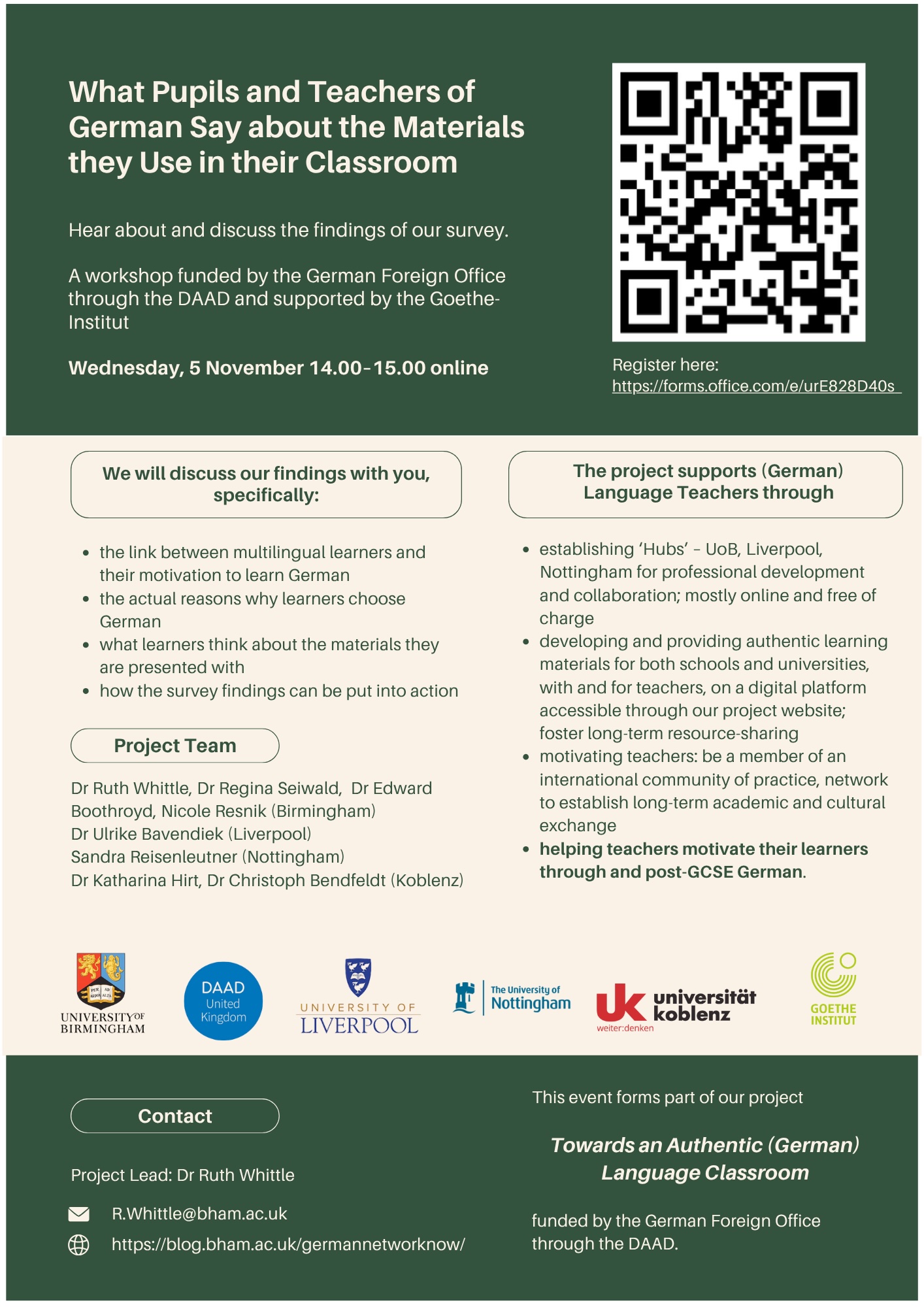
What Pupils and Teachers of German Say about the Materials they Use in their Classroom
Date: Wednesday, 5th November
Time: 14:00–15:00 BST
Please register here if you would like to join the event.