
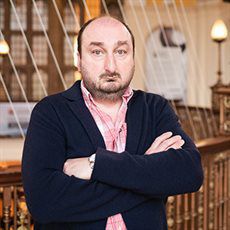
Professor Alexander Orakhelashvili
The Attorney General’s latest lecture on the relevance of international law to UK’s foreign policy, given at the Royal United Services Institute, has produced multiple adverse reactions. It is not my purpose here to assess the wider political implications of that discussion. Instead, I focus on those aspects of this debate that are relevant to the discipline of international law.
The Attorney General’s remark about Carl Schmitt’s approach to international law may be “clumsy” and, at any rate, the political spectrum that is not necessarily familiar with the detail of academic discourse on current implications of Schmitt’s political theory was perhaps liable to react to the Attorney General’s comment the way it did. On the other hand, Professor Richard Ekins, writing for the Spectator to criticise the Attorney General, is far more open about his own perspective on the Schmitt’s relevance in the current academic discourse. Ekins argues that Schmitt often features in scholarly debates “when an academic lawyer wishes to smear his or her opponents without evidence or argument”. He does not specify who those academic lawyers are. Besides, it is much more important that the academic community would be best able to judge or see through whether a particular writer advances the relevant thesis without evidence or argument.
Turning to the substance of the matter, it is abundantly clear that (as discussed in detail here, here, and here), while various ideas of Carl Schmitt were initially voiced in support of the agenda pursued in the Third Reich, they also underlie various political agenda witnessed over past few decades in relation to observance of international law by States in their mutual relations, and also in their national legal systems. It cannot be sensibly contended that theoretical or analytical constructs developed by Schmitt at the service of the extreme evil agenda pursued almost a century ago are impossible to be put at the service of more modern or modest political aims – on the international or domestic plane – that have nothing to do with the Third Reich.
The international law aspect
Schmitt’s central thesis was that the international legal system had never been truly universal, which factor provided, in his view, some justification for the rising or growing national power to regard itself and its own political agenda exempted from the binding and regulatory force of international law. On the empirical plane, the limited representation of great powers in the League of Nations was seen to reinforce Schmitt’s assertions. To the contrary, the Attorney General’s speech has emphasised the universality of international law and institutions in which all great powers participate from 1945 onwards, regardless of their diverging political agenda or ideological persuasion. However, after the end of the Cold War and the emergence of what was seen by many to be the sole remaining superpower – the USA – the original 1945 consensus was seriously compromised. It was the US-led agenda, pursued by mainly Western governments, that has engaged in the manipulation of legal argument to justify the use of force and re-drawing national boundaries not warranted under the UN Charter and general international law, in relation to crises of Iraq and Kosovo. The rising US-led Western power, supported by the ideas of hegemony and “indispensable nation” as the former Secretary of State Madeleine Albright described the USA, was no longer happy to observe legal constraints that were relevant before. Following the view of the Foreign Secretary, the Attorney General correctly suggests that we should move away from the perceptions of 1990s that are no longer suitable to the modern multi-polar world consisting of several power centres that do not share the same political and ideological agenda. He suggests that the opposite attitude, which he denotes as “a pick and mix” approach to international law, could reinforce President Putin’s agenda that holds international law in contempt. In fact, it has been doing that for decades, because if some great powers pursue their political agenda and enhance their power position at the expense of legal requirements, other great powers are bound to do the same. Hence, any asymmetry in the great powers’ compliance with legal requirements limiting their political choices is bound to have both legal and political consequences that are not always foreseen or desired by those who initiate the agenda of superpower selectivity (as further discussed on this Blog earlier, here, here and here).
Ekins suggests “international law is important” and adds that “it has always remained open to sovereign States when or whether to comply with a particular [international legal] obligation.” In a democracy, he suggests, it is up to the parliamentarians to make the relevant decisions. Apart from being inimical to the core of international legal reasoning, this assertion is essentially about the nation-State being immune from the effect of its international law; it fully reflects Hobbesian and Hegelian theories of denial of international law’s binding force, contextualising those theories with modern liberal democracy (see here for further detail). Ekins also suggests that, in the recent treaty, the UK Government has “ceded” the Chagos Islands to Mauritius. However, cession was out of the question in this case, because the status of Chagos has been governed by the principle of self-determination and it has legally formed part of Mauritius ever since the latter’s independence, as was confirmed by the International Court of Justice. Consequently, Article 1 of the Treaty merely acknowledges that “Mauritius is sovereign over the Chagos Archipelago in its entirety, including Diego Garcia.” Therefore, the Treaty neither creates a territorial title nor cedes territorial sovereignty to Mauritius. It simply gives effect to UK’s obligations arising under international law.
The UK law aspect
Ekins takes the issue with the Attorney General’s allusion to the point by his predecessor Dominic Grieve MP that “it is Her Majesty’s intention that her servants should observe binding [international] agreements”, and counters this point by suggesting that “the King’s intentions do not determine the constitutional duties of the ministers on whose advice the King is constitutionally obliged to act.” It is hardly likely, however, that the former Attorney General meant the monarch as a specific person. Instead, the monarch in this context refers to the Crown or the State, and the projection of a certain duality between the monarch and their ministers is hardly plausible. Ministers “advise” the King, which in reality means that ministers make the relevant decisions that either comply with UK’s international obligations or violate them, as opposed to the King intending to comply with international law and then ministers being free to act to the opposite effect.
More importantly, as I detailed in my inaugural lecture, there is ample evidence that the UK’s legal and constitutional system regards international law as binding in relation to both English courts and UK’s public officials, contrary to what Ekins is suggesting. This has been a long-standing view both in courts and in Government circles. The Grieve-Hermer point that the duty to observe international law is enshrined in the UK’s unwritten constitution is therefore correct.
The outlook
Political controversies should not lead to overlooking some principal points the Attorney General has made, or the momentum it could generate. The Attorney General’s speech is the first speech of its kind not only in the UK, but in the entire Western World, in that it professes that the UK Government has to comply with international law without substantial caveats or selectivity, as opposed to complying with it when it is politically suitable. In that sense, this lecture is a rather fortunate instance that sets the UK Government’s position apart from the decades of manipulation of the international legal reasoning over the past few decades with regard to a number of issues such as use of force, statehood, recognition or collective security. As such, this speech is to be welcomed as the useful first step and also, given that the current Prime Minister has international law expertise, it should be hoped that it will lead to a greater consolidation of the culture of compliance with international law by the UK Government, that it will decrease if not eliminate the Government’s need to rely on legal advice that manipulates or distorts the content of international legal requirements, and that it will also persuade other Western States to more solidly prioritise the compliance with international law in their foreign policies. Because, if it will not, the Western States are highly unlikely ever to increase their influence and power position in relation to non-Western centres of power such as China and Russia. There would be more cases like Ukraine, and Western powers would hardly be able to do anything substantial about it.