
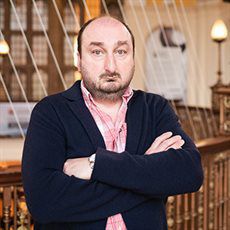
Professor Alexander Orakhelashvili
In a post recently published on EJIL:Talk! Professor Marko Milanovic raises the possibility of States assisting Ukraine with funds, weapons or otherwise could recover from Russia sums they spend on providing that assistance, and whether the International Court would be likely to endorse such claim. That Russia owes Ukraine reparation for harms ensuing from its use of force against Ukraine is beyond dispute. The question is, however, whether the claim of Milanovic regarding the entitlement of third States to recover from Russia is supported either by established categories of international law or by the practice of international courts and tribunals.
Milanovic begins with the undisputed premise that third States are entitled to assist Ukraine, but then follows up with the suggestion that in some cases this assistance could amount to an indirect use of force against Russia that would be lawful under international law. However, use force against any State including Russia cannot be lawful simply because it grows from or relates to assistance provided lawfully to the victim of aggression. There is a clear-cut distinction between aid and assistance as a pattern of relationship between the assisting and assisted State without any military confrontation, and use of force against either the victim or the aggressor State. “Indirect use of force”, discussed here and here, is an unreal concept. Any use of force, including against an aggressor State, can be justified only under the general regime of jus ad bellum that includes the criteria governing collective self-defence which would provide the most straightforward criteria in this situation than any other doctrinally invented notion. Milanovic suggests that Western assistance to Ukraine “may at least partly be seen as an exercise of collective self-defence”; but it cannot be seen as that unless it were to involve use of force against Russia (see here, among others).
When discussing the ILC’s provisions on reparation, Milanovic introduces the causation points into his thesis, and refers to ILC’s Article 31 which speaks of “injury caused by the internationally wrongful act”. While he suggests that causation is of central importance here, it happens that the words such as “injury” and “internationally wrongful act” are just as important. Paragraph 9 of the commentary to Article 31 is clear that the issue of causal link is about “the injury resulting from and ascribable to the wrongful act, rather than any and all consequences flowing from an internationally wrongful act”. In other words, the injury in question must follow from a State’s internationally wrongful act which is, in its turn, attributable to the relevant State. Russia cannot cause injury to Western States assisting Ukraine unless it commits an internationally wrongful act against them. Russia’s aggression against Ukraine does not involve such wrongful act against third States.
By contrast, Milanovic seems to opt for a notion of causal link that is entirely divorced from attribution. He suggests that “had it not been for Russia’s aggression against Ukraine, the US, UK, France would not have spent billions on rearming Ukraine to help defend it against Russia.” There is some causal link here, obviously, but that is a pure material causation that the legal system does not account for. The only concept of causation that the international legal system could operate with is one closely related to attribution, because only such narrower concept of causation (one in contradistinction to a material or common sense notion of it) could encompass the essence of internationally wrongful act. The fact that Western States voluntarily choose to assist Ukraine is of key relevance here, among others because the voluntary nature of their conduct also manifests the separateness of that conduct from Russia’s conduct. Voluntariness is here an incidence of attribution requirements, and Russia is responsible only for its own conduct and for injury that follows from that conduct, which is ontologically different from third State conduct that might not have taken place but for Russia’s conduct. Neither but for causation, nor any other causation test could make sense under international law if divorced from the fundamental concept of attribution. Even in national legal systems, causation is not a loose concept dependent on common sense and abstract sense of justice but one firmly tied to the overall legal framework. The reason why those airlines do not take into account hit-and-run drivers’ situation is that under the legal system they do not have to do so. It is the law, not the abstract justice, common sense of subjective opinion that determines what could be a legally relevant cause for what.
Milanovic further invokes the practice of UN Compensation Commission, especially Saudi Arabia claiming compensation for environmental harm caused by Iraq’s aggression against Kuwait. He suggests that “the injury suffered (and ultimately compensated) by these states was of course different from that of Kuwait, the direct victim of Iraq’s aggression, but it was likewise caused by that aggression.” What is missing here is the obvious distinction that the harm caused was still a product of Iraq’s own activities, not of any third State activities. Moreover, collective self-defence was clearly involved in that case, as was Chapter VII mandate granted to the coalition by the Security Council, which is a differential that could feed into the relevance of third States being “specially affected” the way that Milanovic claims to be at the example of Western States in the Ukraine crisis. Overall, the UNCCs’ reliance on the damage caused by coalition forces was far more nuanced, and whatever was affirmed as a general premise was not invariably implemented in relation to specific facts and situations.
Milanovic also suggests that Western assistance to Ukraine “is in line with the duty of all states to cooperate to put a serious breach of a peremptory norm to an end”. That is very true, as far as it goes, but still not the same as Russia committing an internationally wrongful act against those Western States. The duty in question relates to one particular wrongful act and the latter remains what it is, without miraculously generating another wrongful act committed against different States.
To sum up, international law does not embrace a loose and common sense notion of causation that is divorced from other relevant concepts of international law such as attribution. If it did, that would in theory provide all things to all people and tastes; in practice, however, this would encourage political agenda to be presented as legal argument and induce international courts and tribunals to carry out Humpty Dumpty-style judgment that causation means what they choose it to mean. However, in a legal system based on agreement between States, courts and tribunals cannot act and have not acted like Humpty Dumpty.