
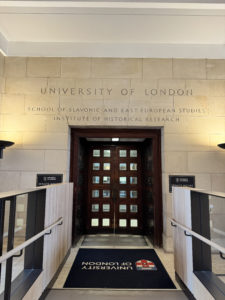
On 25 October, scholars from across Europe gathered at Senate House in London for the annual conference of the Study Group for Slavonic and East European Music (SEEM), held under the auspices of BASEES. The study day offered a compelling glimpse into the rich and often overlooked musical cultures of Eastern Europe, with a particular focus on women composers, performers, and scholars from the 19th century to the present day.
The event opened with two parallel sessions, setting the tone for a day of thoughtful exploration into the intersections of gender, nation, and musical identity. Papers ranged from detailed analyses of Ljubica Marić’s liturgical-inflected orchestral works to new perspectives on the revival of Georgian and Romanian folk music through women’s voices. In a notable presentation, Ioana Carina Cîrtiță traced how Carmen Petra-Basacopol’s piano music negotiated the pressures of Socialist Realism with an emerging modernist aesthetic in post-war Romania.
In Session III, musicologists turned their attention to the 19th century. Professor
Marina Frolova-Walker examined the feminist ambitions of the Damskii zhurnal (Ladies’ Magazine), a rare early Russian periodical to spotlight women’s musical activity. I was pleased to contribute to this panel with a paper on John Field’s Russian female dedicatees, revealing new biographical insights into the salon musicians and aristocratic women who helped sustain Field’s career during his three decades in St Petersburg and Moscow. Drawing on previously unexamined Russian-language sources, the research sheds light on Field’s role in shaping the early Russian nocturne and on the complex social roles of his female students and patrons.
Later sessions explored contemporary issues of identity and resistance. Papers on Ukrainian wartime compositions, alternative music in Belarus, and Soviet ballet in Kazakhstan underscored the political weight of music-making in post-Soviet and postcolonial contexts. Particularly striking was a discussion of the recent project Ukrainian Women Creators with Their Weapons, which highlights the resilience of women composers amid conflict.
The final panels turned to the role of women as musicologists and historians. Elina Viljanen’s examination of Soviet theorists Nadezhda Briusova and Tamara Livanova revealed the intellectual contributions of women working within male-dominated academic structures. These closing discussions reinforced a key theme of the day: that the history of Eastern European music is as much about who is remembered as it is about what is remembered.
SEEM’s study day continues to offer a vital platform for new research into the Eastern European musical landscape. With its blend of archival depth, critical reflection, and international participation, the conference reaffirmed the urgent need to expand and diversify the canon of music history.
