
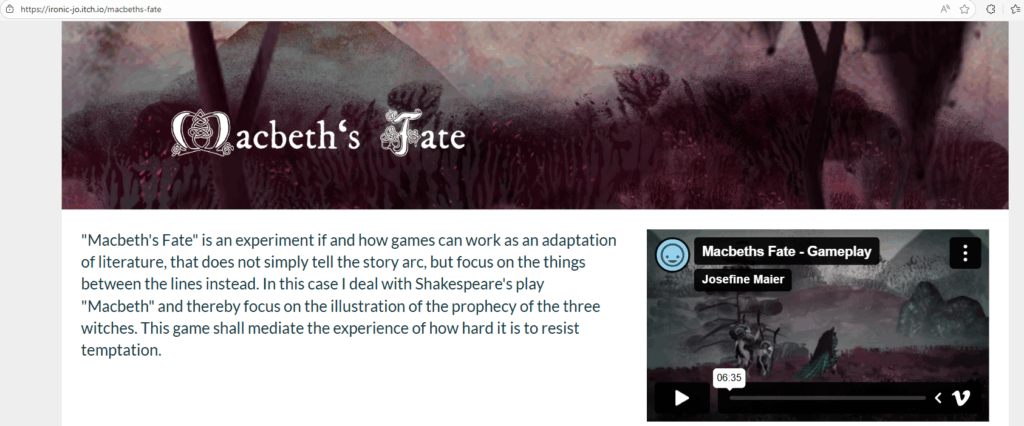
My experience on the CRI which I participated in was overwhelmingly positive. The basic premise of the thing was that we, a collection of interns, would play and review a variety of games which were either inspired by, directly based on, or which incorporated, Shakespeare. Having done this, we would fill out a form assessing the strengths and weaknesses of the game, as well as addressing its use of Shakespeare and how we felt this was handled. I played four games, two (Merchant and Macbeth’s Fate) free from a website called itch.io, where small and indie developers can upload and sell games:
and two (The Nine Lives of Nim: Fortune’s Fool and Elsinore) from the more popular platform Steam.

I found that the two games from Steam were far more enjoyable, with Merchant and Macbeth’s Fate proving to be, respectively, a barely-Shakespeare maze game, and a barely interactable walking simulator.
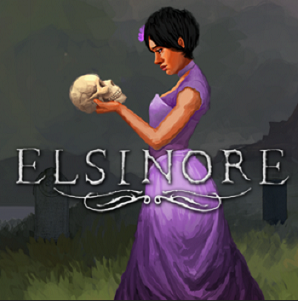
Elsinore, perhaps my favourite of the games, allows the player to explore the world of Shakespeare’s Hamlet from Ophelia’s perspective, implementing timeloop and supernatural elements which allow the player to attempt to prevent the tragedy of the play. TNLoN:FF, on the other hand, proposed an entirely fantasy environment populated by Shakespeare’s characters: the fictional city of Vanora, in which the player attempts to locate the missing Prince of Cats (an actual magical feline, not Tybalt). Of the two, TNLoN:FF had more replayability, but Elsinore provided a far more interesting premise. I would encourage any interested parties to check these two games out – each cost less than £10 at the time I played them, and both were excellent.
Midway through the internship’s duration, with some games reviewed and forms in, we were invited to each give a short <5min presentation about one of the games we had played at the Shakespeare Institute to a panel of attendees, most of whom were in the field of education, or Shakespeare specialists. I gave my presentation on the game Macbeth’s Fate as I felt that despite its extremely limited mechanical scope and interactivity, it was still visually interesting and had potential as an educational tool. After we had each given our presentations, we took questions from the audience about them. Following these questions we sat in on and participated in a roundtable discussion on the topic of education in the UK, which was both very interesting and uniquely informative. The day of presentations and discussions proved a valuable opportunity to learn, both from our fellow interns and from the other attendees, many of whom were experienced educators and academics.
Overall I feel that the CRI provided a valuable and highly enjoyable opportunity to play and enjoy several interesting games, and to simultaneously make a meaningful contribution to the catalogue of game reviews which researchers at the Shakespeare Institute have on hand, better enabling them to be discerning in their choice of games to further research and play. Videogames remain, in my opinion, a goldmine of material for study and research in the field of English Literature and Shakespeare Studies.