
During June and July this year (2024), I was chosen to be an intern for the Collaborative Research Internship project titled ‘Lench’s Trust Almshouses: Old Age provision in 19th/20th Century Birmingham’, led by Professor Nicholas Crowson of Contemporary British History. I worked alongside another history student, Megan Paskin, to reconstruct lives of women who lived in a particular almshouse on Conybere Street in Birmingham.
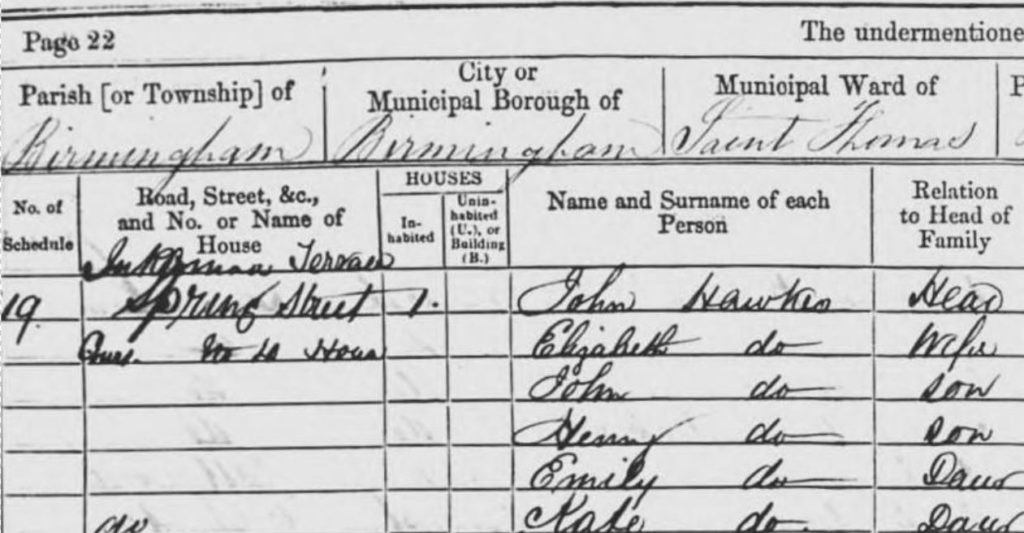
Using FindMyPast, we had access to censuses from 1881 to 1921 for Conybere Street. To begin to recreate a resident’s life I would start by picking a census then choosing a name from one of the residents. The research included finding additional censuses, birth, marriage and death records, and electoral rolls. For example, Elizabeth Hawkes was present as an almswoman in the 1901 and 1911 censuses. Elizabeth was born in Birmingham in 1824 and died in 1916, presumably in the almshouse. By using the 1861 census, I discovered her husband’s name John Hawkes and her four children (John, Henry, Emily and Kate). This meant I could use this information to find the record of their marriage, 1846, and the births of their children. With the birth records of their children, it was easy to identify her maiden name, Lawson.
This research is very emotive, as when you uncovered stories of their lives you rediscovered their losses too. Unfortunately Elizabeth’s daughter Kate had died only age 8 and then her eldest son married and moved out to live with his wife Hannah. However the other side of this research shows the birth of her grand children and her family extending. After the death of husband John Hawkes, it is concluded that Elizabeth moved into the almshouse. I like to believe that she enjoyed her time at Conybere, especially since she was there for over ten years. Revealing the history of Elizabeth’s life shows the importance of almshouses supporting women during their old age.
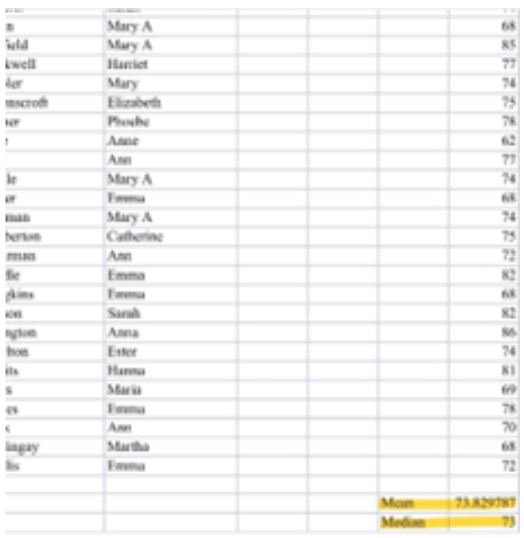
After reconstructing more lives of women at Conybere from the 1911 and 1921 censuses, I became interested in data about these women’s ages. From my example before, Elizabeth died at the age of 93 which was a considerable age in this time period. I used excel to find the mean and medians for the ages of the women present in the almshouse in the 1901 and 1911 censuses. I was able to compare this to the averages already discovered in 1921 and 1939 by Prof Nick Crowson. This showed a trend of the mean and medium being similar as well as the age of these women to be higher than other almshouses across the country. In 1901 I found that the average age of women was 73 whereas in London almshouses this was 71. The data could suggest Birmingham almshouses had improved public health allowing women to live their last years peacefully.
To conclude my internship, Megan and I were invited to Lench’s Trust HQ to discuss our findings by Prof Nick Crowson and the CEO Dominic Bradley. When we arrived we discovered a community of residents still living at Lench’s Trust. The research we have gathered from our internship will be used in a larger project for the 500-year anniversary of the almshouse. They are devoted to bringing these stories to life to understand what daily life was like in the almshouse.
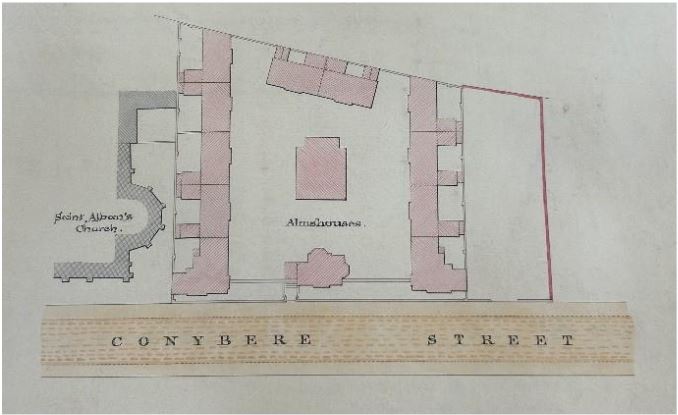
It has been a privilege to be a part of this project. I am grateful to have had the opportunity to uncover lives of these women which show the importance of almshouses. I would recommend this experience of the Collaborative Research Internship to all students interested in academic research within the university.
Jessica Harris, BA History