
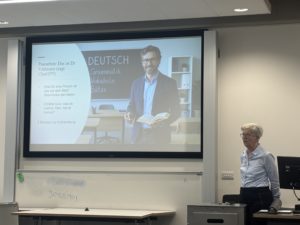
At our recent language event at the University of Birmingham, Dr Ruth Whittle gave an inspiring talk on how AI can be used to create engaging lesson materials, encourage critical thinking, and challenge stereotypes in the language classroom. Using the simple prompt “Dr Feldmann arbeitet an einem Gymnasium in Frankfurt. Beschreibe seinen Tag in wenigen Worten.” (“Dr Feldmann works at a secondary school in Frankfurt. Describe his day in a few words.”), the audience quickly discovered just how creative—and unpredictable—AI can be.
From one simple prompt to authentic language learning
The results were often hilarious. Some versions of Dr Feldmann seemed so busy that he never even found time to eat breakfast, lunch, or dinner! Most AI-generated responses assumed that Dr Feldmann was male, and when asked to create an image, the AI produced the picture of a rather stereotypical-looking teacher.
Beyond stereotypes?
These outputs opened up countless opportunities for classroom discussion. Students could compare their different versions of Dr Feldmann by asking each other questions in German: Is Dr Feldmann married? What are his hobbies? How does he get to work? What does a “typical” teacher actually look like? Why did the AI make these assumptions? Perhaps the most valuable lesson, however, was about critical thinking. Even though everyone used exactly the same prompt, the AI produced different responses every single time. In one version, Dr Feldmann cycled to school because he was particularly sporty. In another, he turned out to be an enthusiastic admirer of Hermann Hesse. These surprising variations highlighted that AI-generated content is not objective or fixed, but shaped by probabilities, patterns, and underlying biases.
Dr Ruth Whittle’s talk highlighted how AI prompts can be used to create authentic, engaging classroom materials that support communication and vocabulary practice, while also prompting valuable cultural reflection on stereotypes such as what German teachers are typically like teaching materials. AI can also become an engaging starting point for conversations about language, culture, stereotypes, and the importance of questioning the information technology presents to us.