
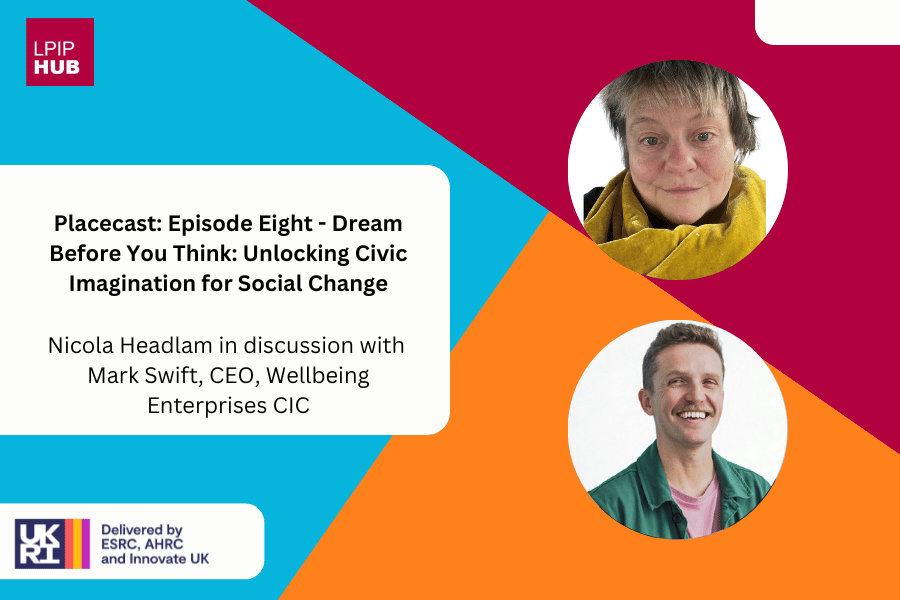
Episode Eight of the Placecast Podcast dives deep into the power of place-based leadership and social entrepreneurship with guest Mark Swift, a social entrepreneur with over 15 years’ experience in health and care. Hosted by Nicola Headlam, the conversation explores how community-centred approaches can transform health outcomes, reduce demand on public services, and reconfigure system architecture for a more inclusive future. Mark shares his journey from NHS public health specialist to founding Wellbeing Enterprises, his lived experience shaping his mission, and his vision for civic imagination as a driver of social change.
Placecast is a Local Policy Innovation Partnership (LPIP) Hub production based at City-REDI, University of Birmingham. Our new podcast is essential listening for those keen to explore the ins and outs of knowledge mobilisation for influence in central and local government, based on the view that it’s only through animating the power of place-based leadership that the wicked problems of 2025 can become more manageable.
Guest speaker
Mark Swift is a serial social entrepreneur with over 20 years of experience working with the public and private sectors. He is the Founder CEO of Wellbeing Enterprises – a healthcare social enterprise, and one of the first Community Interest Companies (CICs) to be established. His special interests include health creation and health equity, social entrepreneurship and social economy and accelerating social innovation processes and social value creation.
He has previously held positions in the NHS as a Public Health Improvement Specialist and a Senior Project Manager, leading on Clinical Quality. He is currently a Fellow of the Heseltine Institute for Public Policy, Practice and Place at the University of Liverpool and Ashoka, which identifies and supports the world’s leading social entrepreneurs.
Host
Dr Nicola Headlam has more than 20 years of experience working within all aspects of the multi-helix innovation system; central and local government, civil society and campaigning, academic research and knowledge mobilisation and in industry. Along the way, she has honed expertise in urban and regional subnational economic development, the roles of government in making and shaping place, and in data and evidence for transformation.
In 2024, she became a freelance economic advisor on the role of leadership and partnerships, urban and living lab forms for research, future of cities and foresighting methods, urban transformations, place-branding and urban regeneration and the spatial consequences of public policy.
Key takeaways from the conversation
From NHS to Social Enterprise: A Journey of Insight and Lived Experience
Mark began his career in the NHS, where he observed the resilience and ingenuity of communities despite adversity. His own experience with mental health challenges reinforced the need for grassroots, strengths-based approaches. This inspired him to create a community business focused on mobilising citizen power for better health outcomes.
The Power of Place and Community Assets
Mark argues that prevention-first strategies require engaging with the social circumstances of people’s lives. Initiatives like social prescribing and citizen asset mapping demonstrate how communities can co-create solutions, shifting from deficit-based narratives to recognising strengths and capabilities.
Learning Through Doing: Ethics and Innovation
Social entrepreneurship, for Mark, is about “learning through doing” and aligning means with ends. He emphasises creating psychologically safe spaces for experimentation, convening diverse stakeholders, and orbiting systems—innovating on the boundaries before bringing ideas to the centre.
LPIP and System Stewardship
Mark’s involvement with the Local Policy Innovation Partnership (LPIP) reflects his commitment to cross-sector collaboration and knowledge mobilisation. He champions moving beyond rhetoric to action, building trust and reciprocity as prerequisites for system change.
Imagination as Infrastructure: The Imaginarium
One of the most exciting developments is the launch of the Liverpool City Region Imaginarium—a space designed to unlock civic imagination for social change. Through imagination labs, system sandboxes, and citizen-led policy briefs, the Imaginarium aims to reconfigure governance and foster participatory, inclusive systems.
Leadership for Complex Times
Mark calls for a new duality in leadership: balancing institutional responsibilities with system stewardship. Leaders must nurture collaboration, build inclusive governance, and resist the temptation to rush into “doing” before laying the foundations of trust.
Practical Lessons for Change
- Surround yourself with radically different people.
- Build diverse, inclusive networks.
- See citizens as solutions, not problems.
- Dream before you think—use imagination to unlock possibilities.
- Recognise that structure and function are relational.
- Prioritise learning as the foundation for innovation.
Show notes
Another World Is Possible: How to Reignite Social and Political Imagination, Geoff Mulgan, 2022
Utopia as method: the imaginary reconstitution of society, Ruth Levitas, 2013.
Unlocking social imagination: reawakening the public sector’s capacity to transform, blog by Mark Swift, 2025.
Liverpool City Region’s Imaginarium to Launch: A New Civic Space for Unlocking Community Imagination
Transcript
Find out more about the Local Policy Innovation Partnership Hub.
Disclaimer:
The views expressed in this analysis post are those of the author and not necessarily those of City-REDI or the University of Birmingham.
Generative AI was used to summarise the transcript from the podcast to create the introduction and key points for the blog.