

The West Midlands Region Economic Development Institute (WMREDI), led by City-REDI, University of Birmingham, has been a transformative force in regional economic development. At its heart lies a unique partnership model—a collaborative framework that brought together universities, local authorities, businesses, and civic institutions to co-produce research, policy, and innovation.
City-REDI is now leading the Local Policy Innovation Partnership Hub. This blog explores the WMREDI partnership model, how it worked, what made it successful, how it could be scaled and what lessons can be learned for those trying to develop local partnerships.
For those developing local partnerships, the WMREDI partnership model offers a proven blueprint for building effective, place-based collaboration between universities, civic institutions, and regional stakeholders. WMREDI demonstrated how long-term investment in shared governance, flexible commissioning, and embedded social science expertise can create a responsive and resilient research-policy ecosystem. Its success hinged on trust, co-production, and a hybrid structure that combined academic rigour with policy agility. Crucially, WMREDI’s collaboration agreement enabled seamless joint working across institutions, while secondments and shared infrastructure fostered deep engagement. Local partnerships can learn from WMREDI’s emphasis on building capacity within local institutions, aligning research with regional priorities, and maintaining adaptability in the face of shocks. However, they should also avoid common pitfalls: short-termism, fragmented funding, and underestimating the time needed to build trust and institutional alignment. WMREDI’s experience shows that impactful place-based partnerships require not just good intentions, but the right structures, incentives, and sustained commitment.
What was the WMREDI Partnership Model?
WMREDI was built on the recently established City-REDI Model and delivered by the City-REDI team. It was a place-based, problem-led approach. Rather than operating as a traditional academic centre, it functioned as a hybrid institute, combining rigorous social science research with responsive policy engagement.
Key features of the model included:
- Shared governance through a formal collaboration agreement.
- Flexible funding mechanisms allowing co-investment and joint commissioning.
- Secondments and placements to embed expertise within partner organisations.
- Open, trust-based relationships with a “we’ll do this together” ethos.
- A physical civic space at The Exchange in Birmingham to host collaboration.
Why It Worked
Several factors contributed to the success of the WMREDI model:
- Long-term investment: Funding from Research England and matched contributions from partners provided stability and flexibility.
- Interdisciplinary team: Social scientists worked alongside economists, policy analysts, and data specialists to address complex regional challenges.
- Responsive structure: The team could pivot quickly to support partners during shocks like Brexit, COVID-19, and the cost-of-living crisis.
- Embedded civic mission: The University of Birmingham’s commitment to civic engagement enabled WMREDI to act as a trusted regional anchor.
How Could It Be Scaled Elsewhere?
The WMREDI model offers a blueprint for other regions seeking to build regional research-policy ecosystems. To replicate or adapt it, the following elements are essential:
- Anchor institution leadership: Universities must commit to civic engagement beyond traditional teaching and research.
- Flexible funding and commissioning: Regional partners need mechanisms to co-invest and share resources.
- Shared vision and governance: A formal collaboration agreement helps align goals and streamline operations.
- Dedicated infrastructure: A physical space for collaboration fosters visibility, trust, and informal exchange.
- Investment in people: Stable contracts, career development, and secondments build capacity and continuity.
Lessons Learned
WMREDI’s experience provides valuable insights for others:
Things to go:
- Build trust through transparency and shared goals.
- Invest in long-term relationships, not just short-term projects.
- Create structures that allow for co-production and joint delivery.
- Recognise and reward civic engagement within academic institutions.
Things to avoid:
- Over-reliance on short-term funding or project-based contracts, need to create balanced portfolios which enable researchers to react to need and carry out long term research to understand and change structural issues.
- Assuming partnerships will work without formal agreements or shared governance.
- Not valuing research skills beyond the academic and university sector.
- Treating civic engagement as an add-on rather than a strategic priority.
- Ignoring the need for internal university reform to support flexible collaboration.
Conclusion
The WMREDI partnership model shows that social science-led, place-based collaboration can drive meaningful change. It’s not just about research it’s about building the infrastructure, relationships, and capacity to make research useful, timely, and impactful.
As regions across the UK seek to tackle inequality, boost productivity, and respond to economic shocks, the WMREDI model offers a powerful example of how universities can lead the way not just as knowledge producers, but as civic partners.
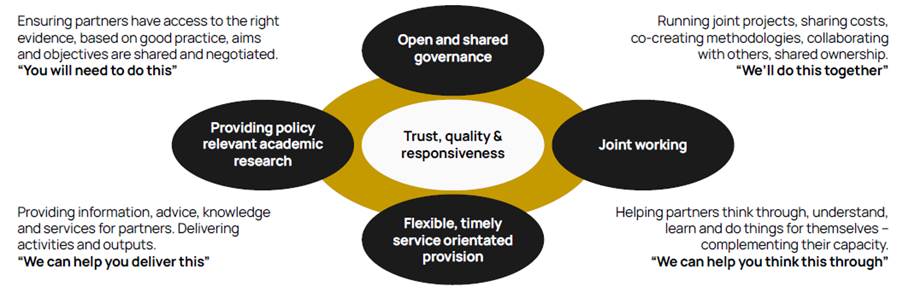
WMREDI was based on a partnership model which focused on collaboration and building trust through quality and responsiveness. We have delivered through mutually reinforcing aims of open and shared governance, joint working, flexible, timely service-oriented provision and providing policy-relevant academic research. These are conceptualised in the statements:
- We will do this together
- We can help you think this through
- We can help you deliver this
- You will need to do this
This blog was written by Rebecca Riley, Professor for Enterprise, Engagement and Impact, City-REDI, University of Birmingham and the Director of the LPIP Hub.
Find out more about the Local Policy Innovation Partnership Hub.
Disclaimer:
The views expressed in this post are those of the author and not necessarily those of City-REDI or the University of Birmingham.