
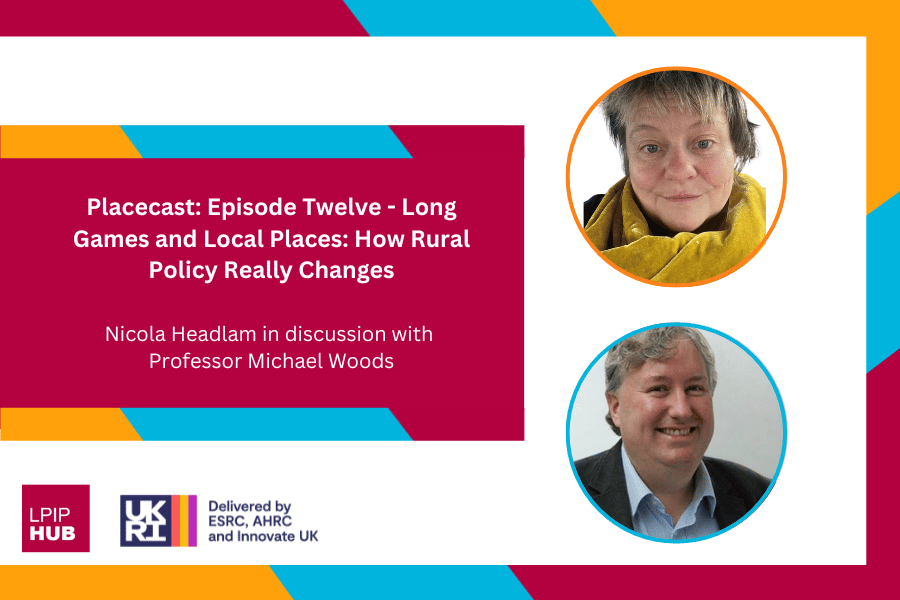
In the latest episode of Placecast, Professor Michael Woods, Director of the Cymru Wledig LPIP (Rural Wales), offers a rich and thoughtful journey through Welsh devolution, rural policy, and the power of deeply embedded place-based research. It’s a conversation that blends decades of academic insight with a grounded understanding of how communities, policymakers, and researchers mutually shape one another.
Placecast is a Local Policy Innovation Partnership (LPIP) Hub production based at City-REDI, University of Birmingham. Our new podcast is essential listening for those keen to explore the ins and outs of knowledge mobilisation for influence in central and local government, based on the view that it’s only through animating the power of place-based leadership that the wicked problems of 2026 can become more manageable.
Guest speaker
Professor Michael Woods is the Director of the Cymru Wledig LPIP (Rural Wales), the Local Policy and Innovation Partnership for Rural Wales. It connects academic researchers, public bodies, third and private sector organisations and communities to enhance the use of research and innovation to support effective policy-making, sustainable regional development, and the wellbeing of people and places across rural Wales.
Michael Woods joined Aberystwyth University as a Lecturer in Human Geography in 1996, became Professor in 2008, and has since held major leadership roles, including Director of the Institute of Geography and Earth Sciences and Professor of Transformative Social Science. A leading rural and political geographer, he co-directs WISERD@Aberystwyth, has led major international projects such as the ERC-funded GLOBAL-RURAL and Horizon 2020 IMAJINE, and previously co-directed the Wales Rural Observatory. He is Editor of the Journal of Rural Studies, a Fellow of the Academy of Social Sciences and the Learned Society of Wales, and an award‑winning researcher with visiting posts in China, Slovenia and Australia, as well as service on the Welsh Government’s Independent Review of Student Finance.
Host
Dr Nicola Headlam has over 20 years of experience working across all aspects of the multi-helix innovation system, including central and local government, civil society and campaigning, academic research and knowledge mobilisation, and industry. Along the way, she has honed her expertise in urban and regional subnational economic development, the roles of government in shaping place, and in utilising data and evidence for transformation.
In 2024, she became a freelance economic advisor on the role of leadership and partnerships, urban and living lab forms for research, future of cities and foresighting methods, urban transformations, place-branding and urban regeneration and the spatial consequences of public policy.
View Nicola’s LinkedIn Profile
Key themes and insights from the podcast
Reflections on Welsh Devolution
- Wales now has “mature” devolved institutions, but the journey has been complex.
- Historically, rural development bodies were merged or dissolved, creating gaps in rural representation.
- There are renewed calls for a dedicated rural development body for Wales.
Challenges of Multi‑Level Governance
- Unlike England’s city-region model, Wales’ geography makes devolving power to city regions difficult.
- This raises questions about how rural areas fit into devolved governance alongside Cardiff.
Strengths of Working in a Small Nation
- Wales’ size creates proximity between researchers, policymakers, and politicians.
- Strong relationships enable meaningful policy influence and rapid knowledge exchange.
Building the Rural Wales LPIP
- The LPIP builds on previous work, such as the Wales Rural Observatory, but is intentionally more inclusive.
- Partners include local government, community groups, social enterprises, and civil society, not just the Welsh Government.
- Co‑production and “responsive research” are central principles.
Examples of Co‑Produced Projects
- Rural crime survey (designed with police, Welsh Government, local authorities).
- Women in farm entrepreneurship (developed with farming unions and community groups).
- Cultural heritage and rural identity work showcased at the Eisteddfod and Royal Welsh Show.
Realities of Policy Impact
- Translating research into policy is slow, sometimes taking many years.
- Earlier research on town and community councils eventually influenced legislation and expanded local powers.
- Post‑Brexit, Wales has lost important community-led local development frameworks previously funded by the EU.
International Learning
- Woods draws on experience in Europe and East Asia, including rural development models in China and Japan.
- He emphasises two-way learning: Welsh ideas influence global research, but Wales can also benefit from innovations elsewhere.
Place Leadership in Rural Areas
- Effective rural place leaders are usually quiet “catalysts,” not high-profile figures.
- Examples include community innovators in Cardigan who used digital infrastructure to revitalise the town
Transcript
Find out more about the Local Policy Innovation Partnership Hub.
Disclaimer:
The views expressed in this analysis post are those of the author and not necessarily those of City-REDI or the University of Birmingham.
Generative AI was used to generate parts of the blog using the transcript from the podcast.