

Dr Kostas Kollydas discusses his recent LPIP Hub study, which maps employer demand for higher-level qualifications, the supply of residents with these qualifications, and the resulting demand-supply gaps across England’s 38 Local Skills Improvement Plan (LSIP) areas.
Background
Local skills systems face a long-standing challenge in that employer demand for skills does not match the supply of people with the right skills and qualifications. Where this mismatch appears, especially at higher qualification levels, productivity can suffer, business expansion may slow, and public spending on skills can have smaller effects. These mismatches differ significantly between places. They are influenced by the local industry mix, workforce characteristics, take-up of training, and wider economic conditions.
Local Skills Improvement Plans (LSIPs) in England seek to contribute to national growth and opportunity goals by linking education and training to employer needs, while keeping delivery rooted in local circumstances. Therefore, analysing skills mismatches at the LSIP scale should provide useful insights into where pressures are most acute and where policy responses may need to differ.
The study combines labour market and economic data from the UK’s Office for National Statistics (ONS) and online vacancy data from Adzuna Intelligence. Together, these sources are used to describe the evolution of higher-level skills demand, supply, and broader labour market conditions across England’s 38 LSIP areas (as defined in 2023). The demand measure is based on the share (%) of online job postings in each LSIP area that require higher-level qualifications (at Regulated Qualifications Framework (RQF) Level 4 and above). The supply measure counts the share (%) of all working-age residents with higher-level qualifications. The demand-supply gap represents the difference in percentage points (pp) between RQF Level 4+ demand and RQF Level 4+ supply.
Spatial variation in RQF Level 4+ demand, supply and demand-supply gaps (2024)
Demand for higher-level qualifications varies widely across LSIP areas. In 2024, it ranged from 47% of all job postings in Cornwall and the Isles of Scilly to 84% in Greater London. Demand is highest in London and nearby areas such as Cambridgeshire and Peterborough (76%), Thames Valley Berkshire (73%), Oxfordshire (71%), and Buckinghamshire (70%). These areas host many professional, technical and business services jobs. In contrast, demand for higher-level skills is much lower in predominantly rural and coastal areas, such as Greater Lincolnshire (47%) and New Anglia (53%). These areas still rely more on lower-skilled sectors.
Supply of higher-level skills also differs significantly across space. The share of residents aged 16-64 with RQF Level 4+ qualifications ranges from 33% in Greater Lincolnshire to 62% in Greater London. Supply is also high in Oxfordshire and parts of the South East. These areas likely benefit from strong education systems and inward migration of graduates. Conversely, supply is weaker across much of the North and parts of the Midlands. The North East (36%), Hull and East Yorkshire (36%), and South Yorkshire (37%) sit at the lower end of the distribution.
The demand-supply gap combines these patterns (see Figure 1). It is smallest in Cornwall and the Isles of Scilly (6 percentage points) and in Oxfordshire (10 pp). It is largest in Cambridgeshire and Peterborough[i] (33 pp) and Greater Manchester (31 pp). Large gaps also appear in South Yorkshire, Leicester and Leicestershire, and several northern city-regions.
Figure 1. Gap (demand-supply) in RQF Level 4+ qualifications by LSIP area (2024)
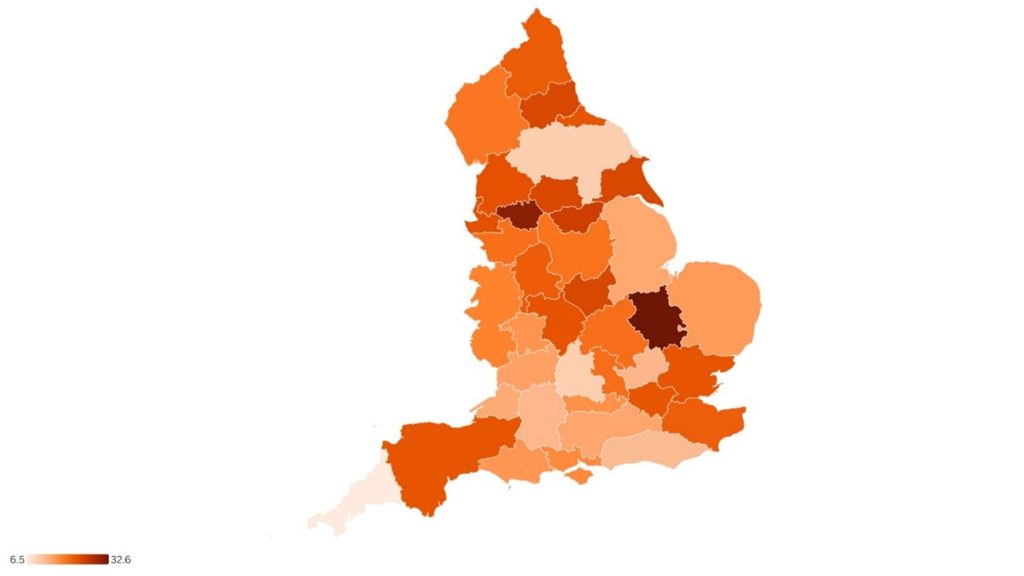
Note: A high-resolution map showing the gap between employer demand and resident supply of RQF Level 4+ qualifications (in percentage points) across LSIP areas is available here. Darker shading indicates larger gaps. Source: Author’s calculations using ONS and Adzuna Intelligence data.
It appears that the demand-supply gap related to higher-level qualifications is not confined to weaker economies. Some dynamic city-regions show large gaps because demand rises faster than local supply adjusts. In parallel, some areas where demand for highly qualified people is low show narrow gaps simply because employer demand is limited. This underlines a key point: a large gap (as measured in the present study) does not always signal labour market failure, and a small gap does not always signal success. Context matters.
What explains variation in higher-level skills demand-supply gaps?
The correlation analysis reveals that higher-level labour demand and supply tend to cluster with higher GDP per capita and a strong presence of finance and business services. Areas with more jobs that require on-site attendance, higher economic inactivity rates and a larger share of residents with no qualifications tend to show weaker skills profiles. Inactivity stands out as a key driver of disparities across places. In particular, LSIP areas with higher inactivity rates also exhibit wider demand-supply gaps (Figure 2). This suggests that barriers to labour market participation are part of the labour and skills challenge. An ageing population, an increase in health-related issues, a rise in early retirements during the COVID-19 pandemic and a “changeover in generations” may have exacerbated this issue.
Figure 2. Relationship between RQF Level 4+ demand-supply gap and economic inactivity across LSIP areas (2023)
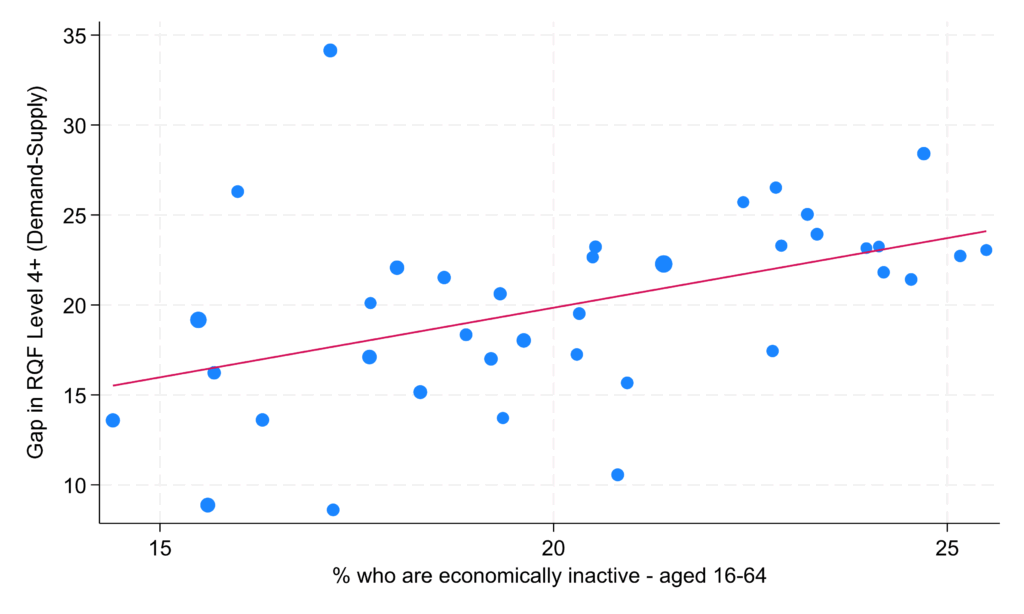
Note: Each point is an LSIP area. Bubble size reflects GDP per capita. The fitted red line indicates the linear association between the RQF Level 4+ demand-supply gap and economic inactivity.
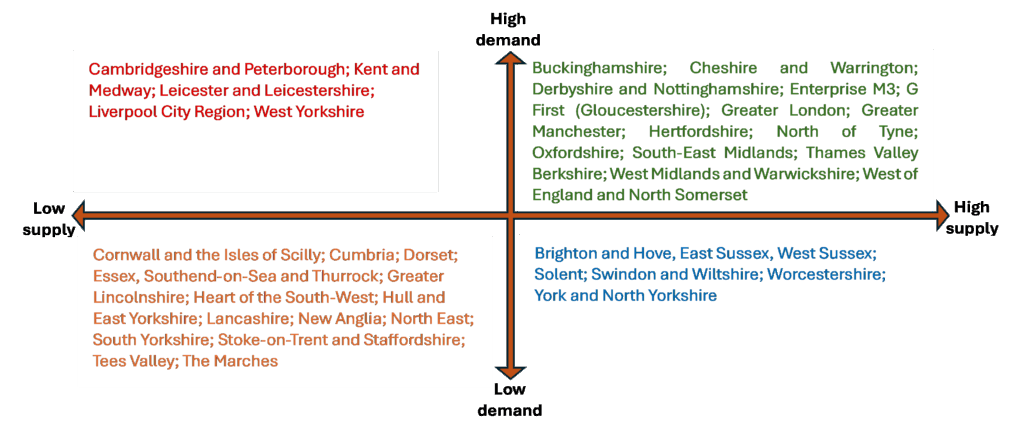
To assess the balance between higher-level skills demand and supply (RQF Level 4+) across LSIP areas, the study classifies each area using a two-dimensional quadrant framework. Specifically, demand and supply are divided into “high” and “low” groups based on the distribution of observed values across the 38 LSIP areas.
The high demand/high supply group contains 14 areas, mainly in London, the South East and parts of the South West and the Midlands (Figure 3). These areas have large graduate populations and strong demand from knowledge-intensive services and activities. Close links to major cities, interconnected labour markets and commuting flows might also support both demand and supply in these places.
The high demand/low supply group includes five LSIP areas. They tend to combine relatively strong employer demand with weaker local qualification profiles. In some cases, highly skilled centres may coexist with lower-qualified neighbouring districts (as in Cambridgeshire and Peterborough). Another five LSIP areas fall into the low demand/high supply group. Some of these areas are located near stronger labour markets, which may suggest out-commuting of highly qualified residents. In other cases, the local economy may generate fewer roles that match the available skills base.
The low demand and low supply group also covers 14 LSIP areas. Most are rural, coastal, or post-industrial. Examples include Cornwall, Cumbria and parts of the North East. In these places, weak employer demand and lower qualification levels tend to reinforce one another.
Overall, these figures suggest strong geographic sorting. This signifies the importance of place-based skills policies rather than uniform regional or national responses.
Figure 3. Demand-supply balance typology for RQF Level 4+ qualifications across LSIP areas (2024)
Policy implications for different local contexts
The findings of this study have some important policy implications:
- In areas with high economic inactivity rates, local partners could connect LSIPs more closely with initiatives related to health, disability and return-to-work. Expanding flexible and hybrid roles should also be considered, depending on the local and business context.
- Sector structure matters. In LSIP areas with a high share of employment in retail and hospitality (where the demand-supply gap for higher-level skills is wider), local strategies should not focus only on entry-level training. There is a need to strengthen higher-level pathways within these sectors. This includes management, digital operations, logistics, finance and compliance roles.
- In high-demand and high-productivity areas, there is a likely issue concerning the speed of adjustment. Here, supply may lag behind demand. Therefore, policy responses could expand the provision of Level 4 and 5 qualifications, promote more flexible higher education, and improve graduate retention. Housing, transport and commuting links also matter, as highly skilled workers may live outside the LSIP area where jobs are located.
- In low-demand and low-supply areas, the challenge appears more structural. It is not enough to raise qualification levels alone if job quality and business investment remain weak. LSIPs in these areas could benefit from connecting more closely with local growth plans and strategies related to inward investment and sector development.
Looking ahead, the nature of higher-level skills is changing. The analysis shows that certain “people skills” such as communication and leadership remain central across RQF levels. Technical skills, including data, engineering and digital capabilities, are prominent. At postgraduate and doctoral levels, employers more often ask for research, AI, programming and advanced analytics skills. This aligns with broader evidence on the growing demand for digital and AI skills. However, formal qualifications do not always capture these skills fully. Evidence suggests that some AI-related roles often place less weight on degrees and more on specific skills.
This has two likely implications. First, LSIPs should pay attention to skills content, not only qualification level. Micro-credentials, modular courses and short-cycle programmes might be more suitable in fast-moving fields such as AI and green technologies. Second, it is important to build closer collaborations between universities, further education providers and employers. This would ensure that curricula reflect related high-demand skills, not only theoretical knowledge.
[i] The large demand-supply gap observed in Cambridgeshire and Peterborough partly reflects substantial variation in qualification levels within the local authorities that make up this LSIP area. Cambridge and South Cambridgeshire record very high shares of residents with RQF Level 4+ qualifications. Other areas, such as Fenland and Peterborough, have much lower attainment.
This blog was written by Dr Kostas Kollydas, Research Fellow, City-REDI, University of Birmingham.
Disclaimer:
The views expressed in this analysis post are those of the author and not necessarily those of City-REDI or the University of Birmingham.
Find out more about the Local Policy Innovation Partnership Hub.