Philological and Proteomic Analysis of Texts from the Reign of Alfonso X
PPROTEX is an Academies Partnership in Supporting Excellence in Cross-disciplinary research (APEX) research project funded by the Royal Society and the British Academy, in association with the Leverhulme Trust. It is led at the University of Birmingham by Professor Aengus Ward, in collaboration with Professor Matthew Collins and Dr. Yun Chiang at the University of Cambridge, Dr. Laura Viñas Caron at the University of Copenhagen and Professor Laura Fernández Fernández at the Universidad Complutense de Madrid.
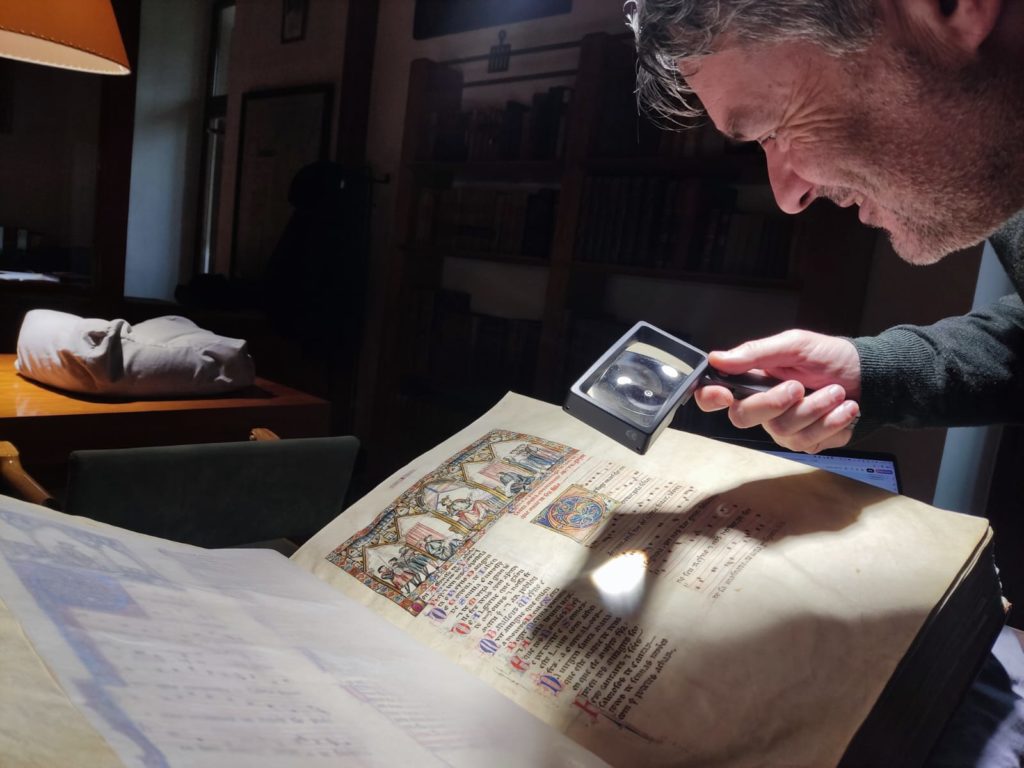
PPROTEX is an interdisciplinary project which brings together specialists in philology, manuscript studies and medieval Iberia, with specialists in biocodicology. Medieval manuscripts are generally written on parchment -that is, animal skin. By analysing the proteins and DNA of the manuscripts, we seek to understand how the parchment was made but also something of the animal biology of animals from which it was made.
The reign of Alfonso X of Castile and Leon (r. 1252-1284) was an extraordinarily fruitful one for cultural production. Alfonso’s scriptorium produced an astonishing array of scientific, legal, cultural, ludic and hostoriographical works. We are fortunate to have an extensive corpus of codices produced in these years. These form an ideal corpus bound in time and space to ask cutting edge questions about book production and animal biology in late medieval Europe.
Acknowledgements
PPROTEX would particularly like to thank the curators, conservators and restorers in the archives where we are working. The generosity of their collaborative spirit is a true marker of intellectual and cultural understanding.
We would also like to express our gratitute to our institutions, the College of Arts and Law at the University of Birmingham and the University of Cambridge, and especially our funders (via APEX award APX\R1\251039) the Royal Society, the British Academy, and the Leverhulme Trust.
We would like to express particular gratitude to Abbie Day of the University of Birmingham for her support in the application process.