

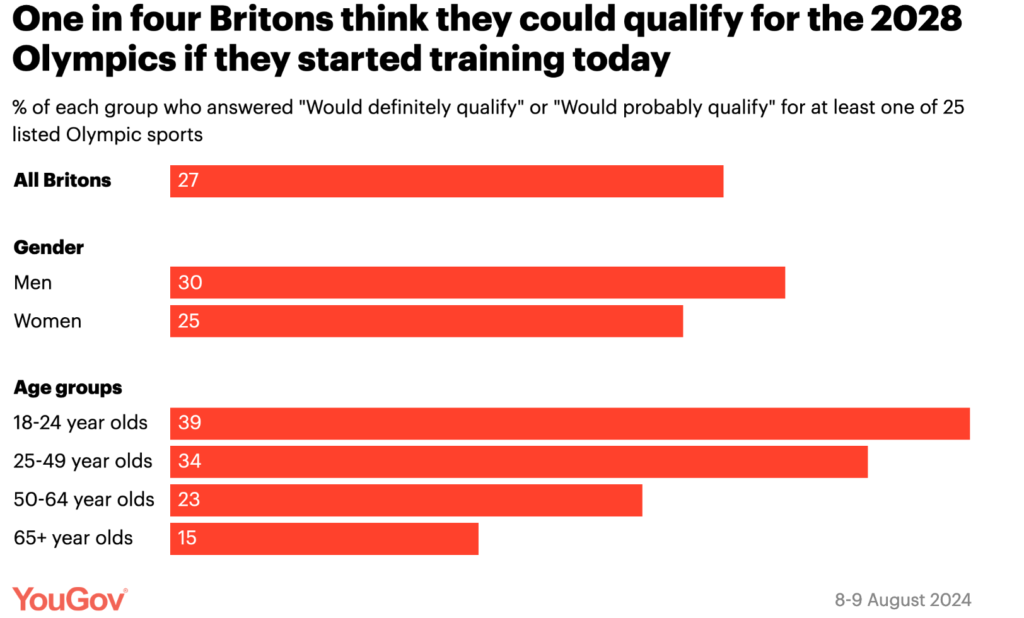
Once every four years the Olympics takes centre stage and for two weeks of the summer, we are treated to the pinnacle of human sporting performance. The recent Paris 2024 Olympics was no exception. Team GB took home 65 medals, with both household names and new champions making the headlines; world-records were set; and we marvelled at the skill and abilities of the very best in the world. But it was a different type of headline that caught the eye, and it wasn’t from the velodrome or the athletics track, but it was the remarkable statistic that 27% of the British public believe that they could become an Olympic-level athlete and qualify for the LA 2028 Olympics.
Thus eyebrow-raising statistic came from a YouGov survey that and a quarter of Brits think they have what it takes to sit at the top table of sporting prowess in at least one of the 25 sports the survey presented and achieve this in the next four years. In the 18–24-year-old group the figure was nearly 40%. It’s easy to dismiss this as the delusion of youthful over-confidence – and let’s make no bones about it – IT IS delusional, but it does raise the question of what makes for world-class performance and just how achievable is it. What makes for being the very best in the world, for breaking records and for delivering such a high level of attainment? Is it pure natural genetic potential – are you born to be great? Or is it hard work and a lifetime of deliberate practice and training e.g., the often-quoted 10,000 hours rule to achieve ‘mastery’*? The ‘Great British Medallists’ project, conducted around London 2012, gave a unique insight into truly world-class performers and their exceptional talent and graft, and whilst that nature versus nurture debate will roll ever onward (and the exact formula is really never knowable), we can at least say the answer lies somewhere in the middle of that picture. *By the way, 10,000 hours is 20 hours a week, every week, or just under 3 hours a day, every day, for 10 years. Even with the best will, LA 2028 is a bit soon for our aspirational 27%.
What we do know is that whether it’s with a highly trained and super-fit athlete, or it’s with a sedentary individual, or with those suffering from disease, all are positioned on the same human continuum of capacity and function (or dysfunction, in fact). The role of the exercise physiologist is to understand how the body works during physical activity and by ‘getting under the bonnet’ of the performer we can reveal how the various body systems work together to make up the physiological capacity of the individual – their heart, their lungs, their circulation, their muscles. We can see how these combine to bring the power, the speed, the endurance, and the agility that makes for sporting physical prowess. And everyone has a bit of gold in them. It might not be record breaking sprint speed, but across the multitude of smaller factors that all come together to make the fitness capabilities of the individual, more often than not we see a little sparkle of the inherent natural physical talent of an individual – there are glimpses of potential revealed in their physiology.
An aspect such as the total haemoglobin mass – the capacity to transport oxygen in the blood – will tell you a lot about an individual’s endurance capabilities, and even in those who haven’t done any training. Of course, that’s just one factor of many, but it’s almost certain there will be something that stands out and shines even when other factors may be quite average, or even dysfunctional in the case of the deconditioned individual. But for the athlete and their coach, the task is to identify and support that inherent talent; to bring together all those numerous fitness components – both the sparkling golden genetic gifts as well as those that need work (more polishing, to stretch the metaphor); and to train or practice them to a level sufficient to compete with the very best in the world.
Talent, training, practice, performance, science – these are all the component parts of the University of Birmingham’s new MSc in High Performance Sport. Details can be found here.

J.Pringle@bham.ac.uk