
Within the Graduate School of Sport and Professional Practice (GSSPP), we take pride in offering our students access to the realities of applied high-performance sport. We feel that allowing students to further understand the nature of working practice in sport can give them a head-start when embarking on their own careers after graduation.
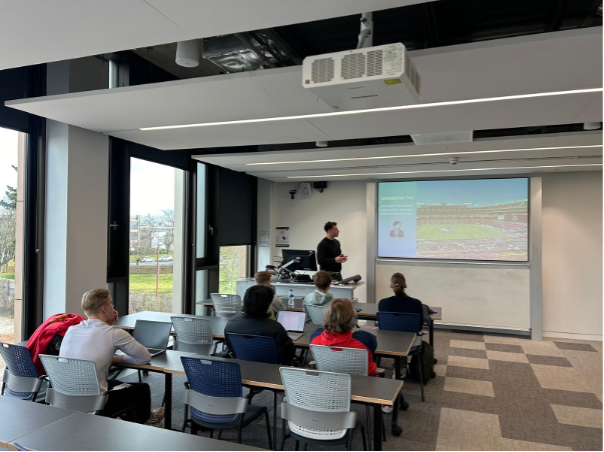
This commitment was on full display recently when James Coneboy, Lead Academy Sport Scientist at Aston Villa Football Club, delivered an inspiring and insightful workshop to our current cohort of applied placement students. James’ talk not only provided a window into the world of professional football but also highlighted the technical and transferable skills, mindset, and dedication that is helping him to build a career in such a competitive industry.
James shared with the students his journey into sport, detailing the experiences that have shaped his career. From his earlier days as a student intern at Everton Football Club, working in international football and more recently, his current role working with the U21s at Aston Villa, who, like their senior team equivalent are also competing in Europe, in the UEFA Youth League. James emphasised the importance of resilience, adaptability, and a relentless work ethic. He spoke candidly about the challenges he has faced in the various roles, including relentless scheduling, time away from friends and family, and other professional set-backs. Yet, he was also very clear when highlighting the incredible rewards that have come with each role, such as traveling the world, working with elite athletes, and being part of an experienced multidisciplinary team, which ultimately assist players with moving their careers forward at the highest level.
One of the key takeaways from James’ lecture was the importance of building a strong foundation of transferable skills. Communication, problem-solving, and the ability to work under pressure were just a few of the competencies he identified as critical to success in the roles he has held. He also stressed the value of networking and seizing every opportunity to learn, whether through formal education or additional opportunities to gain further hands-on experience.
For our applied placement students, these types of workshop can act as a blueprint of what a journey into high-performance sport may look like in reality. By bringing in high-performance practitioners like James, we are aiming to bridge the gap between academia and the world of professional sport, giving our students a realistic understanding of both the demands and rewards of a career in sport.
This approach is what we in the GSSPP feel sets us apart. We don’t just teach the foundational theory behind practice; we aim to provide real-world insight and give our students experiences that better prepare them to transition into graduate roles in high performance sport. Our goal is to create impactful, well-rounded professionals who understand some of the realities of the industry before they get there, and are subsequently ready to make a difference when they do.
At the School of Sport, Exercise and Rehabilitation Sciences, we’re not just educating the next generation of sport scientists, we’re aiming to help shape the future of high-performance sport. And with experiences like this workshop from James, we’re confident that our students are getting the additional experience they need to be successful.
D.Lothian@bham.ac.uk