
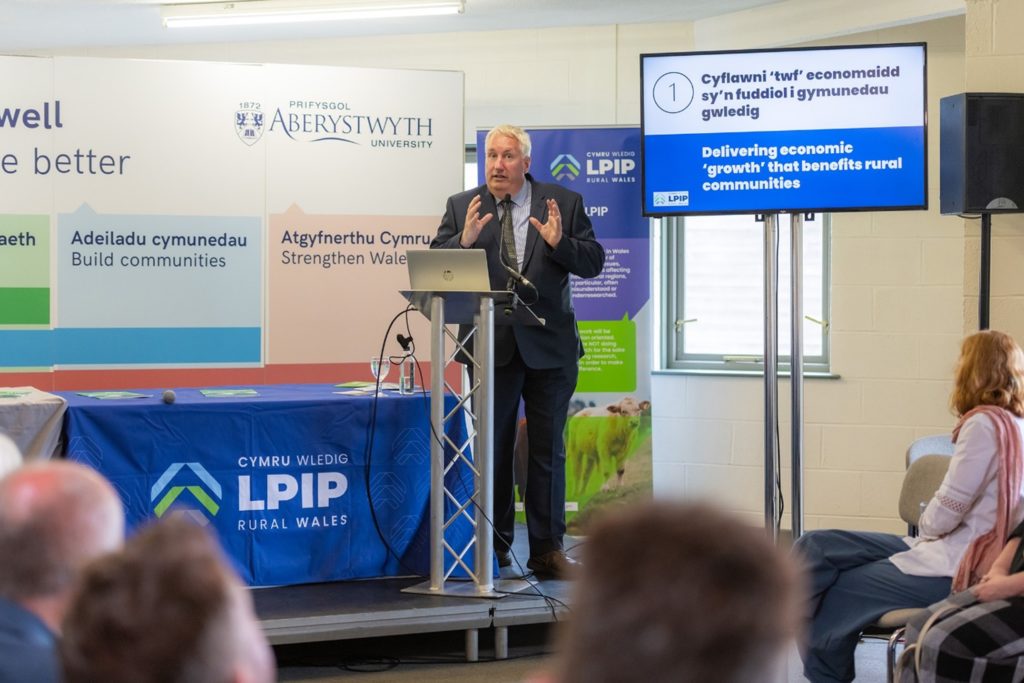
Whilst summer may traditionally be the time when activities may ease slightly within Higher Education, this was certainly not the case for Cymru Wledig LPIP Rural Wales, with several policy and engagement events held across Wales.
The highlight of July’s calendar is the extremely popular Royal Welsh Agricultural Show in Builth Wells, which draws together individuals and groups from the farming and agricultural sectors, as well as all stakeholders interested in rural affairs. Capitalising on this passion for issues impacting rural life, with thousands of people gathered together for this annual festival, Cymru Wledig LPIP Rural Wales organised a packed itinerary as part of our engagement activities. We launched the week with a policy-related event, where Director, Professor Michael Woods, delivered a short talk on ‘Five Key Policy Challenges for Rural Wales at the 2026 Senedd Elections’ at an evening reception attended by the Deputy First Minister Huw Irranca-Davies, several Senedd Members and MPs, council leaders and representatives from a range of stakeholder organisations.

We celebrated the research and participants of the Women in Farm Diversification project, co-run by Professor Sara MacBride-Stewart and Dr Alison Parken, with an interactive event later that week, where responses were gathered ahead of the project’s upcoming research publication.

Finally, we enjoyed in-depth conversations with Future Generations Commissioner for Wales, Derek Walker, as well as other elected politicians from across the mainstream political parties. We shared details of our research projects, identified areas of commonality, and offered our expertise to support the data and evidence used when developing pledges for manifestos ahead of the upcoming Senedd elections. Professor Woods was invited to contribute to the launch of the Welsh Local Government Association’s Rural Manifesto. However, perhaps the climax of this week arose during the Senedd’s Economy, Trade and Rural Affairs Committee consultation on the food processing industry, which was held at the Showground, and to which we were invited. Cymru Wledig LPIP Rural Wales’ annual report was cited 4 times by the Committee members, highlighting our success in engaging with policymakers to date, and raising the profile of our research.
Hot on the heels of the Royal Welsh, we relocated from mid-Wales in July up to North Wales in August, to attend the National Eisteddfod festival, this year taking place in Wrexham. Once again, our focus was to present the work of Cymru Wledig LPIP Rural Wales to a range of stakeholders and the public, with a focus this time on the Welsh language and culture, and communicating how the public could engage with our research. This was achieved by hosting a series of events: the first highlighting the concept of the Innovation Labs (in collaboration with our strategic partner the Centre for Alternative Technology), encouraging the audience to take part in a mock Innovation Lab workshop, where they decided that public transport was the most significant barrier to development in rural Wales, and engaged in a range of proposals they would wish to see presented to policymakers.
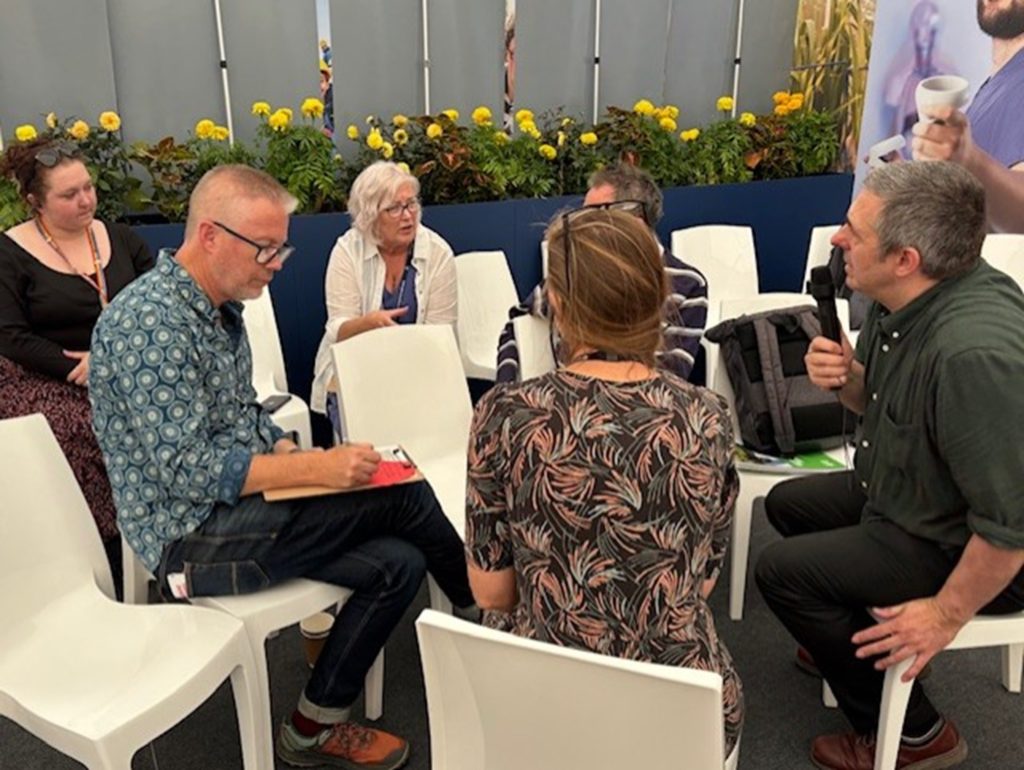
Dr Eifiona Lane and Dr Elen Bonner of Bangor University conducted two events, introducing their latest research project under the Cymru Wledig LPIP Rural Wales banner, focusing on intangible cultural heritage, which was extremely well received amongst the Welsh-speaking audience.
A final event was held in collaboration with colleagues from Together for Change, where we promoted Community-led Action Research and raised awareness of the new £20,000 grants available to community groups.

Throughout the week at the Eisteddfod, colleagues attended a number of government and civil society events, taking advantage of the presence of Welsh government representatives and leaders of non-governmental organisations to probe policies, present our own views, and offer support.
So what did this summer teach us? What did we achieve, and what will happen next?
It was clear from the responses of policymakers that our research is being heard at the highest levels of government and society. It was heartening to hear our projects cited publicly, and to have senior politicians declare how our work is contributing to the future wellbeing of Rural Wales. Our activities this summer taught us that, whilst time-consuming and often challenging, the impact of designing a public engagement strategy and targeted communications to share the research is well worth the effort. It is exciting to know that data and analysis from our projects are directly influencing the approach adopted by elected officials. We have created a suite of policy briefing papers to distil research reports into clear recommendations for policy-makers, and look forward to expanding upon this in the coming months, particularly as the Senedd elections fast approach, and ahead of our attendance at Labour Party Conference (Liverpool, September 2025).
For more information on the policy and engagement activities of Cymru Wledig LPIP Rural Wales, please contact Rhian Curtis, rhc33@aber.ac.uk
This blog was written by Rhian Curtis, Engagement Officer, Cymru Wledig LPIP Rural Wales.
Disclaimer:
The views expressed in this analysis post are those of the author and not necessarily those of City-REDI or the University of Birmingham.