
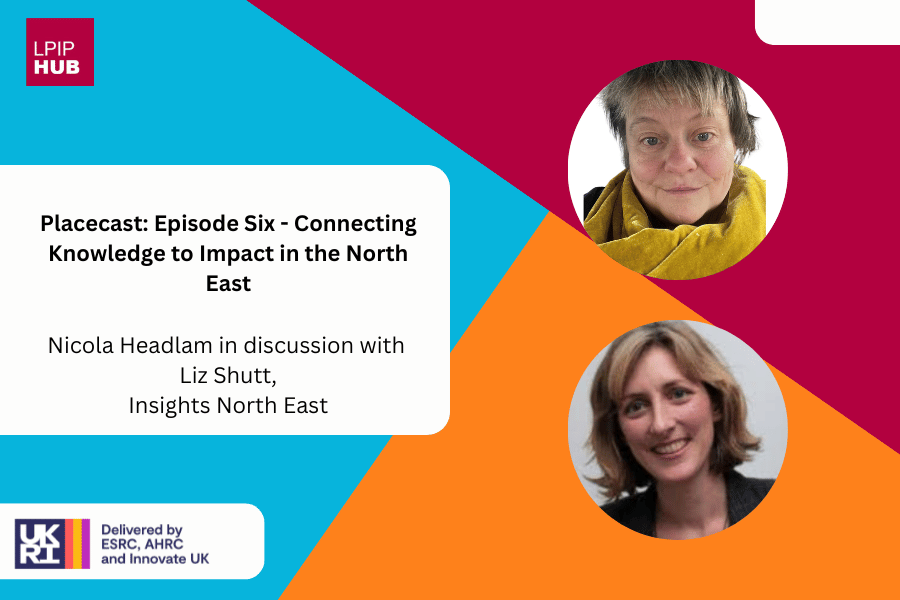
PlaceCast is a Local Policy Innovation Partnership (LPIP) Hub production based at City-REDI, University of Birmingham. Our new podcast is essential listening for those keen to explore the ins and outs of knowledge mobilisation for influence in central and local government, based on the view that it’s only through animating the power of place-based leadership that the wicked problems of 2025 can become more manageable.
In this episode of the Placecast podcast, Nicola Headlam speaks with Liz Shutt, Programme Director at Insights North East (INE), about the evolving landscape of place-based policy innovation and the role of universities in shaping more responsive, inclusive, and impactful policymaking.
Guest speaker
Liz Shutt is Programme Director for Insights North East (INE), an initiative seeking to produce actionable and accessible insights for policy makers in the North East of England, drawing on the rich evidence base from within Newcastle and Northumbria Universities and from the project’s policy partners – North of Tyne Combined Authority, Newcastle City Council, NHS Newcastle and NHS Northumbria Trusts. INE has three priority challenge areas: Net Zero, Health and Wellbeing.
Liz is responsible for setting up the organisation, developing key relationships, setting strategic direction, spotting new opportunities and overall delivery of actionable insights for their policy partners.
Previously, Liz was Director of Policy for the University of Lincoln and the Greater Lincolnshire Local Enterprise Partnership.
Host
Dr Nicola Headlam has more than 20 years of experience working within all aspects of the multi-helix innovation system; central and local government, civil society and campaigning, academic research and knowledge mobilisation and in industry. Along the way, she has honed expertise in urban and regional subnational economic development, the roles of government in making and shaping place, and in data and evidence for transformation.
In 2024, she became a freelance economic advisor on the role of leadership and partnerships, urban and living lab forms for research, future of cities and foresighting methods, urban transformations, place-branding and urban regeneration and the spatial consequences of public policy.
Key points from the podcast:
Creating New Spaces for Collaboration
Liz emphasises the importance of building “middle spaces” where academics and policymakers can engage without judgment. These spaces foster trust, enable early-stage policy co-creation, and allow for iterative, relational working.
Beyond Traditional Academia
Drawing on her experience in higher education and regional policy, Liz advocates for a more permeable university model—one that deeply connects with societal challenges and values diverse expertise beyond traditional academic hierarchies.
Rapid Response and Long-Term Thinking
INE has successfully bridged the gap between academic research and policy needs, particularly in areas like net zero and child poverty. By leveraging existing research and hosting events, they’ve enabled quick turnarounds while also pushing for deeper, structural change.
Funding and Sustainability Challenges
Liz highlights the limitations of short-term, project-based funding and calls for more flexible, cross-system models that support capacity-building and long-term impact.
Leadership and Distributed Impact
Effective place leadership is crucial. However, Liz also emphasises the importance of distributed leadership—empowering individuals at all levels to work collaboratively across institutional boundaries.
A Coalition of the Willing
INE’s approach includes building networks of committed individuals—academics, policymakers, and practitioners—who are eager to work differently and collaboratively. This “coalition of the willing” is key to driving meaningful change.
Transcript
Find out more about the Local Policy Innovation Partnership Hub.
Disclaimer:
The views expressed in this analysis post are those of the author and not necessarily those of City-REDI or the University of Birmingham.