
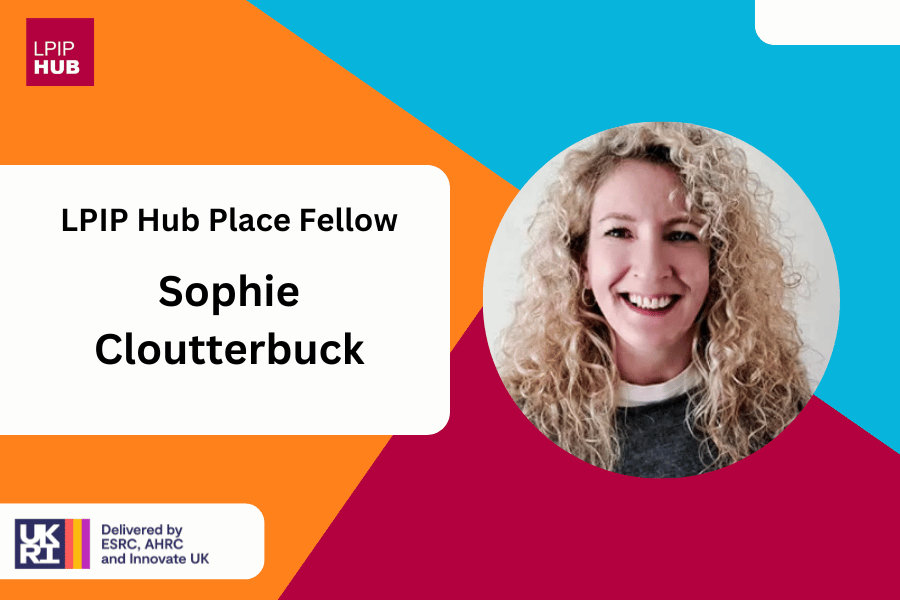
Earlier this year, the LPIP Hub celebrated the appointment of its Place Fellows. In a series of blogs, the Place Fellows will introduce themselves and the work they have planned for the LPIP Hub. First up, Sophie Cloutterbuck, Director of London Engagement and the London Met Lab at London Metropolitan University.
I’m excited to introduce myself as one of the new Place Fellows at the Local Policy Innovation Partnership (LPIP) Hub, based at the University of Birmingham’s City-Region Economic Development Institute (City-REDI). With over 20 years of experience in higher education, my work has focused on building evidence-based strategies that connect universities with the communities they serve. This fellowship offers a unique opportunity to deepen that work—collaborating with colleagues across the UK to strengthen local governance through innovation, engagement, and shared learning. This is a crucial national mission, and I am proud to be part of an initiative that seeks to find solutions from the ground up.
From Youth Work to a Bridge Between Academia and the Public
My journey into civic engagement began not in academia, but as a youth worker embedded in the community. That early experience taught me the power of listening, relationship-building, and co-creating solutions with local people. It shaped my belief that meaningful change starts with trust and shared purpose, a principle that is vital for effective policy across the whole nation. I later moved into higher education, where I served as Head of Widening Participation and Outreach, working to remove barriers to education and support social mobility. This laid the foundation for my current role as Director of London Engagement at London Metropolitan University.
In my current role, I see myself as a bridge and a connector. I work to bring together the rich resources of the university—its research, its students, and its expertise—with the needs of London’s diverse communities. But I also see my role as a challenger. I aim to disrupt traditional, siloed ways of working and push for more collaborative, co-creative approaches. This dual perspective—bridging and challenging—is what makes this fellowship so interesting to me. I’m passionate about driving change and breaking down the barriers that often exist between institutions and the people they aim to serve, a barrier that is unfortunately common in cities and towns across the UK.
At London Met, I led the development of our “Giving Back to the City” (GOTC) strategy, which focuses on six key challenge areas: social wealth, environment, health, crime, poverty, and discrimination. This work led to the creation of the London Met Lab, a hub for community-engaged research, experiential learning, and knowledge exchange. Through this platform, I’ve built partnerships with 22 London boroughs, NHS trusts, businesses, and charities. I continue to lead our Civic and Community strategy, now named “Our Commitment to London”, and I also chair the London Higher Civic Network, coordinating civic engagement across the capital’s higher education sector.
My work extends beyond London as well. I’m a key member of the National Civic University Network Advisory Panel, and I’ve had the opportunity to collaborate with universities in Germany, America, and South Africa on the topic of civic engagement and its role in higher education. These experiences—both local and international—have given me a unique perspective that I’m eager to bring to the LPIP community.
A London Lens on National Challenges
London is more than just a city; it’s a living laboratory of diverse communities, complex governance, and a vibrant civil society. This makes looking through a “London lens” especially useful for my research. The capital’s unique scale and density mean it faces many of the UK’s most pressing challenges—from poverty and health inequalities to trust deficits between residents and institutions—at an intensified level. By understanding these issues at their most acute, we can develop robust, adaptable solutions for the whole country.
By studying how London’s boroughs are tackling issues like community engagement and public health, my research can offer more than just local insights. The sheer variety and size of its boroughs—each with distinct demographics and governance structures—provide a rich, comparative canvas. The lessons learned in one part of London, a borough with a high population density and cultural diversity for instance, can be applied and adapted to other urban centres throughout the UK.
For example, London’s experience with Health Determinants Research Collaborations (HDRCs) can serve as a blueprint for other local authorities seeking to embed research into their public health systems. My research into rebuilding trust between communities and local government, using local boroughs (some as large as other Cities) as case studies, also speaks to a national problem, providing transferable insights that can help reconnect citizens and authorities far beyond the M25.
In short, my research, while focused on London, is designed to have a national reach. By uncovering what works—and why it works—in one of the world’s most dynamic urban environments, I hope to provide practical, scalable insights that can help bridge the gap between policy and practice for communities everywhere.
Project 1: Understanding Community Engagement in HDRC
My first project will explore how different London boroughs are implementing Public engagement/Public Involvement and Partnerships through Health Determinants Research Collaborations (HDRCs)—a major initiative to embed research into local public health systems. I’ll be conducting a comparative analysis of five boroughs: Tower Hamlets, Islington, Lambeth, Ealing, and Southwark. These boroughs were chosen for their diversity of approaches and demographics, allowing me to build a nuanced picture that goes beyond a single-site case study, thereby increasing the national relevance of the findings. The goal is to understand how each area approaches partnership-building and community engagement, and to identify what works, why it works, and under what conditions. The aim is to provide practical tools for engagement and trust-building, a goal that is both critical and challenging.
The project also aims to map the different “theories of change” and engagement models being used by these HDRCs. This will allow for a cross-borough analysis and highlight diverse approaches to involving communities in health research. I’ll be particularly focused on understanding how local voices are heard and incorporated into policy and practice. This research will offer practical insights for councils and communities alike, helping to shape more inclusive, effective, and locally grounded health initiatives.
Project 2: Rebuilding Trust Between Communities and Local Government
The second project tackles a critical issue: the trust deficit between communities and local authorities. When residents feel unheard or disengaged, it can lead to lower uptake of services, reduced civic participation, and weakened social cohesion. At the same time, local government practices—especially those shaped by competitive funding models—can unintentionally reinforce this divide.
Using Local London boroughs as case studies, I’ll explore how trust is built (or broken) and what can be done to foster more relational, co-creative approaches to governance. A key focus will be the role of universities as anchor institutions—how their long-term, place-based presence can support councils in engaging communities more meaningfully. My work as a connector and challenger is central to this project, as I aim to facilitate difficult conversations and push for new ways of working.
Final Thoughts: Driving Change and Breaking Down Barriers
I’m looking forward to learning from fellow researchers, practitioners, and communities throughout this fellowship. Together, I hope we can build a stronger evidence base for local policy—one that centres equity, sustainability, and collaboration. As someone who has always sought to drive change and break down barriers, I believe this work is not just about producing research reports, but about creating tangible, positive change in people’s lives.
Let’s create places where everyone has a voice, and where policy is shaped not just for communities, but with them.
This blog was written by Sophie Cloutterbuck, Director of London Engagement and the London Met Lab at London Metropolitan University.
Find out more about the Local Policy Innovation Partnership Hub.
Disclaimer:
The views expressed in this post are those of the author and not necessarily those of City-REDI or the University of Birmingham.