
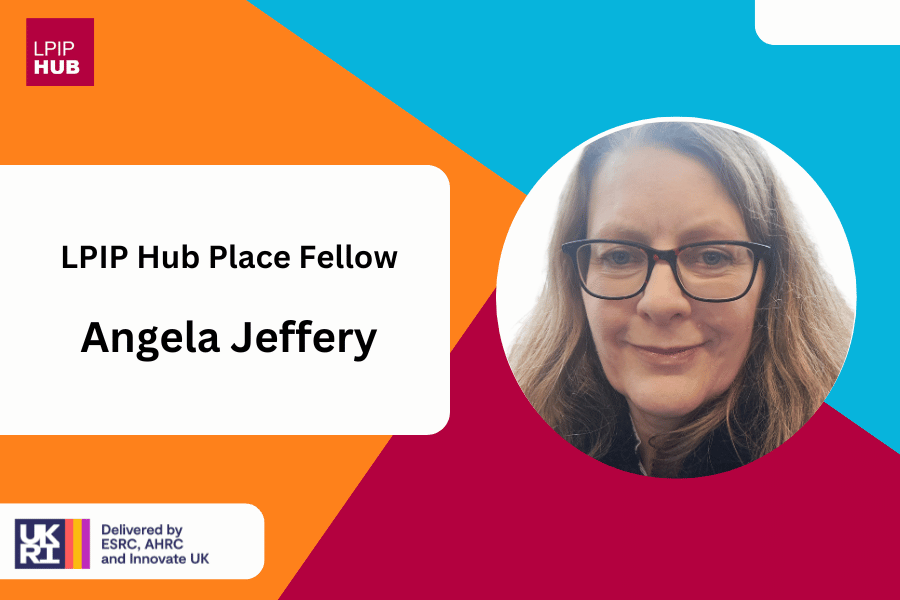
I am Dr Angela Jeffery, Co-Chair of Birmingham Citizens, and I am keen to introduce the Local Policy and Innovation Partnerships project that I am working on.
Although a biologist by background, I have been working on Community Development since 2019, when I led the development of the Aston University Civic Agreement and managed the Policy Support Fund (A fund Research England devolves to Universities to support engagement with policy makers), amongst many other things. I also joined Citizens UK, and since then, I have developed and run a range of health listening projects that have unearthed a whole range of issues spanning well beyond health. In recent times, I have been working on the regeneration of Newtown (Birmingham) and co-developed the Newtown Cultural Placemaking Strategy with Legacy Centre of Excellence, residents, businesses and other stakeholders in Newtown. I have also been working with the Community Connexions team in Birmingham Community Healthcare Trust to address health inequalities, and I am an Executive Director at Saathi House, which is a women’s charity based in Aston that is a beacon of female empowerment and positivity.
My research interests span two interlinked LPIP sub-themes: Communities in their places and Cultural recovery. The purpose of my LPIP Fellowship is to respond to the question posed by government on “What next for neighbourhoods and communities?” which relates to the following Area of Research Interest (ARI) published by the Ministry for Housing, Communities and Local Government (MHCLG) in March 2025: Stronger, more integrated and more cohesive communities
Context
Citizens UK is the UK’s largest, most diverse and most effective people-powered alliance in the UK, comprising 450 institutions. It is a national charity, with 18 Chapters across the country that use Community Organising to help bring change to things that their members care about, such as housing, work and safety.
Most chapters include university partners, and the role of universities in cohesion and integration will be investigated, to outline what works, as well as highlighting challenges.
For many years, Citizens UK has had three strategic aims, which all parts of our organisation contribute to:
1 – Developing leaders
2- Strengthening institutions
3 – Making Change
Last year, the leadership agreed to add another really timely and topical strategic aim:
4 – Organising across difference
This is important as we bring together community leaders from across the spectrum to work together for the common good.
My study involves a deep dive into neighbourhoods in Birmingham through semi-structured interviews with Birmingham Citizens leaders, but also from public services including the NHS, police, combined authority, council staff and headteachers. I will then compare those findings with other chapters of Citizens UK working on aligned projects, to identify learning that is relevant across the UK. I will also be looking at the role of universities and how they can make effective partnerships alongside the other actors in their place. I will also investigate how leaders feel issues such as housing and devolution can contribute to community outcomes.
Why is it timely?
In 2025, we saw riots taking place in the UK after the fatal stabbing of three young girls at a dance class inSouthport. This was followed by further racially aggravated attacks in the Midlands, such as the rape of a Sikh woman in Oldbury and then in Walsall. We have seen community division with Operation Raise the Colours leading to tensions between individuals who see the flags as patriotic and others who view them as aggressive and divisive in multi-cultural suburbs. More analysis of the flag debate in Birmingham is reported in articles such as the Birmingham Mail article – England flags torn down in Stirchley.
There have already been some discussions on this topic –BBC Radio 4 – Moral Maze, Is social cohesion a moral good? And can governments influence it?, but I will be looking at whether gaining insights from community leaders on the ground through trusted relationships gives a clearer insight into what is going on than that which surfaces through high-level interviews with well-known leaders.
What is coming next?
I will be hosting a roundtable and running an LPIP Placecast, where I will interrogate some of the findings against what has been published in papers and reports so far. Then, later in 2026, I will be producing a toolkit of ‘what works’, which can be used by central government, as well as public sector and other partners, to engage with communities in a way that promotes cohesion and integration, aimed at shaping effective partnership working.
Final reflections
It has never been more important for public services to work effectively with communities and to ensure that funding is directed in ways that support people on the ground. There is hope that the new Pride in Place Fund is being managed by local authorities and neighbourhood boards, bringing power to local people in some disadvantaged neighbourhoods, but this needs to align with the whole system, developing a nuanced understanding of places and communities. This is a place where one size definitely does not fit all!
This blog was written by Dr Angela Jeffery, Co-Chair at Birmingham Citizens and a LPIP Hub Fellow.
Find out more about the Local Policy Innovation Partnership Hub.
Disclaimer:
The views expressed in this analysis post are those of the authors and not necessarily those of City-REDI or the University of Birmingham.