
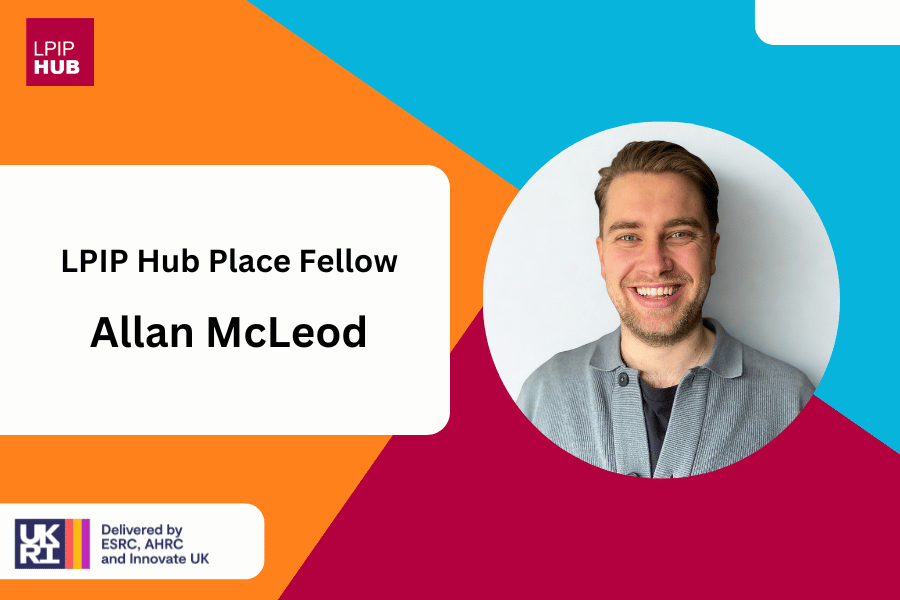
LPIP Fellow Allan Macleod introduces himself and the work planned during his place fellowship for the Local Policy Innovation Partnership Hub.
I am passionate about helping community voices to be heard in policymaking and believe that research and community-based policymaking is the best way to deliver a more just and equal future for all. In my work at the City Office of Bristol City Council, I worked with communities, organisations, businesses and civil society groups, helping them engage effectively with the City Council, the Mayor & his Cabinet and with each other. At the University of Bristol, I worked with academics as they engaged in dialogue between a wide variety of community groups and local and national policymakers and politicians. I also supported work across Bristol’s Environment, Homes and Communities and Transport boards and the Bristol Advisory Committee on Climate Change. Since May 2025, I’ve been leading the Civic and Inclusivity team at the University of West of England (UWE). Our team’s ambition is to support UWE to better engage with and deliver for the West of England region and make the institution and region a more equal place to work and live. Our team leads the University’s partnership work with the Voluntary, Community and Social Enterprise sector and public sector organisations such as the local and regional government as well as supporting students, staff and partners by building equality within UWE.
In my role as a LPIP Place Fellow, I will be continuing and furthering this work, highlighting some of the new methods of community engagement that are emerging across the UK and Ireland. Working with researchers from the University of West England, the University of Bath and the University of Sussex, I will be helping to develop a replicable methodology for using arts-based methods for building relationships and engagement between businesses and local communities, especially in areas where citizens sense that they are being disproportionately affected by low-carbon policies and the impact of transient labour markets on community cohesion. This work will draw on challenges faced in Avonmouth, Galway and Durham and showcase how meaningful community engagement can lead to improved understanding across political and socio-economic boundaries.
This addresses four of the LPIP research themes:
- Communities in their places
- Environment: Living & Working Sustainably in a Greener Economy
- Inclusive and Sustainable Local Economic Performance
- Felt Experiences
The research findings will be made available in the form of a toolkit that consolidates the approach that the UWE team have been piloting in Avonmouth since April 2024, alongside comparative case studies and podcasts to share best practice, and the development of a training offer for national government or LPIPs to learn from these examples. We are also looking to share updates in the form of a podcast and in a multi-media format that showcases the arts-based approach to community engagement in action.
Why prioritise Avonmouth?
Avonmouth is an area of national strategic importance, particularly with regard to waste and green energy production. It is very much a place ‘in transition’ linked to the rapid growth of these industries and to the changing nature of the workforce that supports them. The speed at which this is happening is affecting community cohesion and is causing tensions across business and community interests. There are also considerable environmental concerns at play, with the surrounding estuary containing wetland areas of international importance, providing key habitats for wildlife and bringing their own benefits for decarbonisation. Despite the often competing agendas that these different concerns bring, there is growing momentum in the area for it to become a model for what a just transition can look like. There is a drive to make the Port and the area around it a key education destination for others to learn from its industrial decarbonisation. Given the ongoing risk of short-term economic gain being prioritised over longer-term sustainability, there is a recognised need for improved and ongoing dialogue across the different stakeholder groups. By contextualising the work in Avonmouth alongside other British and Irish examples, I hope to present the importance of new approaches to cross-community dialogue and how these have been implemented in practice.
Why Arts-based methods?
Having seen growing division across the UK between and within communities on a range of different political topics, it is clear that there is a desperate need for new approaches to help bridge the growing divides we are seeing in society. My work as an LPIP Hub Place Fellow will draw on local examples across the country where this is being done well and explore the challenges faced where division is continuing to grow. The work focuses on geographical areas in transition, where changing demographics and environmental policy have been seen to increase division between business and community. It will showcase a new methodology that takes personal experience beyond the page and provokes a felt response through engaging with personal testimony. This audiovisual methodology involves an interactive documentary, where diverse opinions and experiences have been gathered in the form of personal testimonies that are being effectively used as a catalyst for dialogue across different communities. This method has proven to be a useful tool for cross-party dialogue and is likely to be highly transferable to other parts of the country where divisive local topics are being consulted on. By elevating the voices of individuals within the communities and placing them alongside those in positions of financial, political or decision-making power, this method helps to provide commonality in spite of different experiences, interests and concerns. Creating shared personal testimony that can be brought into dialogue through interactive technologies can offer fresh insight into the different perspectives of those with lived experience of decisions made by environmental and economic policy makers.
Applications beyond the research
This work will draw on the use of arts-based methods by a UWE-led research team in partnership with Avonmouth Community Centre, on the collaborative impact project A Just Transition for Avonmouth since 2024. It will include findings from a similar research project between farmers and the local community in Galway, Ireland, as well as insights taken from the ongoing changes to net-zero projects in Durham Council. Working with these academics in collaboration with active community members and local business and policy makers will enable the development of a literature review and a set of comparative case studies that not only review best practice in this area but can consolidate the approach into a toolkit that can be shared with other areas as a methodology for building relationships and engagement between businesses and local communities. By drawing out what is being learnt from these projects into a replicable methodology, policymakers across the UK will gain insight into how to effectively engage decision-makers, leaders and businesses/business clusters on contentious issues, as well as build meaningful partnerships with communities to tackle diverse topics effectively.
Final thoughts
This research will be particularly pertinent to areas where citizens sense that they are being disproportionately affected by low-carbon policies and the impact of transient labour markets on community cohesion. It is only through finding ways for honest and heartfelt community voices to be accessible, listened to and heard by policymakers that solutions to our current challenges can be found that effectively respond to the experiences and needs of all those they are designed to benefit.
This blog was written by Allan Macleod, LPIP Hub Place Fellow, with colleagues, Dr Judith Aston, Dr Karen Boswall, Dr Laura de Vito and Dr Sophia Hatzisavvidou.
Find out more about the Local Policy Innovation Partnership Hub.
Disclaimer:
The views expressed in this post are those of the author and not necessarily those of City-REDI or the University of Birmingham.