
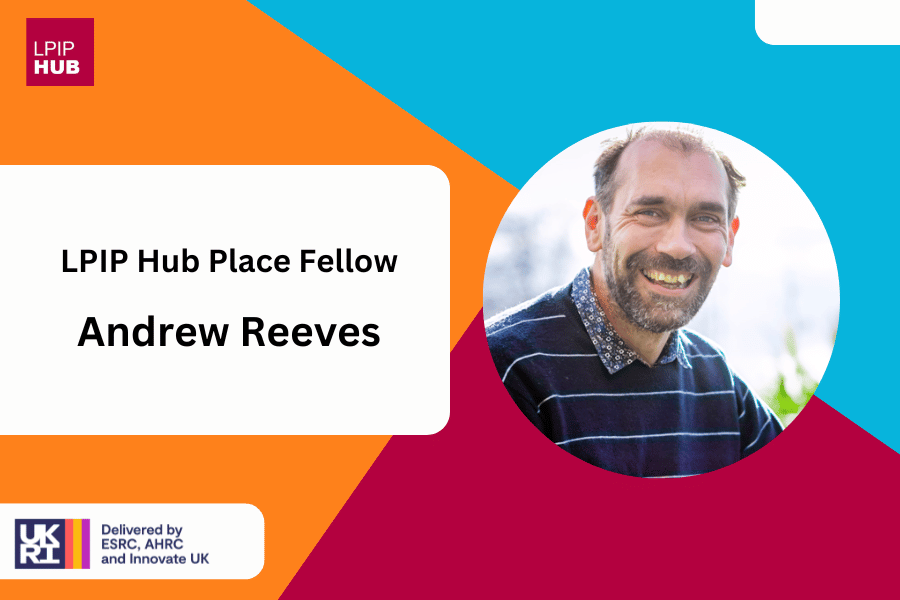
About Me
How do we make a positive difference to big environmental challenges like the climate crisis within the specific communities where we live and work together? Broadly speaking, this is the question I’ve been grappling with for 20+ years through a wide range of voluntary projects and more recently as an academic, currently working as an Associate Professor at De Montfort University in Leicester.
As an LPIP Place Fellow, I’m excited about the chance to explore these themes further – looking into impactful ways that civic universities can make a difference on climate change and sustainability in their localities.
My Background
Working in a university, when people meet you, especially other academics, they often ask “what’s your discipline?” I tend to reply that I’ve never quite had one…
After spending much of my 20s on travel, worthy part-time jobs and a bit of English teaching, I got very lucky and found myself moving to Leicester in 2006 to do a funded PhD on the policy and organisational side of achieving zero carbon social housing. Going straight into a multi-disciplinary research institute to work on a specific multi-faceted problem gave me a pragmatic academic ethos rather than a fixed discipline-specific lens I’d bring to any issue; all the more so, as in parallel to my research I was a very active community organiser, helping kick-off and sustain Leicester’s Transition Town initiative, our local community energy co-operative Green Fox and more.
Fast forward to 2018, after many other projects focussed on the people-side of shifts towards sustainability and a Permaculture design diploma and finding myself with a stable role at De Montfort University, I applied the same ethos to supporting my institution towards making learning about sustainability part of everything we do. With my background, I naturally extended this beyond taught courses towards collaborations and impacts within our local community.
The common thread in all this work is people, relationships and social systems – my habit of thought and action is to look for the opportunities for tangible actions and steps towards changing systems in the place that I’m in, whether that’s my local area, institution or wider systems that I’m part of like the UK higher education sector.
I was delighted to have the opportunity to work as an LPIP Place Fellow, which can bring my work into dialogue with a wider national network of researchers and policymakers, and people bridging those settings.
Fellowship theme 1: Place-based climate action
One of the two main focus areas of my fellowship is to share and disseminate learning from some of the wide range of ongoing and recent work on place-based climate action.
- Universities and Climate Action: Over many years, I have used my university roles towards the vision of all organisations in my locality being motivated and empowered to take action to address the climate emergency. This has included delivering Carbon Literacy Training to businesses, voluntary sector organisations, arts organisations, our local enterprise partnership and others, leading the Leicester Climate Commission to feedback on the City Council’s climate emergency strategy and harnessing university resources to deliver small-scale research projects on our local council’s learning priorities. I’ve noted seven distinctive lenses through which the role of a university can be viewed around this work, a theme I’ll articulate further through outputs of my fellowship.
- Local Net zero Governance. From 2024 to early 2026, I have been part of the Leicestershire Collaborate to Accelerate Net Zero project, through which our locality has supported community energy, trained hundreds of SMEs and developed a local area energy plan. As lead for the work package on governance and collaboration, I found that making meaningful progress has been complicated by local government reorganisation, but that local universities and civic partnerships have a key role to play. I will be using the LPIP Place Fellow platform to share some of the key insights from our work more widely.
- VCSE sector climate action: Building on my background as a voluntary, community and social enterprise (VCSE) organiser for climate action in my community, I am keen to share training, insights and resources through national networks on approaches that work. Here, I am drawing on insights from being part of the writing group for new UNESCO guidance to support learning for climate action beyond formal education settings (see ‘Greening Communities Guidance’ launched in late 2025). I will also draw upon my current local work through the lottery-funded ‘LEAF’ project, which is working with five Leicester charities with a wide range of core priorities (reducing homelessness, providing economic opportunities for young people, amateur sport…) on taking positive action for the environment.
- Green Skills: In 2025/26, I am part of a national project led by Oxford Brookes University to examine the role of Green Skills development within Higher Education. We have been consulting with staff, students and stakeholders in early 2026 and I’ll share insights from this work later in the year.
Alongside written outputs and evidence-based blogs on these themes, I’ll look to arrange joint events with organisations that will use these insights (such as sector bodies for local government or the voluntary sector) to share and explore them more widely.
My fellowship is also supporting me in convening a practice-oriented conference in April 2026, ESD Exchange, to bring together UK Higher Education stakeholders to explore the themes of Green Skills and Education for Sustainable Development. Pursuing the civic university agenda through education will be a big focus, including through a dedicated webinar session on student projects for community benefit on April 28th.
Fellowship theme 2: International Approaches to Resourcing Civic Universities
I have led the Environmental Sustainability theme of the Universities Partnership for several years, through which our three local universities (De Montfort, Loughborough and Leicester) work together with local partners for the benefit of our region. The sense of common purpose amongst those involved and our partners in local government and the voluntary sector is a big positive; but meaningfully resourcing our work at scale on an ongoing basis, as for civic partnerships all of the UK, remains a big challenge.
I’m lucky to be part of a new 3-year ESRC-funded research project, led by my colleague Rosi Smith, that from October 2026 will see what the UK can learn from a radically different civic university model, the Municipal University Centres, which exemplify deep embedding in both policy and place. In the run-up to this work, my Place Fellowship will examine through a small-scale research project how civic university initiatives are resourced and supported in a range of international contexts, focussing on support for climate action.
Final Thoughts
I am excited to be part of the wider network of Place Fellows – people like myself who, from a range of perspectives and backgrounds and in different locations, are all actively trying to make a positive difference in their localities and regions.
I hope to learn some new ways of thinking and working, and that my experience of plugging away at a single (but wonderfully complex and multi-faceted) issue in my place in the world for a fair amount of time will be of some value to others in the network and anyone engaging with the LPIP programme.
This blog was written by Andrew Reeves, LPIP Hub Place Fellow. Andrew is an Associate Professor at De Montfort University Leicester.
Find out more about the Local Policy Innovation Partnership Hub.
Disclaimer:
The views expressed in this analysis post are those of the author and not necessarily those of City-REDI or the University of Birmingham.