
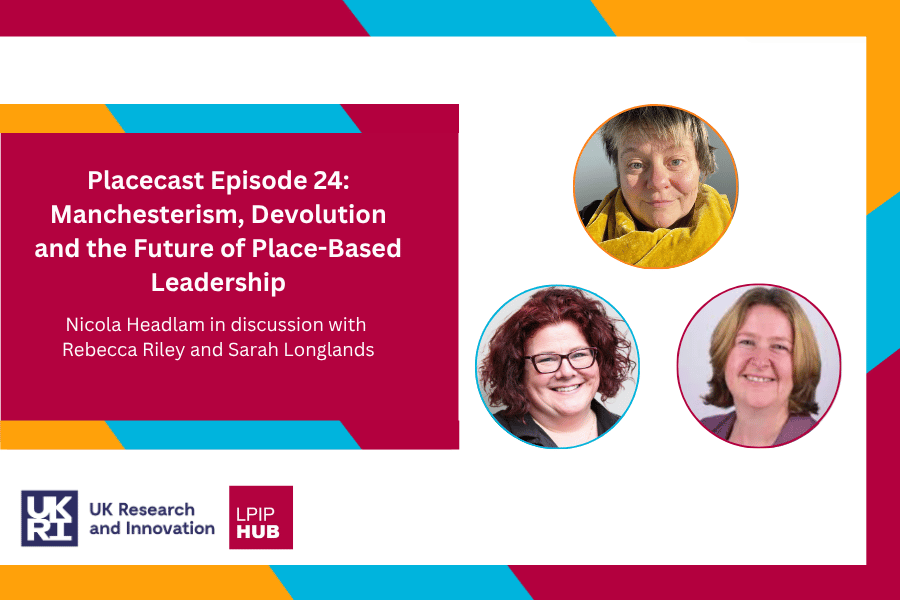
In this special three-way edition of Placecast, Nicola Headlam is joined by Rebecca Riley, Deputy Pro Vice Chancellor for Regional Engagement and Director of City-REDI at the University of Birmingham, and Sarah Longlands, Chief Executive of the Centre for Local Economic Strategies (CLES), to explore the rise of “Manchesterism” and what it means for the future of devolution in the UK. The discussion reflects on the growing influence of city-regional leadership in national policymaking, particularly following the strengthening of devolved governance structures. Drawing on decades of experience in economic development, local government and policy research, the speakers examine how place-based leadership, long-term collaboration and institutional stability have shaped Greater Manchester’s distinct approach to governance.
The conversation also looks beyond Manchester, considering lessons from Scotland, Wales and Northern Ireland, and asking how local and national government can work more effectively together. Rebecca Riley and Sarah Longlands highlight the need to build capacity within local institutions, move away from short-term competitive funding models and create stronger frameworks for democratic accountability and community wealth building. Throughout the episode, Nicola Headlam encourages a thoughtful debate about the opportunities and limitations of devolution, making the case for a more collaborative, place-sensitive approach to policymaking that can deliver inclusive and sustainable growth across all parts of the UK.
Guest Speakers
Rebecca Riley
Professor Rebecca (Bec) Riley is Co-Director of City-REDI, Deputy Pro-Vice-Chancellor for Regional Engagement, Director of the Local Policy Innovation Partnership (LPIP) Hub, and Professor of Enterprise, Engagement, and Impact at the University of Birmingham’s Business School.
Bec joined the University of Birmingham nine years ago to set up City-REDI, to build a distinctive local, regional, national and international research platform through the development of a Birmingham approach to understanding and facilitating growth in city regions. This systemic approach in identifying and conceptualising the inter-dependencies within and between regional economies has provided new opportunities for understanding, conceptualising, modelling, evaluating and comparing economic activity and business trends at the city-region level.
As the newly announced Deputy Pro-Vice-Chancellor for Regional Engagement, Bec will lead on setting the civic and regional vision for the University, while building on the work she has been doing with the University’s Regional Engagement Group. Alongside her new role, Bec remains the Principal Investigator (PI) and Director of the LPIP Hub, addressing nationwide issues through local partnership and place.
Bec’s research interests focus on regional economic development, including research to develop policy and regional strategies, monitoring frameworks, economic forecasting, skills and labour market analysis, and strategic business cases and project evaluation. She applies a mixed-methods approach in her research, with a strong focus and record of impactful policy-relevant applied research and stakeholder engagement. She is an experienced lead on research projects, with over 200 research projects carried out across academia, policy, and consultancy roles.
Sarah Longlands
Sarah Longlands leads CLES, the Centre for Local Economic Strategies, the National Organisation for Local Economies, based in Manchester. She is an expert in regional and local economic development and argues for economic and social justice and the creation of places which enable people to live good lives.
Before joining CLES in 2021, Sarah was Director of IPPR North, the dedicated think tank for the North of England. She previously worked for CLES until 2011 and began her career in local government, working in County Durham and North Yorkshire. She has a PhD in Urban Studies from the University of Glasgow.
Sarah is a member of the LPIP Hub Partnership Team.
Nicola Headlam
Dr Nicola Headlam has over 20 years of experience working across all aspects of the multi-helix innovation system, including central and local government, civil society and campaigning, academic research and knowledge mobilisation, and industry. Along the way, she has honed her expertise in urban and regional subnational economic development, the roles of government in shaping place, and in utilising data and evidence for transformation.
In 2024, she became a freelance economic advisor on the role of leadership and partnerships, urban and living lab forms for research, the future of cities and foresighting methods, urban transformations, place-branding and urban regeneration and the spatial consequences of public policy.
View Nicola’s LinkedIn Profile
Transcript
Show notes
Rewiring the State – Cabinet Statement – Cabinet Policy Paper
If Mayors are the Answer then What was the Question? – Article by Kevin Orr.
Manchesterism: Eternal Work in Progress – Nicola Headlam, Substack
Built From Below: Why Manchesterism Doesn’t Need London’s Playbook – Just Its Powers – Rebecca Riley, LPIP Hub
Andy Burnham’s Devolution Vision: What Does the Evidence Say? – Rebecca Riley, LPIP Hub
Find out more about the Local Policy Innovation Partnership Hub.
Disclaimer:
The views expressed in this analysis post are those of the author and not necessarily those of City-REDI or the University of Birmingham.
Generative AI was used to generate parts of the blog using the transcript from the podcast.