
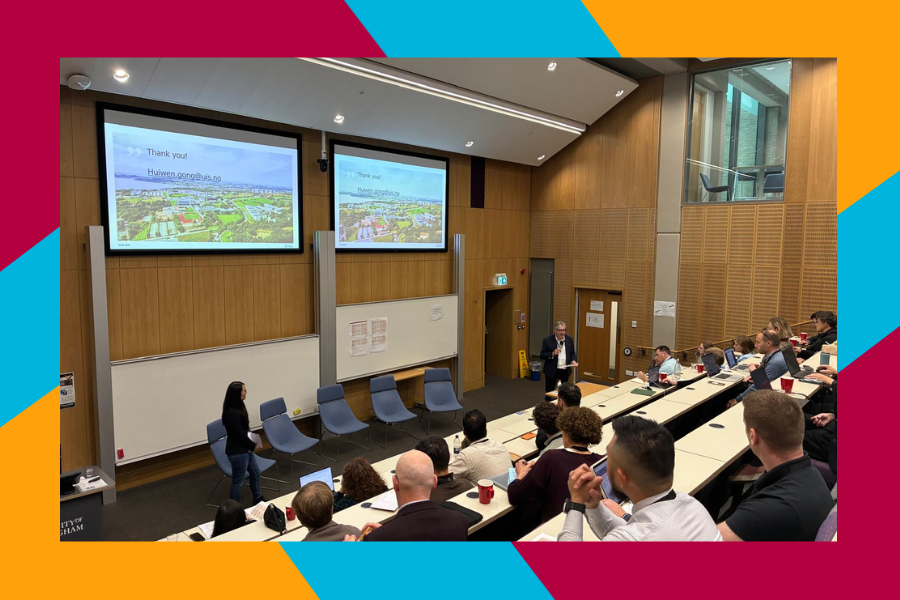
City-REDI, along with Birmingham Business School, hosted the 20th Regional Innovation Policies Conference 2026, funded by the LPIP Hub.
Under the theme of “Navigating Futures with Innovation: Resilient and Resurgent Regions”, over 110 participants from 18 countries had a lively two days on Edgbaston campus.
Dr Chloe Billing reports on the discussions from the conference over the two days in a series of blogs.
Day 2 Plenary: Navigating Green Industrial Transitions in an Era of Geoeconomic Competition, Regional Innovation Policies Conference 2026, University of Birmingham, 18 September 2026
Keynote: Huiwen Gong. Commentators: David Bailey and Annum Rafique
The Day 2 plenary turned to green industrial transitions in an era of geoeconomic competition. The keynote was given by Huiwen Gong, Professor of Regional Studies and Economic Geography at the University of Stavanger, with responses from Professor David Bailey (Birmingham Business School) and Dr Annum Rafique (City-REDI).
Right time, right people, right place
Huiwen opened in the Stavanger region, Norway’s oil capital, where data centres are among the futures being explored as oil runs down. Decarbonisation and AI give regions reason to “dream big and dream differently”, but no one knows which technologies will dominate. Fear of missing the boat has fuelled bidding wars between places to attract multinationals, and geopolitics has encouraged duplicate production in many locations.
She drew on a Chinese saying that success needs the right timing, the right people and the right place. In the literature, these correspond to windows of opportunity, entrepreneurial and institutional agency, and inherited capabilities and institutions. From this she set out four policy questions. Which future should a region pursue? How should it deal with uncertainty? What must change for the system to become more resilient and competitive? And how can transformation be made socially acceptable?
Three regional situations
The first case was new path creation in a less developed region, Huiwen’s hometown of Ningde in coastal China. Local authorities first attracted ATL, a battery supplier to Apple whose founder was born locally, and then CATL, now the world’s largest battery manufacturer. The city built the supply chain around these anchor firms before diversifying into recycling and vehicle production. Proactive local authorities were central, although some residents spoke of a loss of identity and farmers who lost land received standardised compensation.
The second was an incumbent region, Baden-Württemberg, home of the German car industry. Its dominance made it hard to imagine alternatives, and even new visions of future mobility remained tied to car making. The region resisted change until competition from Tesla and Chinese carmakers exposed cracks, after which the Green-led state government pushed for a broader transformation supported by retraining and reskilling programmes.
The third was the Nordic battery sector, where ordinary regions appeared to “check all the boxes”, with renewable electricity, process industry experience and strong public commitment. A Nordic Battery Collaboration set out a vision of a leading European battery ecosystem. Reality proved harder. Northvolt, despite substantial European support, filed for bankruptcy in 2024. Freyr moved towards the United States and solar after the Inflation Reduction Act, and Huiwen reported that Morrow filed for bankruptcy in 2026, a month after starting production. Chinese competition on price, limited protected markets and a lack of patient capital proved decisive.
Social acceptance and new knowledge
Huiwen contrasted how each context handles social acceptance. In China, local authorities prioritise growth and conflicting interests are often silenced or ignored. In Baden-Württemberg, a commitment to leaving no one behind means historical legacies can become obstacles. In the Nordic countries, authorities must listen to voters, and a survey found that Norwegians feel green industrial projects belong in “nobody’s backyard” when benefits appear small compared with local costs.
She concluded that knowledge developed over the last 30 years may not suit this new reality. Policymakers and scholars need to be more open to experimentation and mistakes. Collaboration among smaller regions and middle powers may help, while Nordic battery firms now describe a funding winter following high-profile failures.
Governing under uncertainty
David Bailey took from the keynote that regional policy is less about managing predictable strategies and more about governing under uncertainty. He welcomed the shift from asking what a region should specialise in to asking which future it is betting on. Bets such as data centres involve land, electricity, infrastructure, skills and substantial public commitments, and once made they become politically sticky. The challenge is to preserve optionality, keeping alternatives visible and releasing support in stages as evidence develops.
He noted that Northvolt attracted around €15 billion in investment and support yet still failed, reflecting how hard it is for Europe to build a champion in capital-intensive activity against China, and a lack of alignment between levels of governance. Regional policy might therefore design portfolios of possible futures, with evaluation asking what capabilities and infrastructure remain if a project fails. On value capture, he argued the goal should be regional strategic capacity rather than self-sufficiency, and asked how regions stay viable when the future they invested in does not arrive.
A West Midlands perspective
Annum Rafique observed that the West Midlands fits all three situations. It is creating new paths in clean energy, supported by the Innovation Accelerator programme, which has helped SMEs commercialise through projects such as Clean Futures. As an incumbent automotive region, it faces pressure from job losses at Jaguar Land Rover, a cyber attack that disrupted production, US tariffs and Chinese dominance in electric vehicles. It is also building a health and medical technology ecosystem around its hospitals and SMEs. Because funding is time-limited, she asked how regions can build resilience to energy prices and tariffs, retain benefits locally, upskill existing workers and keep learning after projects end.
Discussion
Responding, Huiwen stressed the need for flexibility to redeploy assets when bets fail, and the tension between playing safe and the fear of missing the boat. Questions from the floor asked whether waiting for market signals leaves late adopters permanently catching up, and whether Europe had the demand that drove China’s battery growth. Huiwen noted that manufacturing know-how cannot be skipped, even for next-generation technologies such as solid-state batteries, and that the missing piece in Europe is the market. Firms are now lobbying for access to protected markets such as defence to build manufacturing experience.
This blog was written by Dr Chloe Billing, Research Fellow, City-REDI.
Find out more about the Local Policy Innovation Partnership Hub.
Disclaimer:
The views expressed in this analysis post are those of the author and not necessarily those of the LPIP Hub, City-REDI or the University of Birmingham.