
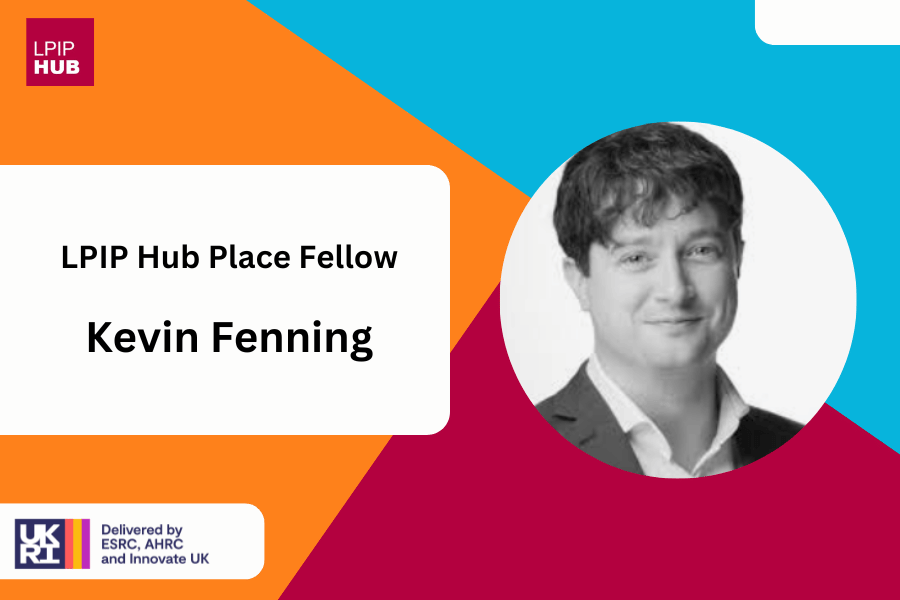
About Me
I am an economic and policy consultant who has spent the past 20 years working with local and national government, universities, colleges, and major private sector investment and infrastructure firms across the country.
An economist by training, my work applies economic thinking to a wide range of public policy issues that affect places and the organisations that lead them. This includes: skills and labour markets; innovation, enterprise, and sectors; housing; commercial property and infrastructure; communities and neighbourhoods; net zero; nature; and health.
My project work spans analysis, strategy and policymaking, and economic impact assessments and Green Book business cases. In other words: defining challenges and opportunities, working with partners to develop a plan of action, and making the case for investment.
Becoming an LPIP Hub Fellow
In 2022, I led a study for the Economic & Social Research Council (ESRC) into the range and effectiveness of local policy partnerships – that is: partnerships between local government and local academic institutions. This work helped inform the development of the proposal for the Local Policy Innovation Partnership (LPIP) programme. In early 2024, I was also involved in an ESRC-funded ‘Sandpit’ exercise, which sought innovative policy responses to pressing policy challenges from a mix of academic and other partners.
From both of these experiences, it is clear to me that:
- There is enormous potential to bring together academic expertise to help support local policymakers in addressing knotty challenges in places.
- This is challenging to achieve and, at present, is mostly dependent upon key people in these organisations going the extra mile to make partnerships work.
- Bridging this gap requires the ability to work rigorously with evidence, but to do so at speed, and in a way that responds to critical challenges and issues arising from real-world public sector delivery.
In mid-2024, I set up Evidence First to provide consultancy support to clients who care about positive outcomes for communities and people. The aim for Evidence First is to help make the case – in terms of data, strategic approach, or investment planning – that leads to meaningful action to create change. Evidence First is based on the idea that my clients are experts in their place or organisation, and what they need is help to bridge the gap between tacit knowledge and decision making, investment or action.
In this context, I was delighted to become a Fellow of the LPIP Hub last year. The Fellowship is a multi-disciplinary group of experts who are able to develop agile research projects that respond to real-world questions and problems. In particular, the Hub provides civil servants and local government leaders with access to a wide-ranging group of experts. The Hub also supports Fellows to network and share expertise and experience.
My Work as an LPIP Hub Fellow
My consultancy work is very wide-ranging, and so is my work as an LPIP Hub Fellow.
At the outset of the Fellowship, I was involved with the Inclusive and Sustainable Local Economic Performance theme. The LPIP Hub was approached by Government policymakers, who sought ideas on a number of key economic policy questions. I produced a provocation paper exploring what ‘good’ economic growth might mean — and how it could be measured. This, along with papers produced by other Fellows, helped civil servants who were grappling with what a rounded perspective on economic success in the places involved.
I am currently leading a project on AI usage in local government, as part of the Hub’s Governance theme. This project aims to provide an up-to-date perspective on how AI is being used in the context of local government services, where this is creating benefits in terms of service provision, and where there are emerging challenges. Given the speed at which AI is changing as a technology, and how the use of AI is changing, this is intended to provide a timely perspective on these issues. The work will also consider future potential benefits and challenges of AI usage, including the implications for the workforce.
In practical terms, the work is a mixture of literature and data review, alongside semi-structured interviews with a range of experts from local government and organisations with a relevant perspective on AI use in the public sector. The research work will continue through 2025, with findings expected to be published in early 2026.
A valuable additional benefit of my role as an LPIP Hub Fellow has been that it has created opportunities to explore other themes in projects that are outside the LPIP Hub. This includes work on a Civic & Economic Impact Assessment for Wrexham University that I have undertaken in partnership with LPIP Hub colleagues at City-REDI at the University of Birmingham. This work has spun out of conversations initiated through the LPIP Hub and has allowed us to trial the use of the 12 pillars model of university economic impact assessment created as part of the National Civic Impact Accelerator (NCIA) work. Supported by the LPIP Hub, I have been able, alongside Wrexham University and City-REDI colleagues, to share the emerging findings of this work at Civicon 2025, thus helping to share knowledge across the university sector and with civic practitioners.
Final thoughts
Many of our most pressing social and economic challenges cut across institutional siloes. Partnership working is essential to tackle these, and a place-based lens is helpful to focus these partnerships in a meaningful way. But partnerships are tricky. Organisations are designed to focus on their core objectives and often struggle with activities outside business as usual. Partnerships need support to be impactful.
One key area for support is the provision of research and evidence to inform decision-making. This needs to be responsive to the practical needs of policy-makers, and it needs to provide clarity that leads to successful action. In this context, the LPIP Hub and the wider LPIP network have a critical role to play in supporting pragmatic, policy-focused research that speaks to the real-world challenges of policymakers and local leaders. I’m delighted, therefore, to be an LPIP Hub Fellow, and look forward to working with colleagues to develop high-quality research that supports the changes we want to see.
This blog was written by Kevin Fenning, Director, Evidence First.
Find out more about the Local Policy Innovation Partnership Hub.
Disclaimer:
The views expressed in this post are those of the author and not necessarily those of City-REDI or the University of Birmingham.