
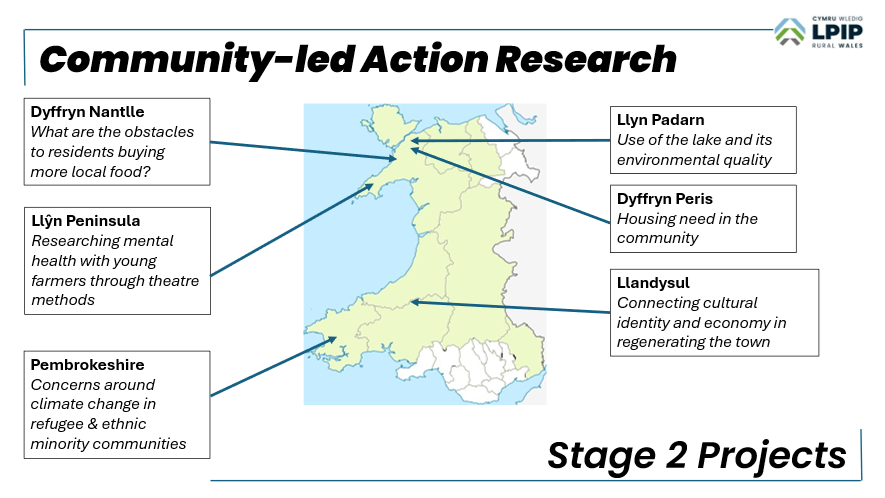
Following the second call for applications from community organisations during summer 2025, Cymru Wledig LPIP Rural Wales, in collaboration with its strategic partner, Together for Change, was pleased to confirm the six successful organisations this autumn, following an exciting and enthusiastic number of applications.
The successful applications were selected from diverse communities across Rural Wales and bring a fascinating range of priorities, local issues, and concerns, as well as a real passion for generating change in their communities. We are delighted to reveal the successful organisations and their project aims below.
However, for every organisation in receipt of funding, there remains a large number of communities across Wales, and beyond, with fantastic ideas or proposals of their own but in need of guidance and funds to bring their projects to fruition. As a result, Together for Change, in partnership with Cymru Wledig LPIP Rural Wales, has created a suite of seminars and webinars, focusing on different topics, to advise, train and inspire other community groups. Launching in January 2026, we encourage all those interested in pursuing their own community projects or with an interest in community engagement to join this fantastic programme of 14 workshops and seminars.
Announcing the six successful community projects
Cwmni’r Frân Wen, Bangor
The CARREG project responds to a silent crisis facing the young agricultural sector: economic stress, demographic changes, work pressure and the isolation associated with agricultural life. The CARREG project combines the social need to support the mental health of rural young people with the creative methods that are already part of the community’s life and identity.
The project will strengthen cohesion by creating a space for the community to come together and recognise the problems that are common between them, whilst, on a cultural level, the work will ensure that rural stories and agricultural experiences are part of a national conversation, giving a voice to a community that is usually on the fringes of the cultural discussion.
Llandysul a Phont Tyweli Ymlaen, Llandysul (Ceredigion)
This project will explore how culture, economy, and wellbeing can be better joined up to support regeneration in the rural mid-Wales town of Llandysul; re-imagining Llandysul as a connected, vibrant small town: linking culture, economy, and wellbeing for future generations. The project will explore issues important to local residents, such as the use of local assets; examine the role of Welsh culture, arts, and heritage in stimulating local enterprise; and consider how transport, digital connectivity, and inclusive spaces can strengthen wellbeing and participation.
The importance of this work lies in giving the community a stronger voice in shaping its own future. Too often, regeneration is designed from the outside; this project will ensure that evidence and priorities come directly from residents themselves. By training community researchers and using participatory methods, the project will also build local skills, confidence, and leadership.
Partneriaeth Dyffryn Peris
Located in North-West Wales, near Llanberis, project partners will work with the community to find holistic solutions to the housing, language and climate crises in the Dyffryn Peris area. The project aims to explore different models of community-led housing, such as community land trusts, and look at how they could be developed as a response to the housing crisis locally.
Partneriaeth Dyffryn Peris will explore these issues in a way that empowers communities by asking what models are supported locally? How do they protect the linguistic texture of a community by creating low-carbon homes led by the community? How can they show the need, the opportunities and influence on planning policy and Local Development Plan reviews when going about it? How can they learn from similar projects across Wales and add an element of linguistic protection to the work?
Pembrokeshire Education and Community Empowerment (PEACE) CIC
‘Climate and Community: Empowering Migrant and Global Majority Communities in Pembrokeshire for a Sustainable Future’ is a project born directly from local conversations and the lived experiences of migrant and global majority communities in Pembrokeshire.
Language barriers, limited access to information, and a lack of culturally relevant examples mean people do not always know how they can contribute or benefit from a net-zero future. Some are unsure where to start, others feel environmental action is ‘not for them’ because they have never been invited to take part. Being able to understand ideas like renewable energy, waste reduction, and food growing in their own language will not only make the information more accessible, but it will give people practical tools to save money, improve health and become more self-sufficient. Increased engagement and conversations with different communities will enable the PEACE team to gather clear evidence of what is needed to make environmental action in Pembrokeshire truly inclusive. This can be shared with councils, environmental organisations and community groups to shape more accessible projects and policies. It will also give individuals the knowledge and confidence to take steps in their own homes and neighbourhoods, from growing food to reducing waste and using energy more efficiently. The team also expect this research to build new connections between communities
Siop Griffiths Cyf (Yr Orsaf), Dyffryn Nantlle, Gwynedd
Posing the question ‘How can local vegetable and fruit producers provide their produce to residents affordably, and in a sustainable manner to local retailers?’ this project – Yr Orsaf – will collaborate with local farms to investigate how effective Sustainable Food Partnerships would be; use “Healthy Start” vouchers for vegetable bags; and offer support and funding to people in terms of increasing accessibility to affordable fruit and vegetables.
Yr Orsaf will create a sustainable food forum, as a community body that leads the research, which will engage with land workers and producers, exploring what challenges they face, their hopes and plans, who their customers are, and their methods of engaging with the population.
Eryri-Bywiol Cyf Snowdonia-Active, Caernarfon
Llyn Padarn, Llanberis, is one of the largest natural lakes in Wales. This project will develop a collaborative catchment-based approach to managing Llyn Padarn, drawing together a host of stakeholders to identify priorities for recreation management and how they could integrate their actions and resources to achieve them. The research will identify opportunities to connect people with the environment as they engage and take ownership of Llyn Padarn.
In the long term, the Llyn Padarn Catchment Management Partnership will enable a sustainable, proactive model which works with the community to address issues and identify opportunities arising from recreation, contributing to the theme of building a regenerative economy. This approach could potentially be applied to other water bodies in Wales.
Further information
For more information on the above community projects, or the workshop and seminar programme, please contact
Cymru Wledig LPIP Rural Wales: lpip@aber.ac.uk
or
Amy Nicholass (Community-led Action Research Facilitator): Amy.Nicholass@tfc.cymru
This blog was written by Rhian Curtis, Policy and Engagement Manager, Cymru Wledig LPIP Rural Wales.
Disclaimer:
The views expressed in this analysis post are those of the author and not necessarily those of City-REDI or the University of Birmingham.