
What if nature recovery wasn’t a “nice to have”, but a foundation of regional development? What if parish councils, farmers, and local communities were recognised as national assets rather than peripheral actors? And what if the future of England’s economy depended not only on cities, but on the rural places that quietly sustain them?
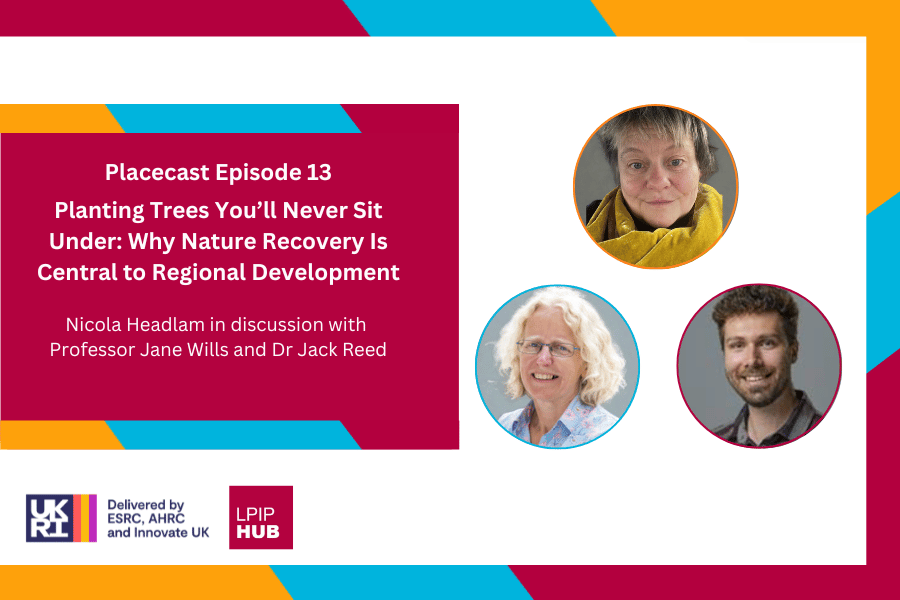
In Episode 13 of Placecast, host Nicola Headlam is joined by Professor Jane Wills, University of Exeter and LPIP Hub Delivery Team member and Dr Jack Reed, Research Fellow, University of Exeter, to explore exactly these questions through the Nature Recovery and Regional Development project. Their conversation moves from parish halls to Parliament, from oak trees to economic strategy, and from the hyper‑local to the national, revealing why place‑based leadership matters more than ever.
Placecast is a Local Policy Innovation Partnership (LPIP) Hub production based at City-REDI, University of Birmingham. Our new podcast is essential listening for those keen to explore the ins and outs of knowledge mobilisation for influence in central and local government, based on the view that it’s only through animating the power of place-based leadership that the wicked problems of 2026 can become more manageable.
Guest speakers
Jane Wills is Professor Emerita, and she previously worked at the Centre for Geography and Environmental Science (CGES) in the Department of Earth and Environmental Science (DEES) at the University of Exeter in Cornwall, UK. She was affiliated with the Environment and Sustainability Institute (ESI) on campus and was its Director between 2020 and 2023.
Jane’s most recent research interests have focused on nature recovery and its integration into regional development policy and practice.
Jack Reed is a Postdoctoral Research Fellow working at the intersection of nature recovery, regional development and environmental sociology. Jack is based at the Environment and Sustainability Institute (ESI) in Penryn and also works with the Land, Environment, Economics and Policy Institute (LEEP) in Exeter.
Jack’s current research explores how nature recovery intersects with rural economies, emerging technologies and public policy. As part of the ESRC-funded Nature Recovery and Regional Development (NaRReD) project, Jack is collaborating with councils across Britain’s Leading Edge to design new approaches for tracking the social and economic impacts of nature recovery, particularly around health, wellbeing, education and place-based development. Through this work, I’m engaging with nature markets like Biodiversity Net Gain (BNG) and thinking critically about their implications for policy and investment.
Host
Dr Nicola Headlam has over 20 years of experience working across all aspects of the multi-helix innovation system, including central and local government, civil society and campaigning, academic research and knowledge mobilisation, and industry. Along the way, she has honed her expertise in urban and regional subnational economic development, the roles of government in shaping place, and in utilising data and evidence for transformation.
In 2024, she became a freelance economic advisor on the role of leadership and partnerships, urban and living lab forms for research, future of cities and foresighting methods, urban transformations, place-branding and urban regeneration and the spatial consequences of public policy.
View Nicola’s LinkedIn Profile
Key themes and insights from the podcast
Nature recovery is central to regional development — not a “nice to have”
Jack and Jane argue strongly that nature recovery should be understood as a core component of regional development rather than an environmental add‑on. Rural and coastal places underpin economic activity through food production, water supply, energy infrastructure and biodiversity, yet these contributions are rarely reflected in policy priorities. Treating nature as separate from economic strategy has led to missed opportunities and growing vulnerability, when in reality, environmental recovery is fundamental to long‑term prosperity and resilience.
Rural places are nationally important but politically neglected
A recurring theme is the systematic undervaluing of rural and peripheral areas. Places associated with Britain’s Leading Edge make up a significant share of England’s landmass and provide nationally critical services, yet they face smaller budgets and reduced political attention compared with cities. The discussion highlights how urban‑centric policy frameworks overlook the deep interdependence between urban economies and rural environments.
Local Nature Recovery Strategies (LNRSs) are an opportunity — but funding is missing
Local Nature Recovery Strategies are presented as a major step forward in embedding place‑based approaches to environmental action across England. They create shared spatial frameworks for understanding priorities and opportunities, but their potential is constrained by the absence of secure delivery funding. As a result, there is a risk that these strategies remain aspirational unless supported by sustained resources, even though the policy architecture itself represents meaningful progress.
Parishes and communities are leading hyper‑local nature recovery
One of the most striking insights is the role of parish councils and small communities in driving nature recovery from the ground up. In areas such as Shropshire, local groups are developing their own plans, mapping land, mobilising residents and, in some cases, acquiring land for nature. This hyper‑local action is effective precisely because it is rooted in deep local knowledge and emotional connection, making nature recovery concrete and collectively owned.
People as Brokers of Change
The podcast consistently returns to the idea that people, not policies alone, make change happen. Parish clerks, community leaders, Community Land Trusts and local authority officers act as brokers who translate national frameworks into workable local action. These individuals often operate beyond formal job descriptions, improvising and connecting actors, resources and ideas to keep momentum going even in fragmented systems.
Long Timescales Versus Short Political Cycles
A key tension identified is the mismatch between the long‑term nature of environmental stewardship and the short‑term rhythms of political cycles. Frequent shifts in national policy, particularly around farming and land management, create uncertainty that undermines trust and discourages long‑term investment. In contrast, local institutions and long‑standing networks are better placed to sustain activity over decades and across generations.
Economic Potential of Nature Recovery
Nature recovery is also framed as an economic opportunity rather than a constraint. Investment in restoration and management can generate jobs in areas such as land stewardship, forestry, marine ecosystems and tourism. These nature‑based economies offer viable pathways for rural regeneration, especially where traditional industries are under pressure, and challenge assumptions that environmental protection undermines economic growth.
Connection, Identity and Intergenerational Stewardship
Personal stories in the podcast reinforce the importance of connection to place in motivating action. As nature connectedness has declined, so too has care for the environment. Community‑led recovery helps rebuild these bonds and fosters intergenerational thinking. Leadership is described not in terms of immediate gain, but as a willingness to invest in outcomes that future generations will benefit from.
Education and the Future Nature Economy
Looking ahead, the speakers emphasise the role of education in sustaining nature recovery. Expanding outdoor learning and embedding environmental education within the national curriculum would equip young people with the skills and understanding needed for emerging nature‑based economies. Young people are eager to engage, but access, opportunity and sustained investment are essential.
Transcript
Find out more about the Local Policy Innovation Partnership Hub.
Disclaimer:
The views expressed in this analysis post are those of the author and not necessarily those of City-REDI or the University of Birmingham.
Generative AI was used to generate parts of the blog using the transcript from the podcast.