
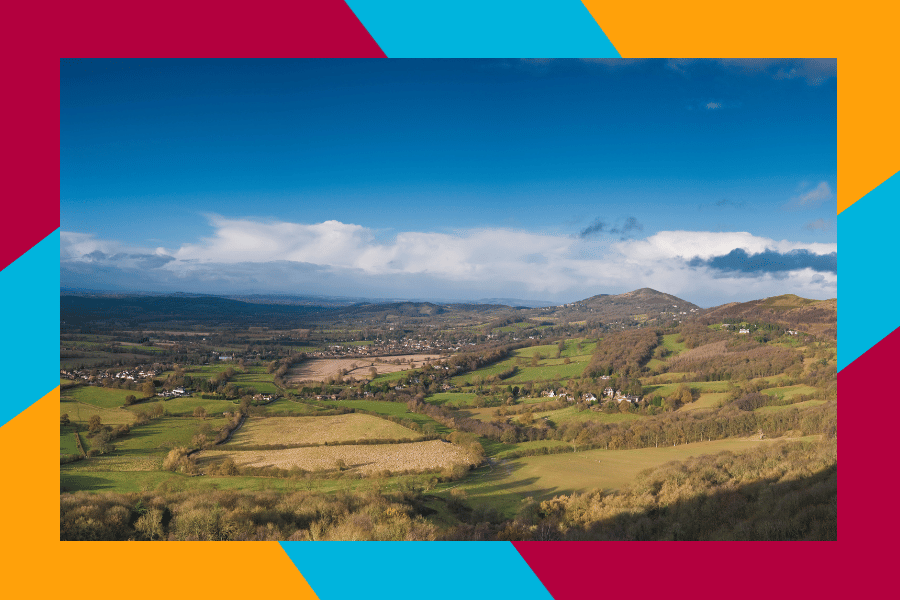
Rural areas face a set of urgent and existential challenges. These will bite hard along the ancient boundary between Wales and England.
Marx & Engels, The Communist Manifesto
“The bourgeoisie has subjected the countryside to the domination of city. It has built enormous cities; it has greatly increased the urban population relative to the rural, and has thus wrested a considerable part of the population from the idiocy of rural life.”
Introduction
Despite the industrial revolution heralding three hundred years of explosive economic growth, prosperity and economic opportunity remains unevenly distributed across people and place.
Across this economic landscape, rurality – covering around 15% of the UK’s population but over 90% of land area – is under examined, and under-considered in national debates around growth, prosperity and the future. There is, however, no future that does not rely deeply on the rural, for our basic services – food, fibre, energy and materials.
For that reason, through 2026 the LPIP Hub, based at City-REDI, University of Birmingham, is looking at the rural – and specifically that interesting region between England and Wales: the Welsh Marches.
For that reason, through 2026 the City-REDI institute at Birmingham is looking at the rural – and specifically that interesting region between England and Wales; the Welsh Marches. Our first report highlights what published data tell us about the structure of the Marches – demographic and economic – and judges how systems are working – or not – to deliver prosperity for the people who live there, and the businesses that work there, whilst remaining mindful of climate and local ecological limits. The report also outlines some key upcoming challenges facing this part of rural Britain and, by extension, much of the rest.
Over the rest of the summer, we will be listening to rural voices – getting out to talk to people who live and work in the Marches (and indeed in other rural places) to get their views on what (if anything) is wrong, and how to fix it. You can get involved here (opens in new tab).
But in the meantime… pull on your virtual hiking boots and come with me for a walk…
Welcome to The Marches
Before Victoria. Before all the Henrys. Before even a load of (vaguely) civilised Vikings roared ashore at Hastings, bringing arrows, embroidery (and the dominion of Westminster over England) with them, it was a thing. A line, or rather ridges in the landscape across which two cultures eyed each other cautiously. On one side, cattle stealing, weirdly named barbarians, letting their women run wild and (and own their own property for goodness sake!). On the other, a motley crew of Johnny-come-lately northern Europeans, barely Christian and only a couple of centuries of shared ‘Saxon’ history. On one side of this border ‘civilisation’ developed – agriculture, hierarchy and specialisation of labour (serfs, lords, proper Kings). On the other, not so much.
Differences solidified, and led to an uneasy relationship. English kings, more interested in the continent, delegated the administration of this region – from the Mersey to the Severn (the Hafren), and around to the far Cleddau – to the Marcher Lords. Over four hundred years this first-go-at-devolution slowly slipped away, ending for half a millennium when Henry VIII brought England and Wales together in his iron fist.
The Marches stayed… sleepy, rural, lush. Perhaps forgettable, apart from a brief-but-starring role in the world’s first Industrial Revolution. Rural places are, of course boring.
The forgotten rural
The forgettability – or at least downplaying – of rural places by economists, the political elite, the chattering classes – is endemic. Everyone knows cities are where it’s at. Agglomeration. Clusters. Innovation, R&D and world-class universities. Power. But this is a problem. The world rests on its countryside and coasts, not on its cities. This is where the food, the fibre, stone and cement, and the energy, the heat and light come from. And when we look back to the Marches we can see trouble ahead.
The world faces great transitions. There are the two interlinked nature and climate crises that – whatever the latest breed of populist politician says – will require deep transformation in economic production, intermediation and consumption to stay within ever more terrifying planetary and ecological red lines. Then there is the demographic time bomb, as we all get older, fated to have ever-more national GDP – public and private – lavished on us and our ever-increasing need, made more weighty by our poorer health, and the poorer health (and wealth) of the youngsters looking after us. And the final horseman, the automation of productive tasks and the dominance of a particular flavour of artificial intelligence, which promises freedom but so far has only brought the overwhelming, ostentatious global dominance of a handful of American billionaires with… questionable viewpoints.
The rural challenge
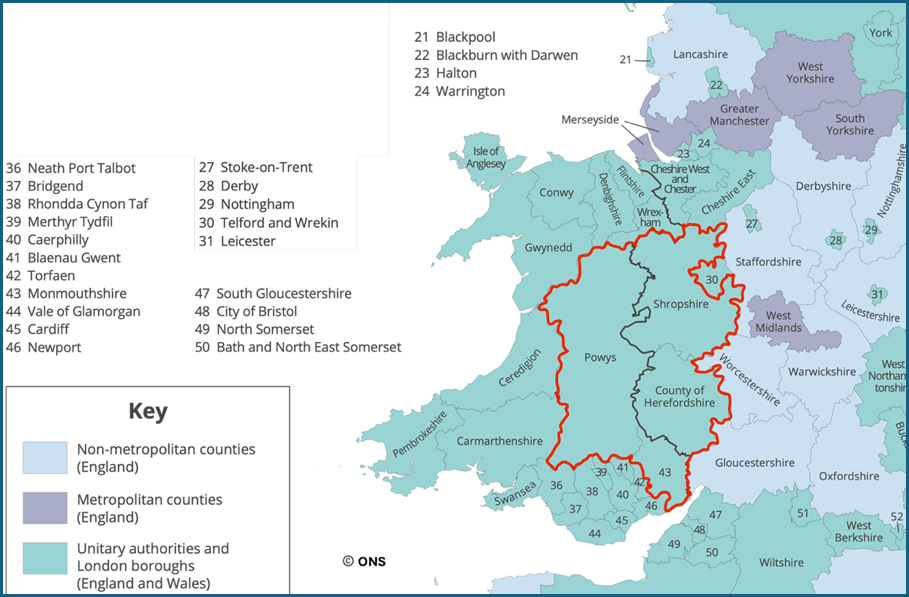
The Marches (see map for our modern definition) shares with other rural regions some real weaknesses in the face of these challenges. Let’s look here at the core of the Welsh Marches, the Marche Wallia: the English counties of Shropshire and Herefordshire, and the siroedd Cymraeg of Powys and Monmouth. This is an overwhelmingly rural place. Telford was the largest place (historically a Shropshire (but now seceded), home to only 150,000 people. The Marches is an old place; over a quarter of residents are now aged 65+ compared to less than a fifth in England and Wales.
It is of low ‘economic value’, at least in terms of how we measure these things, with Gross Value Added (GVA) ranging from 75% of the UK average in Monmouthshire and Herefordshire, down as low as 60% in Powys. Higher education, innovation and R&D are notable, largely by their absence – or at least invisibility. It is, relatedly, a place of low wages, where you can earn more by commuting out, and where self-employment is 50% higher than in the UK.
Much of that self-employment is, of course in farming. A quarter of businesses here are in agriculture, compared to only 4.6% in the UK. Incomes and hence the ‘value’ from those farms – typically small and family-run farms – will vary greatly across size, farm and ownership type, and made murky by farm support mechanisms, and by fuzzy financial boundaries between the farm and household. We think we might know the economic character of farms… but do we?
The Marches is also a place with some climate and ecological challenges. Whilst greenhouse gas (GHG) emissions from its (scarce) industry are low, dispersed and older housing and lack of extensive public transport drives GHG emissions. And emissions from agriculture – here methane from livestock rather than carbon dioxide – are far, far higher per-capita than the UK average (over ten-times so for Powys), meaning that overall per-person emissions are much higher than for Britain. Agriculture has impacts closer-to-home, with significant worries around how far landscapes, and especially the nationally important rivers of the Severn, Wye and Usk that make the region what it is, are challenged by agricultural production and especially by poultry production. Our four Marches counties are home to more than 25 million chickens at any one time, although each chicken… doesn’t stay long.
Conclusion: managing change in complexity
This is then a place that in many ways typifies rural Britain and the challenges it faces.
- Services for an unusually aged population – a third of people will be over 65 years old by 2049 – must be found, but with very little history of younger immigration to fill the required jobs, and with housing supply constrained by planning considerations, so rents and prices high compared to low wages.
- Thousands of small, capital-, information- and time-scarce farmers must be enabled, encouraged, cajoled or dragged towards low-carbon and low-impact production and products.
- Tourism must be re-invigorated and pulled up the value chain, but in ways which are mindful of ecological and cultural heritage.
- And innovation and economic transformation must be enabled, but this within a context where rural areas are effectively ignored in the UK’s modern industrial and development strategies… except as handy locations for windfarms, housing and AI datacentres.
And all this must be done with policy and legislation split right down the geographic middle. On the right, a government that inherits and inhabits a very ‘traditional’ government approach – of top-down strategies, of a focus on economic growth, on openness to the market and technology, and of a relative disinterest in sub-national governance which appears to be breeding chaos. On the left a much younger Senedd and brand new Nationalist government which lack institutional maturity and political experience – and which have devolved-and-different approaches to education, to planning, to environmental management and, increasingly, to politics.
This disjuncture is what splits and joins the Marches and has for over a millennium. It is what makes this rurality especially interesting, and especially illustrative of how we might approach rural resilience in this wonky, unbalanced and challenged country we have.
It is worth talking about.
Take part in our project
If you would like to be part of this project, please complete our online questionnaire about rural futures, both in the Marches and the UK more generally. The information collected will inform our next report – and a civic and policy conversation – on the Future of the Marches later this year and beyond.
First report
This blog was written by Professor Calvin Jones, LPIP Hub Place Fellow and City-REDI Associate.
Find out more about the Local Policy Innovation Partnership Hub.
Disclaimer:
The views expressed in this analysis post are those of the author and not necessarily those of City-REDI or the University of Birmingham.