
As strategic authorities take on greater responsibilities through devolution, new LPIP Hub research from Alice Pugh highlights the capacity and capability challenges affecting the development of business cases and economic appraisals across the UK.
Business cases and economic appraisals are fundamental to public investment decision-making. They enable public bodies to establish the case for intervention, compare alternative options, assess value for money and demonstrate accountability for public expenditure. Yet their effectiveness depends on more than the availability of formal guidance. Strategic authorities must also have the staff, expertise, evidence, governance arrangements and institutional infrastructure needed to apply appraisal methods well.
New research from the LPIP Hub the suggests that these foundations are not consistently in place. Based on responses from 88 officers across 57 strategic authorities in the UK, the study identifies a widening gap between what authorities are expected to deliver and the resources available to them. This is especially significant as devolution gives strategic authorities greater responsibility for prioritising investment, assuring expenditure and demonstrating public value.
A structural capacity challenge
The report’s central conclusion is that weaknesses in appraisal should not be understood simply as individual skills deficits. They reflect a broader structural challenge involving constrained staff time, limited specialist expertise, fragmented organisational arrangements and uneven access to training and evidence.
More than three-fifths of respondents, 62%, reported that their organisation had little or no dedicated business case or economic appraisal expertise. Where expertise existed, it was often concentrated in particular teams or spread thinly across the organisation. Meanwhile, 62% identified resourcing as a bottleneck in producing business cases and economic appraisals. These findings suggest that many authorities may possess relevant knowledge but lack the capacity to deploy it consistently across projects and programmes.
This distinction between capacity and capability matters. Capability concerns whether organisations possess the necessary knowledge, skills and professional judgement. Capacity concerns whether officers have sufficient time, resources and institutional support to put those capabilities into practice. An authority may know what robust appraisal requires while remaining unable to deliver it within compressed funding timetables, competing workloads and complex approval systems.
Confidence is high, but technical expertise is uneven
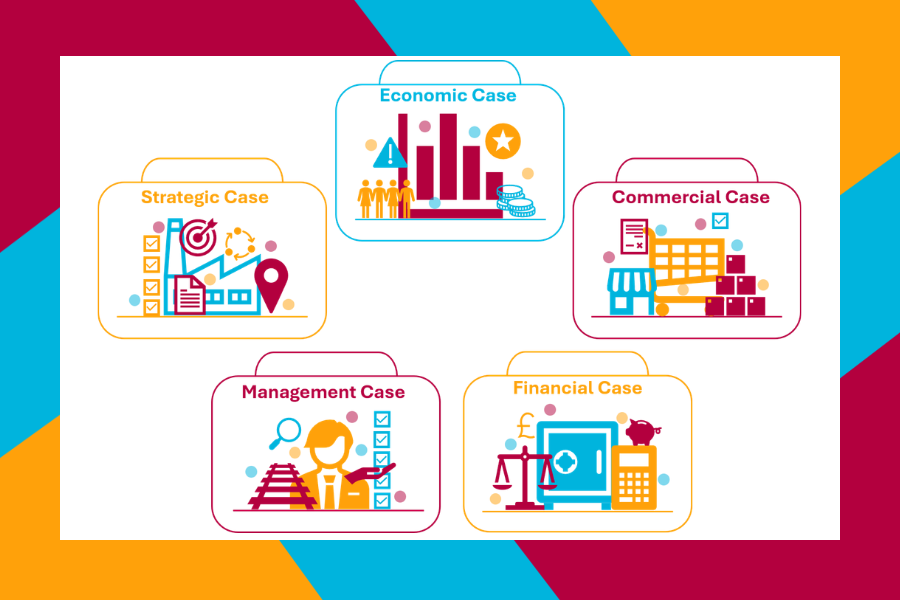
At first sight, the survey presents a relatively positive picture. Overall, 82% of respondents felt somewhat or extremely confident in their ability to contribute to a business case or economic appraisal. However, confidence varied considerably across the Five Case Model.
Respondents were most confident in contributing to the strategic case, at 91%, and the management case, at 84%. Confidence was lower for the economic case, at 71%, the commercial case, at 61%, and the financial case, at 55%. Officers therefore appeared least confident in areas requiring more specialised analytical, financial and commercial knowledge.
The specific challenges identified by respondents reinforce this finding. Valuing non-market benefits was the most frequently reported difficulty, selected by 52% of respondents. Discounting and appraisal periods were identified by 33%, while distributional and place-based analysis and the treatment of risk, uncertainty and optimism bias were each identified by 22%.
These are particularly important issues for place-based investment. The intended benefits of regeneration, cultural, environmental and social interventions cannot always be captured through conventional market prices. Without the expertise and evidence required to assess these effects, appraisals may systematically understate the value of interventions that produce substantial public or social benefits.
Formal training remains limited
The unevenness of expertise is partly explained by access to professional development. More than three-quarters of respondents, 76%, had never held a Better Business Case Green Book appraisal qualification. Only 24% had received either foundation or practitioner-level training. Furthermore, 46% reported that their organisation had not offered formal training, while a further 28% said that only limited training had been available.
This does not imply that officers without qualifications lack valuable expertise. Considerable knowledge is developed through professional experience, collaboration and direct involvement in investment programmes. Nevertheless, the results indicate that officers are frequently expected to participate in technically demanding processes without systematic development in the methodologies underpinning them.
Training should therefore be broadened, but it must also be differentiated. Business case development is inherently cross-disciplinary, involving policy, economics, finance, procurement, programme delivery, assurance and senior leadership. Generalist officers may need an accessible introduction to appraisal principles, while analysts require advanced technical training and senior decision-makers need support focused on scrutiny and assurance.
When external support becomes institutional dependence
Consultants are widely used to address both capacity and capability gaps. Almost three-quarters of respondents, 73%, reported using consultants to provide specialist knowledge. Some 67% used them when developing the economic case, 48% for value-for-money assessments and 40% to review, sense-check or appraise business cases.
External expertise is not inherently problematic. Specialist modelling or sector-specific analysis may not be required often enough for every authority to retain permanent internal teams. However, the report draws an important distinction between commissioning specialist input and outsourcing core institutional capability.
Authorities still need sufficient internal expertise to define the question, commission work effectively, assess methodological choices and challenge consultants’ assumptions. Without this “intelligent client” capability, they risk becoming dependent on external providers not only for technical production but also for judgements about the quality and meaning of the resulting evidence. Repeated outsourcing can then reduce opportunities for officers to gain experience, reinforcing the original capability gap and hollowing out expertise within the strategic authority.
Governance, proportionality and the quality of decisions
Capacity pressures are intensified by governance arrangements. Respondents reported an average of between three and four approval levels, with 23% requiring five or more. Approval could involve directors, finance teams, heads of service, boards, committees and political decision-makers. Although these processes support accountability, they can also create bottlenecks, particularly when external funding deadlines do not align with internal meeting and assurance cycles.
A related concern is proportionality. Officers did not reject rigorous appraisal. Instead, they questioned whether the same evidential and procedural burdens should apply irrespective of an intervention’s value, risk, complexity or timescale. Overly burdensome requirements can divert scarce capacity away from analysing options and improving project design towards producing documentation for compliance.
Under severe time pressure, there is also a risk that a business case is used to justify a preferred initiative retrospectively rather than to compare credible alternatives. This weakens its value as a decision-making tool. Proportionate appraisal should not mean lower standards. It should mean applying the right degree of analysis to the scale, uncertainty and consequences of the decision.
From individual skills to institutional capability
The officers surveyed expressed strong demand for practical support. Access to evaluation evidence was rated useful by 98% of respondents, followed by access to good-practice examples and case studies at 97%, and workshops and seminars from government departments at 96%. Clearer guidance, constructive feedback, templates, place-based data and access to departmental expertise also received substantial support.
These priorities point towards a systemic programme of capacity and capability building. Alongside expanded and more affordable training, the report recommends a sustained national or cross-regional knowledge-sharing network; an annotated repository of place-sensitive business cases, templates and case studies; clearer guidance on proportionality; improved feedback on funding bids; and better access to evaluation evidence.
Pooled appraisal resources may also offer part of the solution. Strategic authorities, universities and other anchor institutions could share specialist expertise in economics, financial modelling, evaluation, data and assurance. Such arrangements could be especially valuable for smaller authorities that cannot sustain these functions independently, although the pool of such resources must not be allowed to develop unevenly across places.
Ultimately, effective devolution requires more than transferring responsibilities. It requires investment in the institutions expected to exercise them. Strategic authorities need the capacity to develop, commission, scrutinise and learn from appraisal, while retaining ownership of the decisions it informs.
The goal should not be to produce more business cases. It should be to ensure that business cases become meaningful, proportionate and place-sensitive tools for choosing between alternatives and improving public investment. Without institutional support, appraisal risks becoming an uneven and burdensome compliance exercise. With it, appraisal can provide a stronger foundation for transparent, accountable and evidence-informed devolution.
This blog was written by Alice Pugh, Senior Economic Analyst – City REDI, University of Birmingham.
Find out more about the Local Policy Innovation Partnership Hub.
Disclaimer:
The views expressed in this post are those of the author and not necessarily those of City-REDI or the University of Birmingham.