
Although football is once again capturing the world’s attention during the latest World Cup, it is easy to forget that some of the sport’s most devoted fans came from a wide variety of professions. One of them was the composer Dmitri Shostakovich.
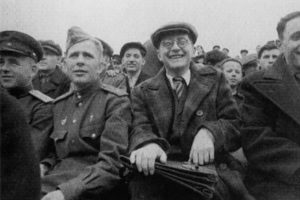
Today, Shostakovich is remembered as one of the greatest composers of the 20th century, whose works reflected the upheavals of Soviet Russia. However, football played no less an important role in his personal life. He regularly attended matches, followed the league tables with obsessive dedication, kept detailed match statistics, and, in his youth, even qualified as a football referee [1].
This was much more than a passing hobby for him. For most of his life, Shostakovich worked under intense political pressure. Soviet cultural policy strictly controlled artistic expression, and a single official condemnation could destroy a career. His relationship with the state was often strained, oscillating between public acclaim and oppression. In such circumstances, football offered him an escape from the demands placed on him as a composer and public figure [2].
The depth of his passion was remarkable. Shostakovich did not merely watch matches. He recorded results, analysed team tactics, and maintained extensive statistical records [3]. Friends and colleagues recalled his remarkable knowledge of football and his ability to discuss the league table with the same attention to detail that characterised his musical work. This sport provided a sense of order and predictability that was often lacking in Soviet cultural life.
Football was one of the few areas of life in which Shostakovich could participate as an ordinary citizen rather than as a famous composer. At the stadiums, he joined thousands of supporters whose main concern was neither politics nor artistic doctrines. Sharing the excitement of the football festival created a sense of community that existed beyond the confines of the concert hall.
His passion for the game also found its way into his creative work. In 1929, Shostakovich composed the ballet The Golden Age, centred on a Soviet football team travelling abroad. In this work, sport was used as a vehicle for satire and political commentary, contrasting the play of Soviet footballers – amateurs playing for a pittance – with the professional play of Western athletes, who rightfully earned their living through sport [4]. Although the ballet reflected the ideological issues of the era, it also demonstrated how naturally football had become part of the composer’s creative imagination.
There is indisputable evidence that in 1966 Shostakovich intended to attend the final matches of the World Cup held in England in person [5]. He was not allowed to leave the country. The composer’s experience of the World Cup matches was limited to television broadcasts.
Football held a special place in Soviet culture. Football clubs were often associated with influential institutions such as the armed forces, trade unions, the police, and the security services, and matches could serve as an expression of local and social identity. For many citizens, football offered an opportunity to experience excitement, feel part of a community, and find a temporary escape from the hardships of everyday life. Shostakovich’s enthusiasm reflected this broader cultural significance, while remaining deeply personal.
Viewing Shostakovich through the prism of football challenges the familiar image of the composer as an exclusively tragic artist struggling against political oppression. It reveals a more complex personality who found joy, friendship, and freedom through sports. Football was not something separate from his life; it was one of the ways in which the composer coped with it.
Whilst the World Cup reminds us of football’s remarkable ability to unite people across borders, Shostakovich’s story offers a useful perspective. Long before football became a global media spectacle, it served as a source of identity, community, and emotional refuge. For one of the greatest composers of the 20th century, it provided something even more precious — a space of freedom.
Bibliography
[1] Dmitrii Shostakovich, letter dated July 3, 1940, Leningrad, in Dmitrii Shostakovich v pis’makh i dokumentakh[Dmitri Shostakovich in Letters and Documents], ed. and comp. I. A. Bobykina (Moscow: DSCH Publishing House, 2000), 127–28.
[2] Dmitrii Shostakovich, letter to B. L. Yavorsky, July 3, 1940, in Dmitrii Shostakovich v pis’makh i dokumentakh[Dmitri Shostakovich in Letters and Documents], ed. and comp. I. A. Bobykina, scientific eds. L. V. Esipova and M. P. Rakhmanova (Moscow: DSCH Publishing House, 2000), 127–28.
[3] Dmitrii Shostakovich, quoted in Marietta Shaginian, “Beseda s D. Shostakovichem” [“A Conversation with D. Shostakovich”], Novyi mir 12 (1982): 131.
[4] Dmitrii Shostakovich, “Kompozitor o baletnoi muzyke” [“The Composer on Ballet Music”], in Zolotoi vek(Leningrad, n.d.), 4.
[5] “Izvestiia,” January 23, 1966.
