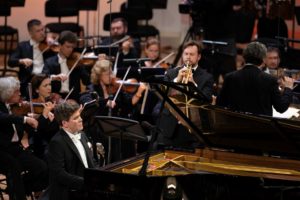
In June, Moscow welcomed the latest edition of the Grand Piano Competition, an international event for young pianists founded by renowned Russian pianist Denis Matsuev. Over the past decade, the competition has grown from a personal initiative into one of the most prestigious opportunities for exceptionally talented, young musicians.
What makes the competition particularly remarkable is not only the level of artistry on display but also its philosophy. Unlike most music competitions, there are no early eliminations. All fifteen participants who have successfully passed the preliminary selection perform throughout the entire event and appear in the final round. Rather than experiencing disappointment after a single performance, every young musician is given the chance to develop, learn, and showcase their abilities on some of Russia’s most important concert stages.
The competition’s impact can be measured through the careers of its former participants. Past laureates, including Sergei Davydchenko, Alexander Malofeev, Ivan Bessonov, Eva Gevorgyan, and George Harliono, have gone on to achieve international success and perform in many of the world’s leading concert halls. For these young musicians, Grand Piano often serves as the first major step towards a professional career.
This year’s competition brings together 15 pianists aged between 10 and 16 from seven countries, including Australia, China, Croatia, South Korea, Switzerland, Belarus, and Russia. At a time when political divisions often dominate international headlines, the competition serves as a reminder that music remains a universal language. Young performers from different cultural backgrounds come together through a shared commitment to artistic excellence and musical expression.
The international jury reflects this global perspective. Alongside Matsuev, the panel included distinguished musicians and educators from Germany, Spain, Romania, China, and Australia, ensuring that participants were evaluated through a variety of musical traditions and pedagogical approaches.
Another distinctive feature of the competition is its approach to awards. Instead of the traditional first, second, and third prizes, five participants are named laureates, while the remaining ten receive diplomas recognising their achievements. The overall Grand Prix winner is awarded a concert grand piano—an invaluable resource for a young artist whose development depends on daily practice and access to a high-quality instrument.
The competition opened with a gala concert at Moscow’s Tchaikovsky Concert Hall, featuring Matsuev alongside former laureates and the State Academic Symphony Orchestra of Russia under the direction of Dmitry Yurovsky. The competitive rounds take place between June 15 and 18, culminating in a final gala concert and awards ceremony on June 19.
Reflecting on the competition’s tenth anniversary, Matsuev emphasised its original purpose: to showcase the extraordinary achievements of young pianists and create opportunities for the next generation of performers. Perhaps the most striking aspect of the Grand Piano Competition is its belief that artistic growth matters more than rank. In a field often defined by winners and losers, competitions offer a different vision—one in which every participant leaves the stage having gained valuable experience, international exposure, and the foundations for a future musical career.