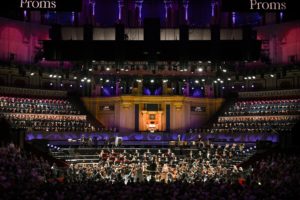
This year’s BBC Proms continues an encouraging trend by featuring numerous living women composers and new commissions. Yet one area remains comparatively unchanged. Within the nineteenth-century Romantic orchestral repertoire, the familiar names still dominate: Beethoven, Brahms, Schumann, Mahler, Berlioz and Scriabin, while composers such as Clara Schumann, Louise Farrenc and Emilie Mayer remain rare in the main concert programmes.
This raises an interesting question. Over the past two decades, musicologists, performers, and publishers have worked tirelessly to recover the music of 19th-century women composers. Their works are now available in scholarly editions, recorded by leading musicians, and increasingly discussed in concert programmes and university classrooms. If these composers have been rediscovered, why do they still appear so rarely in mainstream concert life?
The answer has less to do with the quality of music than with the remarkable stability of the classical canon.
The Romantic canon that audiences recognise today was not created overnight. During the nineteenth century, critics, publishers, performers, and concert organisers gradually established a relatively small group of composers whose music came to define what we now consider the ‘standard repertoire’. Music historian William Weber has shown how nineteenth-century concert programming gradually created the repertoire that still dominates concert halls today. Once these works became central to conservatoire training, orchestral programming, and public expectations, they reinforced one another. Students learned them, audiences requested them, orchestras performed them, and publishers continued to invest in them.
Changing such a system is inevitably slow and difficult.
This helps explain why composers such as Clara Schumann, Fanny Hensel, Louise Farrencand Emilie Mayer continue to face an uphill struggle despite growing scholarly attention. Their music has not been forgotten because it lacks artistic merit. Rather, it has been absent from the institutions that shape musical taste for generations.
Take Louise Farrenc, for example. During her lifetime, she earned considerable respect as both a composer and professor at the Paris Conservatoire. Her orchestral works received successful performances in Paris, and her chamber music was admired by leading musicians of the day. Emilie Mayer, meanwhile, composed eight symphonies and was celebrated by some contemporaries as one of Germany’s finest composers. Clara Schumann remains one of the nineteenth century’s most influential pianists, yet her compositions are still heard far less frequently than those of her husband, Robert Schumann.
Their gradual return to concert programmes demonstrates that the situation is changing positively. Record labels such as Hyperion Recordshave invested heavily in recordings of neglected Romantic composers, publishers have produced reliable scholarly editions, and performers have increasingly championed these works. Festivals devoted to neglected repertoires have introduced audiences to composers who, until recently, were scarcely mentioned outside specialist circles.
Yet, rediscovery does not automatically lead to regular performance.
Programming an orchestral season involves balancing artistic ambition with financial realities. Concert organisers know that audiences often buy tickets for familiar masterpieces. A Brahms symphony or Beethoven concerto offers a degree of certainty that a lesser-known Romantic work cannot always guarantee. Even when orchestras wish to diversify their programs, there is often limited space within each season to introduce unfamiliar repertoire.
There is also a broader historical context. Women in the nineteenth century encountered structural barriers that affected every stage of a musical career. Professional opportunities were frequently more limited, large-scale orchestral performances were harder to secure, and publishing networks often favoured established male composers. Many women enjoyed successful careers as performers or teachers while composing alongside these responsibilities, leaving smaller catalogues than some of their male contemporaries. These circumstances influenced not only the amount of music they produced but also how widely it circulated.
However, it would be misleading to portray these composers simply as forgotten victims of history. Many achieved considerable success during their lifetimes. Clara Schumann enjoyed an international performing career that few musicians could match. Louise Farrenc became the first woman appointed Professor of Piano at the Paris Conservatoire. Fanny Hensel organised influential musical salons in Berlin that brought together leading intellectuals and musicians. Their contributions to nineteenth-century musical life were substantial, even if later histories often overlooked them.
The current revival, therefore, represents more than an attempt to correct historical injustices. It also reflects a growing recognition that our understanding of the Romantic period has been incomplete. As musicologist Marcia J. Citronargues in Gender and the Musical Canon, the exclusion of women from the standard repertoire was shaped by historical and institutional factors rather than musical merit alone. Expanding the repertoire does not require removing Beethoven or Brahms from concert programmes. Instead, it asks whether our picture of nineteenth-century music becomes richer when we hear a broader range of voices alongside these familiar figures.
This question extends beyond women composers alone. Music history is full of influential figures whose reputations have diminished despite their importance. My own research explores the Irish composer John Field, whose nocturnes transformed nineteenth-century piano music and profoundly influenced Chopin. Like Farrenc or Mayer, Field is admired by specialists yet rarely appears in mainstream concert programmes. His story reminds us that canon formation has always involved selection, omission, and changing tastes.
Perhaps this is why renewed interest in Romantic women composers matters so much. The challenge is no longer discovering their music; that work is already well underway. The next step is ensuring that rediscovery becomes regular performance. When hearing Louise Farrenc or Emilie Mayer at the Proms no longer feels like a novelty, we will know that the Romantic canon has truly begun to evolve.