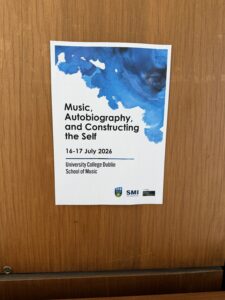
On July 16 and 17, 2026, I joined scholars from several countries at University College Dublin for the symposium Music, Autobiography, and Constructing the Self. Over two days, the event explored a fascinating question: how do musicians create and communicate a sense of who they are? The programme moved across centuries, genres, and disciplines, showing that autobiography is not limited to a published memoir. Identity can also be shaped through performance, composition, correspondence, concert programming, and the stories musicians tell about their work.
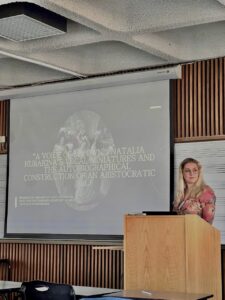
I presented my paper, “A Voice of My Own: Natalia Kurakina’s Vocal Miniatures and the Autobiographical Construction of an Aristocratic Self,” in a session devoted to self-fashioning in scores and sketches. Princess Natalia Kurakina (1768–1831) was a Russian aristocrat, salon hostess, harpist, contralto singer, and composer. She wrote around fifty vocal miniatures, including romances and Italian arias, some of which circulated in manuscript and print.
Preparing this paper also gave me an opportunity to connect my broader doctoral research on early nineteenth-century Russian musical culture with questions of gender and authorship. Focusing on Kurakina widens the familiar story of salon music, drawing attention to a woman who participated in the networks around her.
Kurakina is especially interesting because her musical life challenges familiar assumptions about aristocratic women. Their music-making has often been described as ornamental: an elegant social accomplishment rather than serious creative work. Reading Kurakina’s memoirs and letters alongside her surviving songs, however, reveals a richer picture. Her compositions allowed her to express emotion, demonstrate artistic knowledge and negotiate the expectations placed upon a noblewoman in early nineteenth-century Russia.
In my paper, I argued that these pieces can be understood as acts of self-fashioning. Their intimate scale does not make them insignificant. Usually written for voice with piano or harp accompaniment, they belong to the social world of salons and domestic performance, where private feeling and public identity could overlap. Kurakina drew on European vocal styles while giving them meaning within Russian aristocratic culture. In doing so, she presented herself not simply as a talented amateur but as an author and cultural mediator with a distinctive musical voice.
The wider symposium helped me think about this argument from new perspectives. Papers considered figures ranging from female opera singers and jazz musicians to Ethel Leginska, Benjamin Britten and contemporary Korean women composers. Mark Evan Bonds explored the changing practice of composers commenting on their own music. Together, these contributions highlighted how musical identity is never created in isolation. It emerges through relationships among artists, audiences, institutions and cultural expectations.
For me, one of the most valuable aspects of presenting at a symposium is seeing a specialised case study enter a much larger conversation. Kurakina’s songs may appear small beside grand public works, but they raise major questions about whose creativity is preserved, how women’s artistic labour is valued, and what counts as autobiography. Her story reminds us to look beyond conventional sources. A diary or memoir may describe a life, but a song can also preserve choices about language, emotion, style, and self-presentation.
The symposium reinforced the importance of recovering overlooked musicians. It is not simply about adding another name to the music history. It can change the questions we ask and the evidence we consider in our research. By listening closely to Kurakina’s music and reading it alongside her own words, we can begin to hear how she fashioned a place for herself within the cultural world she inhabited. More than two centuries later, this voice still invites us to listen